SGD to JPY in Tokyo: Complete Currency Exchange Guide 2026 — For Singapore Travelers
⚡ 30-Second Answer: SGD → JPY in Tokyo: Mustafa Centre = arguably the world's best exchange (mid -0.3-0.5%). Japan acceptance limited, but Singapore-side rates are unbeatable = bring yen with you.
Quick Reference
Value
Best option
Mustafa Centre (-0.3-0.5%)
The Arcade
Raffles Place (-0.4-0.6%)
Tokyo street
Shinjuku-West/Ikebukuro (-1.3-1.7%)
Wise/Revolut
mid -0.5% + ¥220 ATM
Last verified
June 2026
✓ Last verified: Sep 2026
📖8 min read
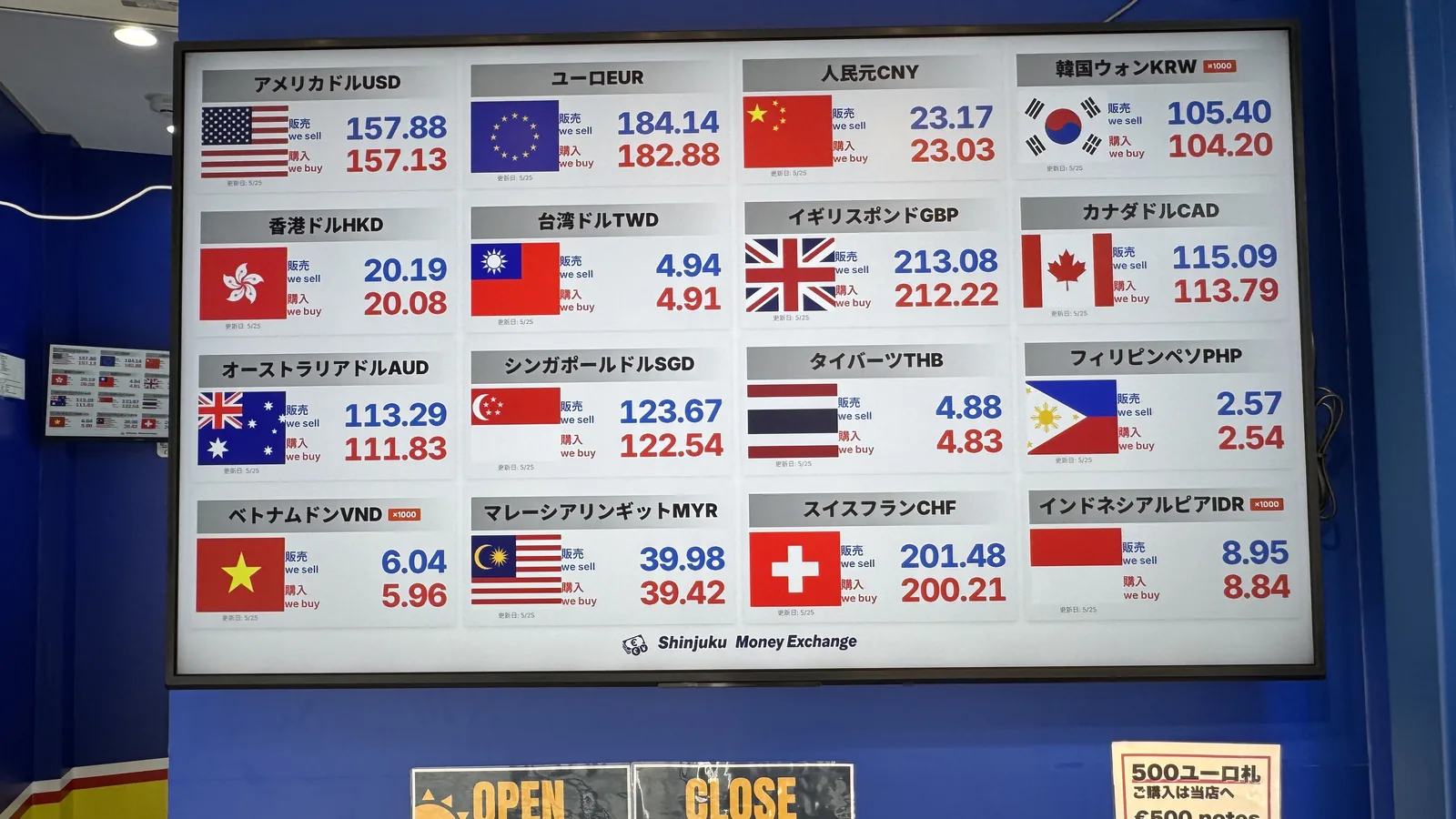
Photo: Yen Finder Editorial, Shinjuku 2026-05-24
SponsoredThis article contains affiliate links. We may earn a commission when you sign up through them, but our recommendations and editorial stance are not influenced by the partnerships.
Contents📖 ~8 min read
The biggest thing to know about Singapore dollars (S$) → yen is this: not many shops in Japan handle SGD, but the rates available back home in Singapore are among the best in the world. This guide covers the optimal route for SGD → JPY, walking through famous Singapore exchange spots like Mustafa Centre, your backup options in Tokyo, and smart electronic payment strategies.
TL;DR — The Bottom Line for SGD Travelers Heading to Tokyo
💡 Yen conversion note: A 5% rate gap on S$500 means about ¥2,900 lost (at roughly 1 SGD = ¥116). That is the price of a nice lunch in Tokyo.
Comparison ① Buy Yen in Singapore or Tokyo?
Mustafa Centre and The Arcade at Raffles Place in Singapore are among the world's top-tier money changers:
Location
SGD → JPY Rate (approx.)
Mustafa Centre (Little India)
Mid-market -0.3–0.5% (world best)
The Arcade (Raffles Place)
Mid-market -0.4–0.6%
Major Singapore banks (DBS / OCBC / UOB)
Mid-market -0.8–1.2%
Changi Airport (SIN)
Mid-market −1.0–2.5%
Tokyo street exchanges (Shinjuku-West / Ikebukuro)
Mid-market -1.3–1.8%
Tokyo airport counters
Mid-market −3.0–4.5%
Verdict: Mustafa > The Arcade > Singapore banks > Changi Airport > Tokyo street > Tokyo airport. Buying 90% of your yen at Mustafa is the strongest strategy in the world.
Comparison ② SGD Exchange Spots in Tokyo
Area
Representative Shops
Handles SGD
Rate Competitiveness
Shinjuku-West
World Currency Shop, etc.
✅
🟡 Mid-market -1.3–1.7%
Ikebukuro
Asia-focused exchange shops
🟡 Some
🟡 Mid-market -1.3–1.8%
Ginza / Yurakucho
Travelex
✅
🟡 Mid-market -1.3–1.8%
Haneda Airport (HND)
Major exchange chains
✅
🔴 Mid-market −3.0–4.5%
Narita Airport (NRT)
Major exchange chains
✅
🔴 Mid-market −3.0–4.5%
Because Singapore's rates are so good, exchanging in Tokyo really should be treated as a last-resort top-up only.
Comparison ③ Singapore-Issued Cards and Electronic Payments
Singapore-issued credit cards (Visa / Mastercard / Amex from DBS / OCBC / UOB) are widely accepted in Japan:
Store Category
Accepted?
Major department stores, convenience stores, chain shops
✅
Via Apple Pay / Google Pay
✅ (major cards supported)
Street food stalls, small independent shops
🔴 Limited
If you live in Singapore and hold a multi-currency account with DBS or OCBC, you can withdraw JPY directly or pay overseas through the account to minimize FX fees. Combining this with a Wise / Revolut card also works well.
Specifically: the DBS Multi-Currency Account + DBS Visa Debit lets you preload JPY at roughly mid −1.0% to −1.5% and spend with no separate FX fee; OCBC Global Savings Account + Mastercard debit works similarly at a slightly wider rate; UOB's Mighty FX Account also carries JPY support around mid −1.5%. None of these beats Wise on raw rate, but if you already bank there, you skip opening a new fintech account.
Comparison ④ Using Wise / Revolut Cards
Singapore has one of the world's highest Wise / Revolut adoption rates, and many travelers heading to Japan already use them:
Item
Mustafa Exchange + Carrying Cash
Wise / Revolut Card
SGD → JPY rate
Mid-market -0.3–0.5%
Mid-market -0.5% (fixed)
Cash-carrying hassle
Yes (large amounts)
None
Per-transaction cap
None
¥30,000–100,000 per swipe
Best amount
S$1,000+
S$200–1,000
Cash users go to Mustafa; card users go with Wise / Revolut — the two main paths.
Comparison ⑤ Which kind of SGD traveler are you?
Pick the row that matches you, then use the comparisons above for the details.
If you're...
Best SGD move
Why
Planning ahead before you fly
Buy 90% of your yen at Mustafa Centre in Singapore
World-best rate (mid -0.3 to -0.5%); nothing in Tokyo beats it
A budget traveler pulling small amounts
A Wise/Revolut card at a 7-Eleven Seven Bank ATM
Near mid (mid -0.5%), 24/7, ~¥220/withdrawal
Already in Tokyo and short on cash
Top up only at a Shinjuku-West shop (World Currency Shop)
Best Tokyo option (mid -1.3 to -1.7%); treat as last-resort
Holding a 0%-FX Singapore card (DBS/OCBC/UOB)
Tap to pay and always choose JPY (never DCC)
DCC costs 3-7%; you barely need cash
Just landed, need a little cash now
Exchange only ~¥10,000 at the airport
Tokyo airport is mid -3.0 to -4.5%; cap it, top up later
3 Mistakes Tourists Often Make
Exchanging everything at Changi or Narita airport → On S$500, that is ¥2,000–3,000 lost. Buying ahead at Mustafa is dramatically better.
Choosing DCC and paying in SGD: When a restaurant asks "in SGD?" and you say Yes → 3–7% lost. Always pay in JPY.
Expecting card payment at small shops: Street stalls and independent shops are often cash-only. Carry ¥10,000–20,000 in cash.
Recommended Itinerary (5 Days in Tokyo on SGD)
Day
Action
Funds on Hand
Day 0 (before leaving Singapore)
Buy ¥80,000 at Mustafa + top up Wise
¥80,000 + Wise
Day 1 (arrival)
Airport → city center, use cash as is
Cash + Wise
Day 2–4 (sightseeing)
Card at larger shops, cash at small shops
Adjust balance
Day 5 (top-up + return)
If short, top up via street exchange in Shinjuku-West
Remaining balance
Vendor Names Worth Knowing — Singapore and Japan Airport Side
In Singapore: besides Mustafa Centre and The Arcade, Raffles Money Change (multiple branches) and CashChanger (Changi T2/T3 transit counters) are common options — CashChanger is convenient but typically prices JPY a further 1-2 points worse than Mustafa or Raffles Money Change.
At Japan's airports, the counters you'll actually see are Travelex (ubiquitous, among the worst for SGD), Pocket Change and the JCB Exchange Corner (both at Haneda T3), and unstaffed Smart Exchange kiosks — the kiosks are usually the single worst rate of the group. If you must convert on arrival, do the smallest amount that covers train fare and dinner (around ¥5,000–10,000), then handle the rest via card or a downtown counter the next day.
¥30,000 cost comparison — a worked example
Ranking (not exact yen, since the live rate moves daily):
Q: Is Mustafa Centre really the best rate in the world?
A: Many money-changer review sites and travel blogs rate Mustafa as world-class. The combination of 24-hour operation, support for nearly every major currency, and rates of mid-market -0.3–0.5% is exceptionally good by global standards.
Q: How much yen can I buy in Singapore?
A: Singapore has effectively no export limit (you only need to declare cash above S$20,000). Around ¥500,000 per person is no problem at all.
Q: Wise / Revolut or a Singapore bank account — which is better?
A: If you already have a DBS or OCBC multi-currency account, go through the account; otherwise Wise / Revolut is convenient. For frequent visitors to Japan, using both is the most efficient mix.
Q: What should I do with leftover yen?
A: Singaporeans tend to visit Japan often, so keeping it for the next trip is the most efficient choice. For shorter-term storage, converting it to Suica or an Amazon gift card at airport Pocket Change kiosks is also an option.
Q: How can I find SGD-handling shops in Ginza or Shinjuku?
A: The World Currency Shop chain has many branches that handle SGD as one of the major currencies. The safest bet is to check online beforehand that the branch lists "SGD available" before heading over.
Q: Is Wise safe and legal for Singapore residents to use?
A: Yes. Wise Asia Pacific Pte. Ltd. is licensed by the Monetary Authority of Singapore (MAS) as a Major Payment Institution, and SGD balances sit in segregated trust accounts. Wise SG accounts typically get free ATM withdrawals up to about SGD 350/month (2 withdrawals); beyond that, a per-withdrawal fee applies on top of the standard conversion spread — check the current terms in-app before you fly, since fee schedules are set per registered country and can change.
A: If you're already back at Changi, Raffles Money Change beats the transit counters. If you're still in Tokyo, a downtown specialist like World Currency Shop Shinjuku-West (roughly mid −1% to −2.5%) will typically beat converting SGD cash at a Japan airport counter — so convert before you fly out if you can, not after you land back in Singapore.
Q: Can I send money via PayNow directly to a Japanese account?
A: No — there's no direct PayNow-to-Japan channel. You'll need to convert SGD to JPY first (Wise, a bank transfer, or cash) before the funds can move into a Japan-side account or be spent locally.
Editorial info: Yen Finder Editorial / photographed 2026-05-24 / last verified 2026-06-03. Rates and operating hours are based on each shop's official information. Always confirm the final rate at the counter display.