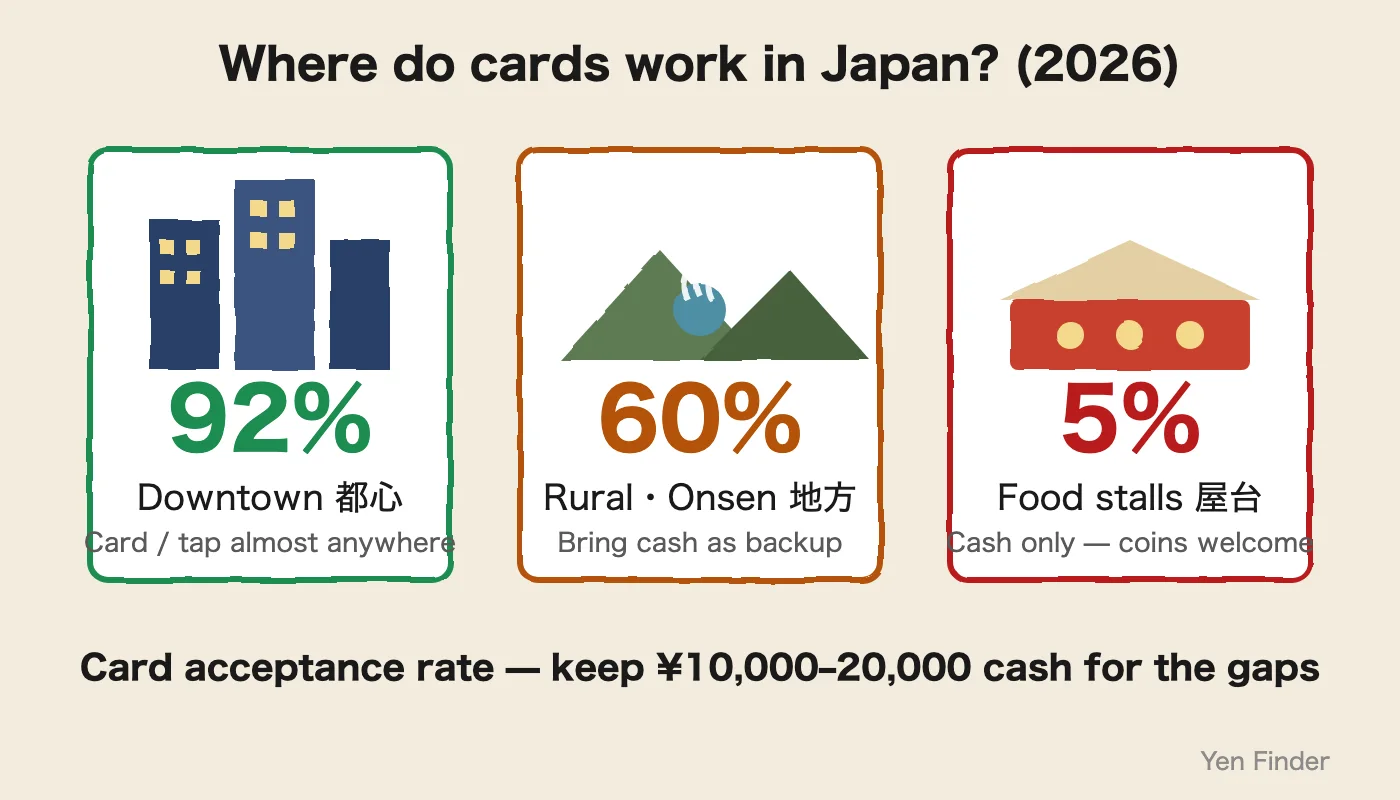
Is Japan Cashless in 2026? — The Reality: 92% Downtown, 60% Rural, 5% at Food Stalls
⚡ 30-Second Answer: Japan cashless ratio = 42.8% (latest METI reading, on the way to the 80%-by-2030 target), which still leaves cash at roughly 57% of payments. 92% card acceptance urban / 60% rural, "100% cashless" remains impossible. Budget ¥10,000-20,000 in cash for a city-only trip, ¥20,000-30,000 once shrines, food stalls or rural areas are on the itinerary, and more if a ryokan asks for a cash deposit. Stalls + shrine offerings + rural taxis + old ticket machines + coin lockers + sentō are cash-only — the reasons are card fees of 2-4%, an elderly customer base and decades of deflation-era habit. Suica/PayPay surging = "hybrid" is more realistic than "card only".
Quick Reference
Value
Cashless %
42.8% (cash ~57%)
Urban card
92%
Rural card
60%
Cash needed
¥10-20K city / ¥20-30K with shrines, stalls, rural
Why shops stay cash-only
2-4% card fees, elderly customers, simplicity
Suica/PayPay
Surging
Last verified
September 2026
✓ Last verified: Sep 2026
📖12 min read
Yen Finder Editorial
SponsoredThis article contains affiliate links. We may earn a commission when you sign up through them, but our recommendations and editorial stance are not influenced by the partnerships.
Contents📖 ~14 min read
💸 TL;DR: In 2026, Japan is 92% cashless in downtown areas, 60% rural, and 5% at food stalls. The real answer is "bring both, switch based on context". Hotels and chain restaurants work fine on card; the tiny izakaya next to your hotel almost certainly does not. This 5-minute read gives you the exact decision rules per scene.
📊 2026 latest data: Japan's cashless ratio is now 42.8% (METI Q1 2026), up from 36% in 2023. Among tourist hubs: Tokyo 58% / Osaka 49% / Kyoto 41% / rural prefectures still under 25%.
The image of "Japan is a cash society" is outdated in 2026 — but Japan is not fully cashless either. According to METI data, the cashless payment ratio has reached 42.8% (latest METI reading), finally starting to catch up with South Korea (95%), China (83%) and the US (55%). What matters for tourists is that card acceptance ranges from 5% to 100% depending on where you go. This article compresses the real-world card acceptance rate by city and venue type onto a single page, assuming you use Wise / Revolut / Apple Pay.
TL;DR — Quick reference
National cashless ratio: 42.8% (METI, latest)
Main tourist areas in central Tokyo: 92% (Shinjuku, Shibuya, Ginza, Harajuku)
Tourist areas in Kyoto: 78% (excluding temple/shrine offerings)
Regional cities (under 500K population): 60-70%
Yatai (food stalls) and festivals: 5-15% (almost entirely cash)
Small family-run diners and soba shops: 30-50%
Konbini and major chains: 99%
Taxis (urban) 90%, (rural) 60%
Saisen (temple offering coins) and goshuin (shrine seal stamps): 0% (cash only)
→ Bottom line: ¥10,000-20,000 in cash + a virtual card on Apple Pay covers 95% of situations.
1. How the national cashless ratio has evolved
Year
Cashless ratio
Source
2010
13.2%
METI
2018
24.1%
METI
2022
36.0%
METI
2024
39.3%
METI
2025
42.8%
METI (preliminary)
2030 target
80%
METI "Cashless Vision"
Comparison: South Korea 95%, China 83%, UK 65%, US 55%, Germany 22%. Japan is "mid-tier among developed countries, last in East Asia."
Why Japan still runs on cash
Five interlocking reasons, none of which is "backwardness":
Deflation-era habits. Two-plus decades of flat or falling prices (1990s-2010s) meant cash under the mattress never lost value, and the habit of keeping money physical stuck across generations. Japan's cash-in-circulation-to-GDP ratio is about 22%, the highest in the developed world (US ~10%, UK ~4%).
Trust in the banknote. Counterfeits are practically nonexistent — under one in a million notes per Ministry of Finance data — and public safety is high, so carrying ¥50,000 feels no riskier than carrying a card.
Demographics. About 30% of the population is over 65, and family-run businesses serve that customer base in the way it prefers.
Merchant economics. Card fees run 2-4% per transaction on Visa/Mastercard (versus about 0.6% in China). For a soba shop on single-digit margins, 3% is the difference between profit and none; cash is fee-free, immediate, and needs no terminal, no connectivity and no chargeback handling.
Regulation and identity. Multi-network acceptance was slow to be liberalised until the 2019 cashless push, and for some owners a cash register is simply part of who the shop is.
Why the small shop next to your hotel still won't take your card
Roughly half of small, family-run restaurants and shops remain cash-only for exactly the reasons above. What changed since 2018 is PayPay: its QR-code readers are cheap enough that around 85% of Tokyo's family restaurants now take PayPay even when they still refuse credit cards. That helps residents more than visitors — a "PayPay only" shop is, for most Western tourists, effectively cash-only (see the FAQ on who can scan the PayPay code). Card acceptance in small shops is rising by roughly five percentage points a year, so the picture improves each season, but not fast enough to leave your cash at home.
2. Card acceptance by city
Tokyo 23 wards (central)
Card acceptance: 88-95%
Ginza, Marunouchi, Yurakucho: 95%
Shinjuku, Shibuya, Harajuku: 92%
Asakusa, Ueno: 85% (souvenir shops and stalls pull the average down)
5. The 12 "cash required" situations tourists actually hit
Saisen (drop a ¥5/¥50/¥100 coin into the offering box)
Goshuin (shrine seal stamp, ¥300-500, cash only)
Omamori (amulets, ¥500-1,500, cash only)
Omikuji (fortune slips, ¥100-300, cash only)
Yatai takoyaki / yakisoba (¥500-800)
Ticket machines at independent ramen shops (¥800-1,200)
Sento ticket machines (¥500-800)
Old-school soba shops and family izakaya (¥800-3,000)
Farm stands at roadside stations (¥100-500)
Independent taxis in rural areas (¥1,000-5,000)
Rural buses, small ferries and local commuter lines that don't take IC cards (¥200-1,500 per ride)
Traditional ryokan deposits — many ask for ¥10,000-30,000 per night in cash at check-in against in-room charges; the final bill can usually go on a card, the deposit can't
→ Items 1-11 together fit inside ¥10,000-15,000 in cash; a ryokan night adds its deposit on top.
What that looks like over a 7-day Tokyo trip
Category
Cash needed
Card alternative?
Hotel deposit and check-in
¥0 (card pre-auth)
✅
Major restaurants (4-5 meals)
¥0
✅
Family restaurants (1-2 meals)
¥3,000-6,000
❌
Konbini stops (10-15)
¥0
✅ Apple Pay / Suica
Vending machines
¥1,000-2,000
✅ Suica
Shrines and temples
¥1,500-3,000
❌
Festival or yatai evening
¥3,000-5,000
❌
Rural day trip transit
¥1,000-2,000
❌
Buffer
¥3,000
—
Total cash
¥10,000-20,000
Add a ryokan night with a cash deposit, or a festival-and-countryside itinerary, and ¥30,000-50,000 for the trip is not excessive.
6. Why visitors still feel "Japan is a cash society"
Reason 1: The famous tourist spots are exactly where cash rules
Asakusa, Kyoto's Gion, Dotonbori, Fukuoka's yatai — popular tourist spots are "traditional," "old-town," and "night food stalls," all of which run high on cash.
Reason 2: The konbini-ATM safety net keeps cash habits alive
Japan's konbini are everywhere with 24-hour ATMs. Ironically, the assurance that "you can pull cash anywhere when you need it" reinforces a cash-first habit.
Some terminals are JCB-only and throw "tap not supported" errors on foreign Apple Pay. This easily creates the misperception that "Japan's cashless system is hostile to foreigners."
One practical defence: even where a sticker says "Credit card OK," the terminal may only take an inserted chip card, not tap-to-pay — smaller restaurants especially. Keep one physical card in your wallet rather than going phone-only; when Apple Pay errors out, inserting the same card almost always works.
A little cash etiquette
Cash is handled formally in Japan, and a few small habits mark you as someone who gets it: put notes and cards on the small tray at the register rather than into the cashier's hand; hand cash over with both hands in small, personal transactions; use crisp notes for any gift money (weddings, funerals — rarely relevant to tourists); and pay a ¥1,000 note rather than counting out a fistful of coins at a busy counter. None of it breaks a transaction if you forget, and none of it involves tipping — see tipping in Japan for why not.
7. Bottom line for tourists
A. Cards cover 95% of central-city tourism
Dining and shopping in Ginza/Shinjuku/Shibuya/Harajuku → card is fine
Konbini and supermarkets → Apple Pay or Suica
B. Temples, stalls and rural areas need cash
Kyoto shrines, Asakusa, Fukuoka yatai → ¥10,000 in cash
Rural onsen and farm villages → ¥20,000 in cash
C. ATM withdrawal is the best value
Instead of exchanging yen back home, withdraw at a 7-Bank ATM on arrival for around -0.5 to -1.0% off the mid-market rate
A Wise / Revolut virtual card in Apple Pay can be used to withdraw at the ATM
Q: "Chinese tourists are cashless but Japan is behind" — is that true?
A: By ratio it's a fact (China 83% vs Japan ~43%), but qualitatively it's the opposite. China is a WeChat/Alipay duopoly that visitors can't use without pre-registration. Japan offers the universality of Visa/Master contactless that anyone can use. From a tourist viewpoint, Japan is actually easier.
Q: Will I struggle in regional trips to Hokkaido, Okinawa or Tohoku?
A: Tourist-developed places (Hakodate, Otaru, Naha, Sendai) are 70-80% card-friendly. Remote backcountry and small islands skew more toward cash. Go with the two-prong combo: extra cash + a Wise virtual card.
Q: Can tourists use PayPay?
A: Generally no — you can't open a PayPay account without a Japanese phone number and bank account. Wise/Revolut + Apple Pay is the effective substitute.
⚠️ Exception — it depends on which app you already carry: if you're from mainland China (Alipay, WeChat Pay), Hong Kong (AlipayHK), South Korea (Kakao Pay), Taiwan, or several Southeast Asian markets, your home payment app can often be scanned directly at PayPay's in-store QR code — no Japanese account needed. As of June 2026, PayPay covers 35 services across 17 countries/regions this way (full list here). Everyone else should stick with the Wise/Revolut + Apple Pay route above.
Q: How should I handle Japanese coins?
A: There are six denominations: ¥1, ¥5, ¥10, ¥50, ¥100 and ¥500. A ¥5 coin (go-en, meaning "good fortune/connection") is considered lucky for saisen offerings. Use up leftover coins at konbini or vending machines before you fly home — that's the iron rule.
A: METI is targeting 80% by 2030. The more inbound tourists arrive, the faster cashless adoption accelerates (Osaka Expo, Sapporo Winter Olympics bid). There's a strong chance that within three years, PayPay/Apple Pay will be standard even at yatai. The rural and cultural tail will persist, though — expect Japan to still be the most cash-heavy major developed economy in 2030.
Q: Can I survive a 7-day Tokyo trip with no cash at all?
A: Mostly. About 90% of meals and shops take cards, and the 10% you can't cover — small temples, family restaurants, the odd vending machine — costs you ¥3,000-5,000 of missed experiences rather than a crisis. ¥10,000 in the wallet makes the whole week friction-free.
Q: Why are some ATMs closed at night?
A: Older bank-branch ATMs keep business hours. The ones inside 7-Eleven, at Japan Post and in major stations run 24/7, so plan after-hours cash around those.
Q: Can I keep my leftover yen for the next trip?
A: Yes — yen never expires, and old-design notes stay valid. Many repeat visitors keep ¥3,000-5,000 in small bills as a "Japan starter kit."
Q: Are scams or counterfeit notes a risk?
A: Almost never. Counterfeits are under one in a million notes and fraud rates are very low. Most "scam" stories from tourists turn out to be misunderstandings — an izakaya's table charge, a hotel's deposit, an ATM's operator fee — rather than anything dishonest.
Real-world Examples (2026 articles)
Want the chain-by-chain reality? Here's the latest:
Last verified: 2026-09-08. Cashless ratios are from METI "Cashless Roadmap 2025." Exchange rates and payment shares fluctuate; check the linked sources for the latest figures.