Depachika guide 2026: half-price sticker times, the best food halls, and how much to budget
⚡ 30-Second Answer: Depachika = the gourmet food hall in a department store basement (Isetan Shinjuku, Mitsukoshi Nihonbashi/Ginza, Daimaru Tokyo, Hankyu Umeda…) — restaurant-grade sushi, bento, sozai, wagashi and pastries for ¥500-3,000 a piece. Most Tokyo halls close at 20:00; discount stickers start around 18:30-19:00 and the half-price (半額) wave peaks 19:00-19:45. Cards work at virtually every counter, and you pay stall by stall. Tax-free only applies to sealed souvenirs you carry out of Japan (¥5,000+ per store per day) — never to food you eat here. Same-day shelf life for fresh items, 1-3 months for boxed souvenirs.
Fresh: same day-3 days; boxed souvenirs: 1-3 months
Day budget
¥3,800 light / ¥7,500 standard / ¥19,500 splurge
Last verified
September 2026
✓ Last verified: Sep 2026
📖10 min read
Yen Finder Editorial
SponsoredThis article contains affiliate links. We may earn a commission when you sign up through them, but our recommendations and editorial stance are not influenced by the partnerships.
Contents📖 ~11 min read
Depachika and Japanese supermarket discount culture fully covered. Depachika (department store basement food halls) is called "the world's greatest food concert" — ¥500-2,000 buys Japan's top-tier sushi, bento, and prepared dishes. Plus, the time-discount culture where "half-off / 30% OFF" stickers appear 1-2 hours before closing moves tourists who learn about it. Same for supermarkets — hitting the evening discount window means meals at ¥300-500.
1. What is depachika?
A Japanese cultural treasure
Depa-chika = abbreviation of "department" + "basement food hall". The Japanese department store standard is luxury brands 1F-B2F, food hall in basement. The format dates from the 1920s-30s, when stores put fresh food downstairs to pull daily shoppers into the building; a century later it has become one to three basement floors of 100-200 counters covering prepared meals, produce, meat and fish, wagashi, Western pastry, bakery, sake and wine, tea and imported gourmet.
For a visitor it solves several problems at once: restaurant-quality food at supermarket prices, beautiful presentation that travels well to a hotel room or park, dozens of categories under one roof, no reservation and no queue, and a front-row seat to how Tokyo actually shops for dinner.
Major depachika and their character
Depachika
Location
Character
Isetan Shinjuku
Shinjuku-sanchome, 5 min from JR Shinjuku east exit
Praised as "Japan's best food hall"; ~150 counters over two floors; 10:30-20:00
Mitsukoshi Nihonbashi / Ginza
Nihonbashi (founded 1673) / Ginza station direct
Legacy crystallization, top-tier wagashi and prepared dishes; 10:30-20:00
Daimaru Tokyo
Tokyo Station building
Reachable without leaving the station — last-stop souvenirs before the airport; open to 20:30
Takashimaya Nihonbashi
5 min from Tokyo Station east side
Traditional Japanese flavours, premium wagashi; closes 19:30
Tokyu Food Show Shibuya
Shibuya station direct
Youth-oriented, trendy; open to 21:00
Seibu Ikebukuro / Tobu Ikebukuro
Ikebukuro station
Huge, less famous abroad, less crowded
Hankyu Umeda / Daimaru Umeda
Osaka Umeda station direct
Kansai's largest (two floors, 200+ counters); Osaka specialities; 10:00-20:00
Daimaru Shinsaibashi / Takashimaya Osaka
Shinsaibashi / Namba
Tourist-friendly, handy for Dotonbori
Outside the two big cities the same format runs at Daimaru and Takashimaya Kyoto, JR Takashimaya and Matsuzakaya in Nagoya, Daimaru Hakata and Iwataya in Fukuoka, and Daimaru Sapporo — hours there tend to end 19:00-19:30, so the sticker window comes earlier.
What's on the floor
A typical layout, in the order you'll walk it: samples and small sweets near the escalators; fresh fruit and vegetables (the famous ¥1,500 melons); the meat and fish counters (wagyu, kurobuta, sashimi); the prepared-food strip — bento, sushi packs, tonkatsu, karaage, simmered dishes; the wagashi shops; Western pastry and chocolate; a bakery; pickles, miso and soy; then sake, wine and tea. Every counter is its own shop with its own register — there is no central checkout, so you pay stall by stall.
2. Five categories to buy at depachika
1. Sushi / sashimi
Kyubey (Isetan) / Ginza Kyubey: ¥3,000-8,000, branch of the Ginza-famous shop
Isetan "Toraya", Mitsukoshi "Tsuruya Hachiman" and other legacy
5. Western sweets
Mont blanc / cheesecake / tart: ¥400-1,000/each
"Pierre Hermé" / "Jean-Paul Hévin" and other high-end French in depachika
3. Half-off sticker time (time service)
When the half-off stickers appear
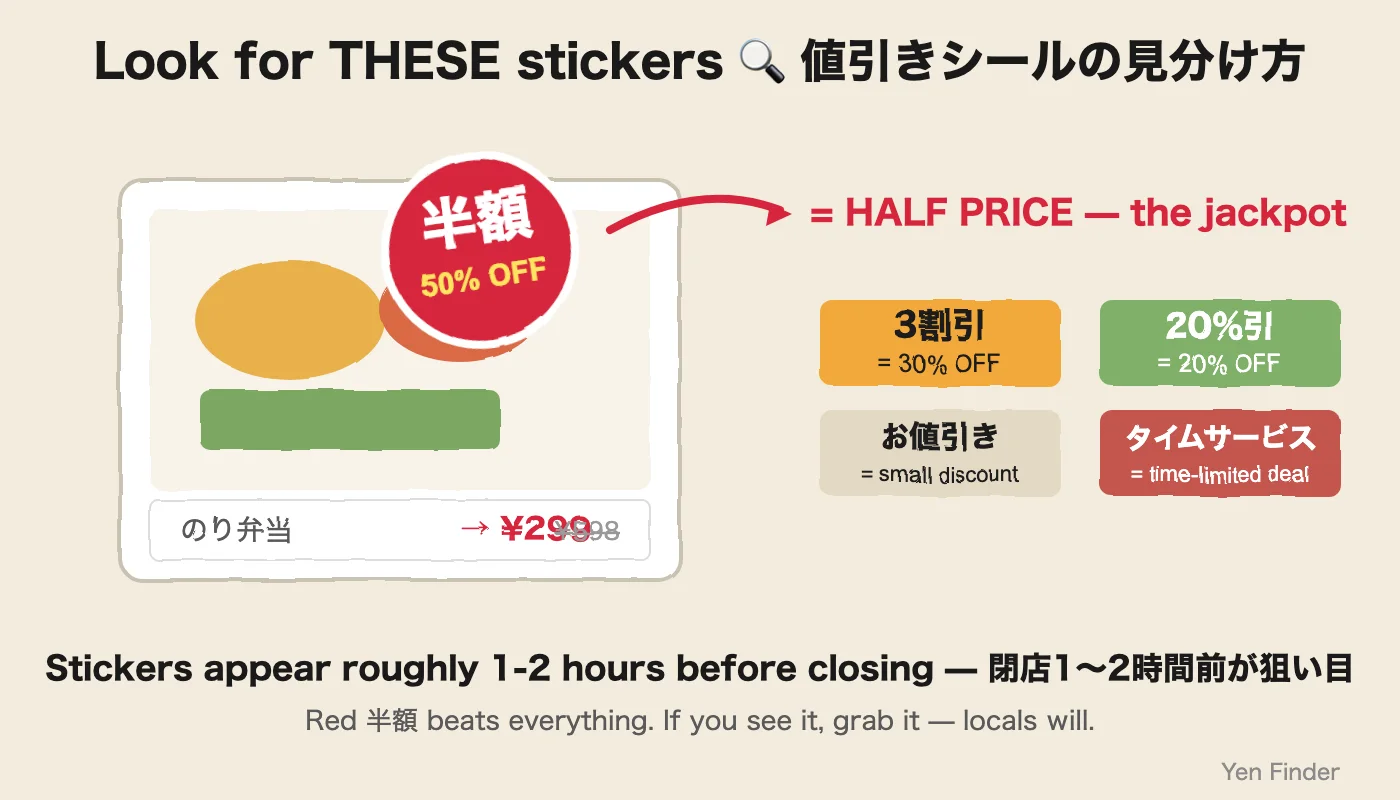
1-2 hours before closing the discount gradually starts, and the rate climbs as the clock runs down.
Around 18:30-19:00: 20% OFF and 30% OFF stickers go on
Around 19:30: 30-50% OFF — the red 半額 (half-price) stickers appear
Right before the 20:00 close: 50-70% OFF can appear — if anything is left
Regional department stores (closing 19:00-19:30): the whole sequence runs about an hour earlier
Half-off golden window, store by store
Store
Discount starts
Closes
Best window
Isetan Shinjuku
~19:00
20:00
19:15-19:50
Mitsukoshi Ginza / Nihonbashi
~19:00
20:00
19:15-19:50
Daimaru Tokyo
~19:00
20:30
19:30-20:15
Takashimaya Nihonbashi
~18:30
19:30
19:00-19:25
Tokyu Food Show Shibuya
~19:30
21:00
20:00-20:45
Hankyu / Daimaru Umeda (Osaka)
~19:00
20:00
19:15-19:55
Regional stores
~18:00
19:00-19:30
18:30-19:15
Going "at 21:00 for the discounts" is the classic mistake — by then almost every Tokyo hall is shut. Popular items also go fast, so 19:00-19:45 is the realistic sweet spot rather than the final minutes.
What the stickers look like
Sticker
Meaning
半額 (usually red)
50% off
3割引
30% off
20%引
20% off
本日限り
"Eat today" — a freshness note, not necessarily a discount
Wagashi / Western sweets often no discount even at close
Look instead at sozai, bento, sushi and sashimi packs, and the fish counter
The hotel-room dinner plan
A sushi pack (¥800), a sashimi pack with the half-price sticker (¥1,500 → ¥750), one dessert (¥350) and a konbini drink (¥200) makes a restaurant-quality dinner for about ¥2,100 with no reservation. A depachika bento that started at ¥1,500-2,500 and got the 50% sticker is arguably the best dinner deal in Tokyo. A park lunch (Shinjuku Gyoen, Ueno, Hibiya) with a bento and a soup runs ¥1,200-2,000 a head; on trains, the equivalent is the ekiben sold at stations.
Morning visits are worth it too
Late morning (10:30-12:00) is quiet and fully stocked — nothing is discounted yet, but the premium items are still there and there is no crowd. Lunchtime (12:00-13:00) is the bento rush.
4. Supermarket discount culture
Japanese supermarket 3-tier system
Tier
Examples
Price range
High-end
Kinokuniya, Seijo Ishii, FRESCO
Slightly higher, abundant imports
Mid-tier
AEON, Seiyu, Life, Maruetsu
Standard pricing
Discount
Gyomu Super, Lopia, OK
Very cheap, cash recommended
Discount time
AEON / Seiyu etc.: 18:00-19:00 from 20-50% OFF
Gyomu Super: high discount-sticker frequency
Discount days are weekly Mon / Thu / Sat (chain-dependent)
Recommended supermarket for tourists
Seijo Ishii (high-end, near many JR stations): imported cheese, wine, bread, prepared dishes, salads. Evening discount turns Japan's top-tier prepared dishes into ¥500-1,000.
Subscribe to the weekly digest (free, unsubscribe anytime).
Email used for the newsletter only. Never shared.
Last verified: 2026-09-08
5. Depachika / supermarket payment
Place
Card
IC
Cash
All depachika
100%
100%
OK
Major supermarkets
100%
100%
OK
Discount supermarkets
80-90%
80%
OK
Indie produce shops
60-70%
50%
OK
Best payment UX in Japan
Apple Pay's Suica/PASMO is strongest. Tap to pass, email receipts (some shops). Remember that each counter rings you up separately, so a five-stall haul means five taps. Keep ¥1,000 or so in cash for the odd produce corner that still runs on cash and PayPay.
Tax-free: what actually qualifies
Tax-free applies to purchases of ¥5,000 or more (before tax) at one store on one day, and department stores process it at their tax-free counter against your passport. Note that stores deduct a handling fee of about 1.5% (commonly 1.55%), so the effective refund on 10% goods is roughly 8.4-8.5%, not the full 10%.
⚠️ Food is a "consumable": bought tax-free, it must be sealed in a special bag and taken out of Japan unopened. Buying a bento, sashimi or sozai tax-free and eating it in your hotel, a park or on the train is tax evasion. Tax-free is only for take-home souvenirs you will carry abroad — boxed wagashi, matcha, sealed snacks, sake. Anything you eat here, buy tax-included as normal.
A typical depachika dinner run never reaches the threshold anyway; it only matters for gift boxes and bulk souvenir buys.
⚠️ It depends on which payment app you're carrying: some smaller depachika stalls and family-run produce corners skip card readers entirely and take "PayPay" QR only. If you hold a mainland China (Alipay/WeChat Pay), Hong Kong (AlipayHK), South Korea (Kakao Pay), Taiwan, or Southeast Asian e-wallet, there's a good chance you can scan that same PayPay QR code directly (as of June 2026, 17 countries/regions and 35 services are supported — details here). Everyone else (Western wallets, etc.) should stick with a credit card or a Wise/Revolut multi-currency card — still the safe bet.
6. Compared with hotel breakfast
Hotel breakfast comparison
Luxury hotel breakfast: ¥3,000-5,500/person
Business hotel breakfast buffet: ¥1,200-2,000/person
Depachika bento breakfast: ¥800-1,500/person (¥400-750 at half-off sticker)
Konbini breakfast: ¥500-800/person
→ Buying depachika bento the night before and eating the next morning is the tourist savings royal road.
7. Depachika mastery tips
About the tasting counters
A reality check for 2026: the big free-tasting culture has shrunk a lot since COVID — these days samples are mostly limited to some wagashi shops and select counters. Don't plan a "free tasting crawl"; the smart move is choosing by the display window (every dish is presented beautifully for exactly this reason), and accepting a taste graciously when it's offered.
Buy with packaging
Have it gift-wrapped and a carry-paper bag transforms it. ¥0-200 packaging fee typical.
"Please add an ice pack"
"Horeizai o irete moraemasu ka?" (保冷剤を入れてもらえますか — Can you add an ice pack?) gets a frozen ice pack added for free. Important in summer.
Wi-Fi environment
Free department store Wi-Fi, 1-minute registration.
Souvenirs: what travels and what doesn't
Fresh sozai and sushi are same-day food. For gifts, stick to the boxed categories with a 1-3 month shelf life: matcha and green tea (¥800-5,000), wagashi and cookie assortments (¥1,500-5,000), yokan (¥1,500-5,000), nori and tsukudani, umeboshi, chocolate assortments (¥2,000-8,000), sake mini-bottle sets (¥1,000-3,000) and umeshu. Check the date on the box, weigh your luggage before the last shopping run, and ask whether the counter ships — some offer EMS/DHL overseas shipping at roughly ¥3,000-15,000.
Gift wrapping and bags
Most counters wrap for free or ¥0-200 and the branded carrier bags are part of the aesthetic; there is no need to bring your own.
8. How much to budget for a depachika day
Style
What you buy
Total
Light
Lunch bento ¥1,500 + sweets ¥800 + a small souvenir ¥1,500
about ¥3,800
Standard
Lunch ¥2,500 + souvenirs ¥3,500 + a bottle of sake ¥1,500
Hit the evening sticker window and the "light" day comes in under ¥3,000.
9. Five mistakes first-timers make
Turning up at 21:00 for the discounts — most halls are already closed; 19:00-19:45 is the window.
Buying only the foreign brands — the wagashi, sushi and bento are the experience.
Buying food tax-free to eat in Japan — illegal; see the tax-free section.
Missing the date label — fresh items are same-day; boxed souvenirs 1-3 months.
Overbuying on the last day — a dozen boxes of yokan weigh more than you think.
FAQ
Q: Can tourists enter depachika?
A: Anyone can enter freely, no admission. Most depachika close at 20:00 (20:30 at some flagship stores on weekends); regional stores often 19:00-19:30. Late-night supermarkets are the ones open until 22:00+, not depachika.
Q: When do half-off stickers reliably appear?
A: Reliably from about 1 hour before close. Stickers start around 18:30, peak 19:00-19:30, and the shelves are picked clean right at the 20:00 close.
Q: What currency does depachika accept?
A: JPY only, no foreign currency exchange. Credit cards billed at mid-market rate.
Q: Are there kid-friendly bento?
A: Kids bento ¥500-1,000, including toy-attached or animal-shaped rice ones.
Q: Vegetarian options?
A: "Shojin-ryori bento" (Buddhist vegetarian) at ¥1,500-2,500, meat-fish-free Japanese-style bento. Beyond that, choice is limited — Kyoto-vegetable dishes and most wagashi are safe; check ingredients on anything else.
Q: Can I eat inside the depachika?
A: Some halls have small eat-in corners or a food court on the same floor, but the default is take-away — most people carry it back to the hotel or a park. Eating while walking the aisles is frowned upon.
Q: Is there a tourist discount?
A: No dedicated one. The evening stickers are the discount; department-store tourist coupons (5% off with a passport) apply to general merchandise more than to the food floor.