What is the mid-market rate, and why every smart traveler to Japan checks it
⚡ 30-Second Answer: The mid-market rate is the real interbank rate — same as what you see when Googling 'USD JPY'. When you exchange cash you always get slightly below it: within −1% to −2.5% of mid-market (downtown counters) = OK, −3% or worse = find another shop. Saves ¥3,000-5,000 on $500 by choosing right.
Quick Reference
Value
How to check
Google 'USD JPY' for current mid-rate
Good rate
mid −1% to −2.5% (downtown counters)
Caution
mid −3% or worse
Avoid
airports/hotels (mid −3% to −7%)
Last verified
June 2026
Rates are indicative and move daily — always check the live rate before you exchange. On Yen Finder only World Currency Shop is live-tracked today; treat other figures as typical ranges, not quotes.
✓ Last verified: Aug 2026
📖9 min read
SponsoredThis article contains affiliate links. We may earn a commission when you sign up through them, but our recommendations and editorial stance are not influenced by the partnerships.
Contents📖 ~11 min read
The mid-market rate is the wholesale rate that banks use when they
trade currency with each other — no markup, no spread, no commission.
It's the closest thing to a fair price for any currency, and it's the
single best yardstick for judging whether an exchange shop, ATM, or card
is giving you a reasonable deal. On a $1,000 cash exchange in Tokyo, the
gap between a good in-town shop and a typical airport counter can run to
several thousand yen — a difference you can only see if you know the
mid-market rate first.
TL;DR
The mid-market rate is the midpoint between the highest buyer
bid and lowest seller ask on the wholesale forex market. It's free
to look up on Google, XE.com, or the
Bank of Japan's daily fix.
Every retail option (banks, exchange counters, ATMs, cards) adds a
spread above mid-market to make money — that gap is what your
transaction actually costs.
For cash on USD/EUR, a good downtown counter runs about 1–2.5%
below mid-market; anything 3% or worse is a red flag (airports,
hotels). A travel card via ATM gets closest, near 0.5%.
What does "mid-market" actually mean?
When a bank in New York and a bank in Tokyo swap dollars for yen at
noon on a Wednesday, neither is making a per-trade profit off the
other — they trade at the interbank rate, also called the
mid-market rate. It's calculated as the midpoint between the
highest "bid" price a buyer will pay and the lowest "ask" price a
seller will accept on the wholesale forex market, where daily
volumes run into trillions of dollars.
Three things make the mid-market rate the right reference price for
travelers:
It's wholesale, not retail. No one is making margin on it.
It's transparent and free. Google's currency converter,
XE.com, OANDA,
and the Bank of Japan publish it live — and they all agree to within
a few basis points.
It's the rate Wise, Revolut, and most modern fintech apps actually
use when they convert your money. They make their fees explicit
instead of hiding them inside a worse rate.
The number to remember: the mid-market rate is the only "fair
price" you can verify in three seconds, anywhere, for free.
How is the mid-market rate calculated?
Forex is an over-the-counter market — there is no single global stock
exchange for currencies. Instead, dozens of major banks publish
constantly updated bid (buy) and ask (sell) quotes, and the
mid-market rate is the simple average:
mid-market = (best bid + best ask) / 2
Real-time data aggregators like Reuters and
Bloomberg collect quotes from those banks
and publish a consolidated mid-market rate, which is then used by every
consumer-facing tool (Google included). The rate moves continuously
during market hours — typically 24/5, with brief gaps over weekends.
How do retail rates differ from the mid-market rate?
Anywhere a person physically hands you yen, the price is not the
mid-market rate. Two layers of cost are added:
The spread
The shop displays a buy rate (what you receive when you sell foreign
cash to them) and a sell rate (what you pay if you want to buy
foreign cash from them). The midpoint of those two sits roughly at
mid-market, and the gap on either side is the shop's gross margin.
A flat fee or commission
Less common in Japan than in some other countries — most counters
advertise "0% commission" — but that almost always means the spread is
wider to compensate. Always check the rate, never the commission.
A typical USD → JPY picture, expressed as how far each option sits
below the mid-market rate (always look up the live mid-rate first —
exact yen figures move daily):
Source
Gap vs mid-market (USD buy)
Mid-market (Google / XE)
reference (0%)
Travel card (Wise/Revolut) via 7-Eleven ATM
about −0.5% + ~¥220 ATM fee
Downtown specialist counter (WCS, Daikoku, etc.)
roughly −1% to −2.5%
Automated exchange machine
~mid −10% (measured Jul 2026)
Bank counter
roughly −2% to −3%
Airport counter (Haneda/Narita)
roughly −3% to −6%
Hotel front desk
roughly −4% to −7%
Home-country bank (typical)
roughly −4% to −7%
These are indicative ranges, not quotes — the spread varies by shop and
by day, and a cash buy rate is always below mid-market. As of mid-2026
the only operator Yen Finder live-tracks is World Currency Shop, whose
USD buy rate sits around mid −2%; treat everything else as a typical band.
The bottom line: on a $500 cash exchange, choosing a good in-town
Tokyo counter over an airport counter or hotel desk is worth several
thousand yen — for a short walk.
Why can the best Tokyo shops get closer to the mid-market rate?
A street shop's buy rate is always below mid-market — that gap is
how the shop earns its money. But the best central-Tokyo specialist
counters shave it down to roughly 1% to 2.5%, far tighter than the
3–7% you see at airports and hotels. It's perfectly legal price
competition, not a scam (the
same mechanism that lets Shinjuku's discount-ticket kinken shops
thrive). The gap stays razor-thin because:
Tourist cash flow is a desirable inventory for them — they re-sell
the foreign currency to outbound business travelers, so they can
accept a tiny spread on the buy side
Competition between four or five shops within 200 meters compresses
margins on the most popular pairs (USD, EUR, KRW)
The shop bears the inventory risk, which is rewarded only when the
rate moves their way; on slow days they accept tiny margins to keep
cash moving
This phenomenon is concentrated in central Tokyo districts (Shinjuku
West, Shibuya, Ginza, Tokyo Station). Outside those clusters,
spreads widen sharply.
How do you read a rate board in 5 seconds?
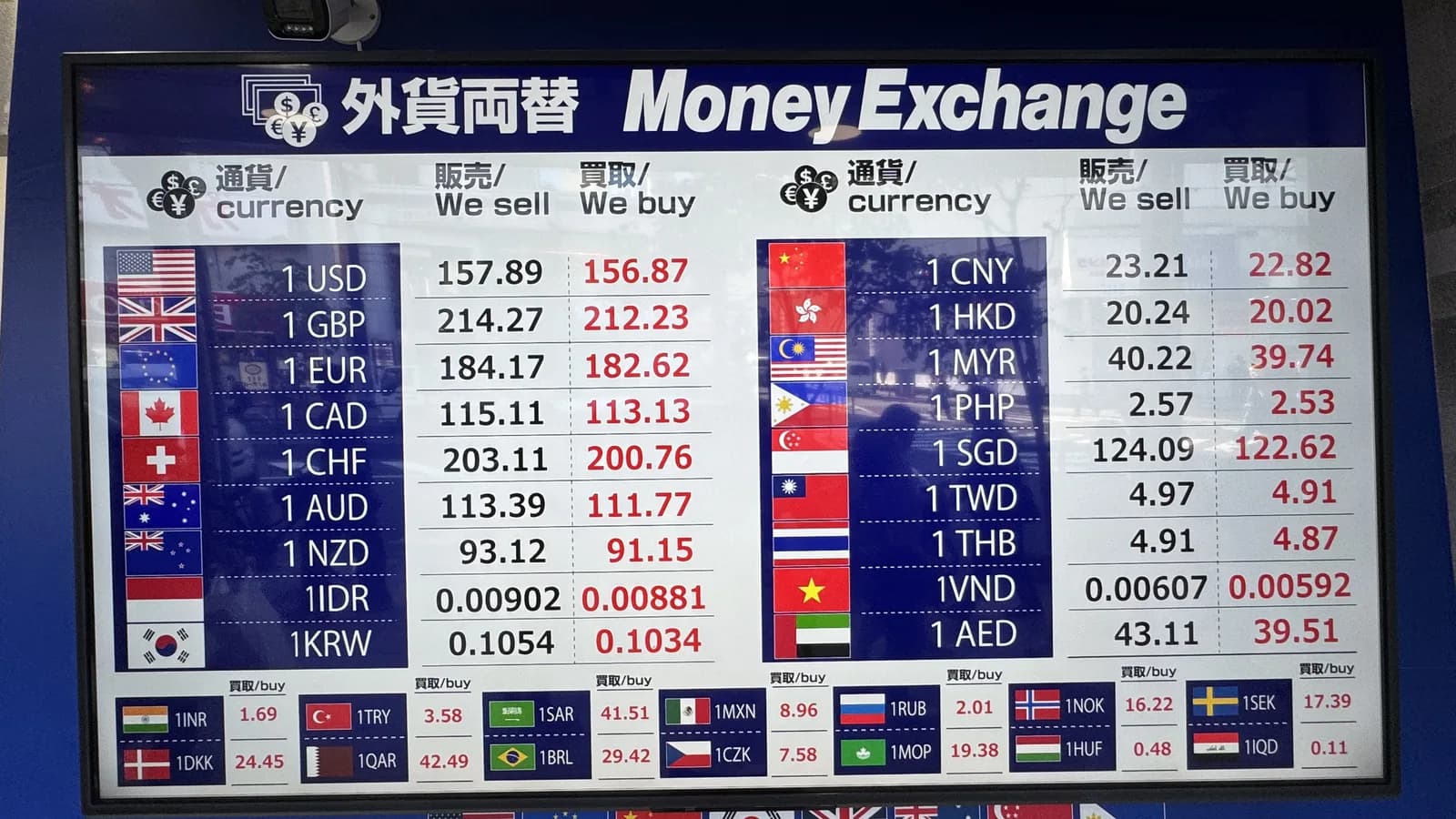
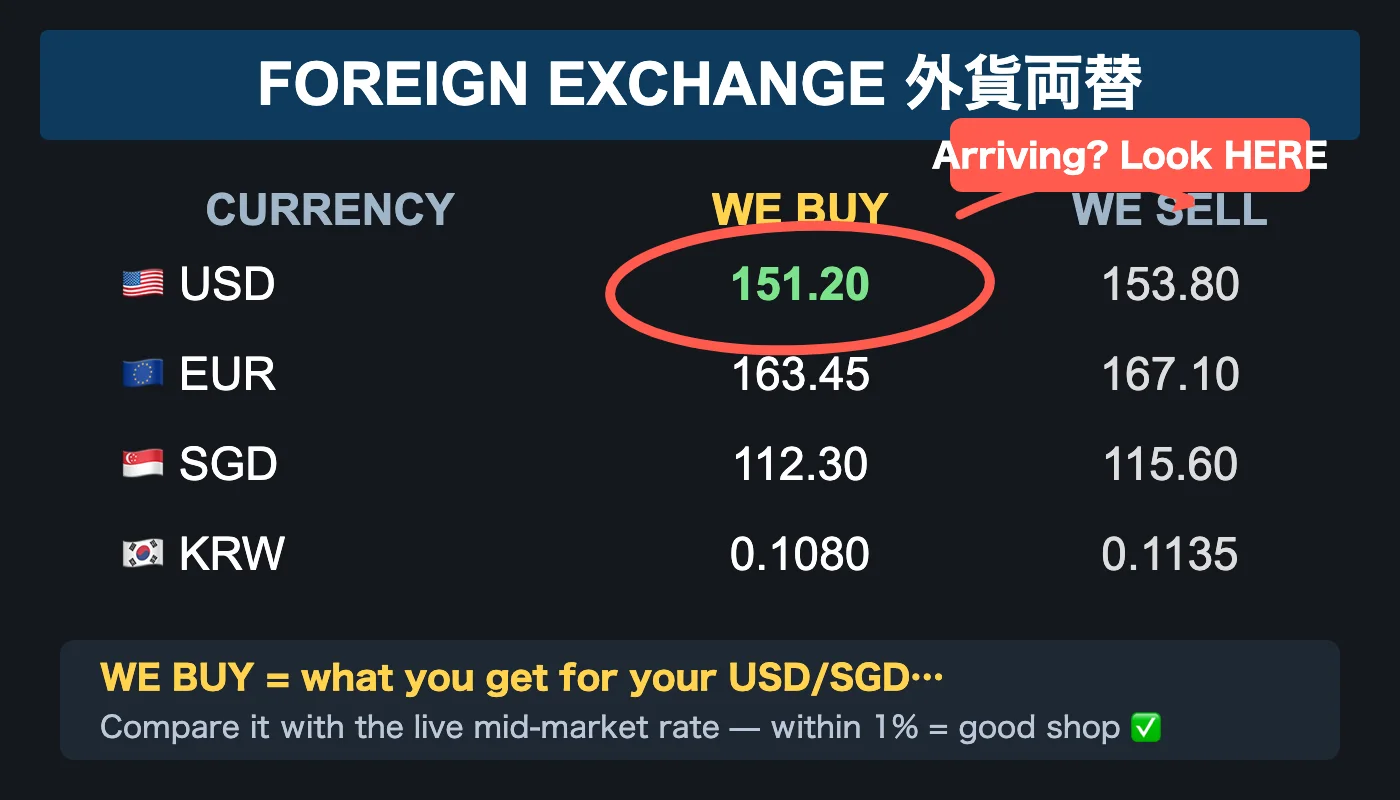
Most physical shops display two columns labelled in English:
WE BUY — what they pay you when you sell foreign cash to them
(this is the column that matters for arriving tourists)
WE SELL — what they charge you when you buy foreign cash from
them (matters for departing travelers wanting USD/EUR for the next
trip)
Bring the live mid-market rate up on your phone before walking in.
If the BUY column for a common pair like USD/JPY is more than ~3%
below mid-market, you're in the wrong shop.
What this means for your trip
✅ Open Google or Yen Finder and check the mid-market rate
before every exchange — it takes 3 seconds.
✅ For cash on USD or EUR, a good downtown counter sits about
1–2.5% below mid-market; rarer currencies like THB or VND run
wider.
✅ Treat any cash rate 3%+ below mid-market as a red flag —
most common at airports and hotel front desks.
⚠️ "0% commission" signs almost always mean a wider spread, not a
free transaction.
✅ Tap-to-pay credit cards now work in nearly every chain store, and
many PayPay QR merchants also take Alipay+-linked overseas wallets —
but every tap is still priced against the same mid-market logic. See
Is Japan cashless in 2026?
⚠️ Avoid converting at home unless your bank publishes a Wise-style
transparent fee.
Frequently asked questions
Is the mid-market rate the same as the official exchange rate?
Yes, in practice. The "official" rate published by central banks (such
as the Bank of Japan's daily fix)
is set against mid-market quotes from major banks, so the two move
together within a tiny margin.
Why is the mid-market rate different on different sites?
Each site polls a slightly different set of banks at slightly different
times. Differences are typically under 0.05%, well within the noise
that most retail tools round away.
Can I get the mid-market rate as a tourist?
Almost: the Wise multi-currency card charges a
small flat conversion fee (typically 0.4–0.6%) on top of the
mid-market rate, with no spread markup. That's the closest a normal
person gets to wholesale pricing.
Does the mid-market rate change overnight?
Yes — forex markets trade 24 hours from Sunday evening through Friday
afternoon (UTC). Weekends are flat. Most retail Japanese shops update
their displayed rate once or twice a day, so a major overnight move
won't reach the counter until morning.
What's the difference between "interbank" and "mid-market"?
They're the same number, named from different perspectives.
"Interbank" describes who trades at this rate (banks); "mid-market"
describes how it's calculated (midpoint of bid/ask).
Check today's real rates on Yen Finder
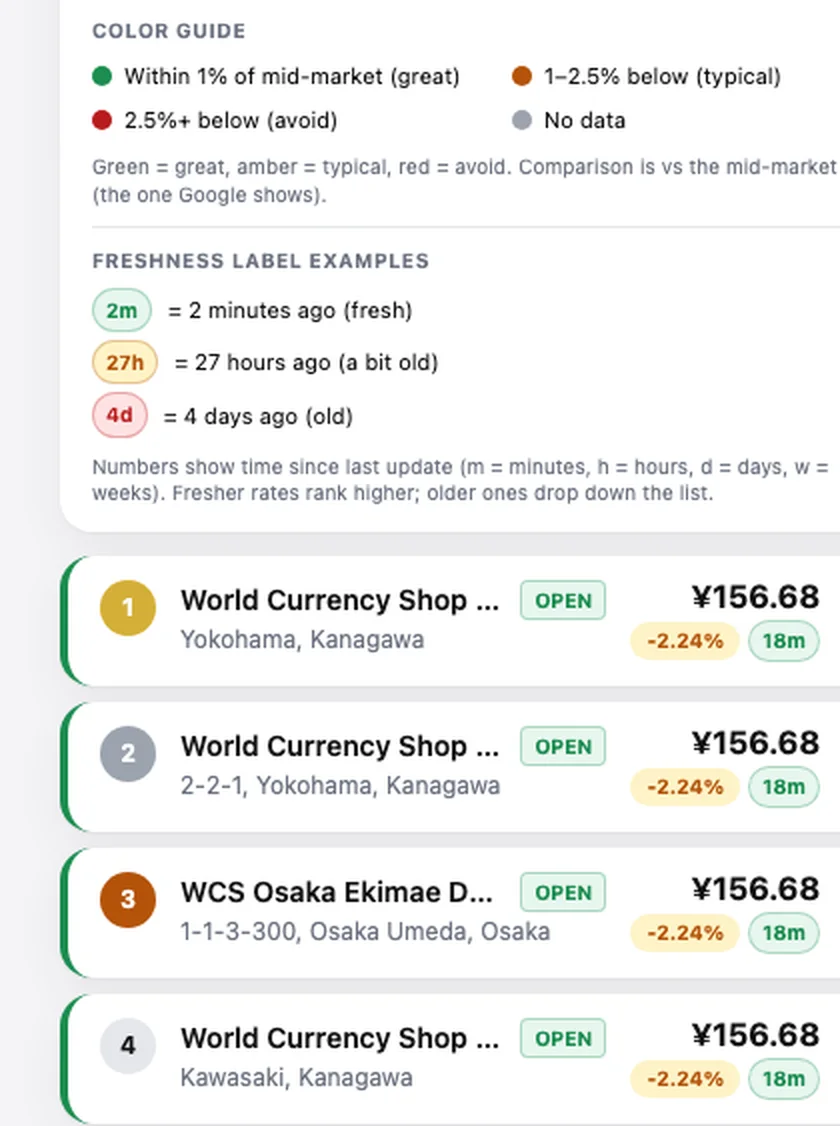
The home screen of Yen Finder shows the live mid-market rate for
your chosen currency, and every store in the ranking is tagged with
how far above or below mid-market it sits. You can sort by best rate,
nearest to your location, or "open right now" — and every rate badge
is colour-coded green/yellow/red against the mid-market gap, so the
"is this a good deal?" question is answered instantly:
For a side-by-side comparison of every shop in a major area, jump to
the interactive map and filter by currency.
Once you understand the mid-market, the next three reads cover how banks price (TTS/TTB/TTM), what moves the yen, and the head-to-head Wise/Revolut/bank cost test — together they're enough to make every exchange decision on your trip.
TL;DR — the whole cluster in 30 seconds: The mid-market rate (also called TTM in Japanese banking) is the interbank reference. Actual exchanges use TTS (bank sells foreign currency to you) and TTB (bank buys foreign currency from you) — the gap between them is the spread that funds the bank. USD: ±¥1 (≈0.66%) per side. KRW: ±¥0.04 (≈4–5%). Wise charges a flat ~0.5% on top of live mid-market, putting it between 1/3 and 1/10 of a megabank's cost. Yen rates move on four drivers: US-Japan rate differential, trade balance, Bank of Japan policy, geopolitical risk. 7-Eleven ATM + Wise debit card is the tourist-optimal combo (24-hour, near mid-market — about −0.5% — plus a ~¥220 ATM fee).
🏦 TTS vs TTB vs TTM 2026 — the three Japanese bank rates decoded, with ¥100,000 conversions to USD/SGD/CNY/KRW priced at every layer
💳 Wise vs Revolut vs banks 2026 — ¥30,000 / ¥100,000 / ¥1,000,000 tests across six channels and four currencies, with a currency-by-currency winners table
💡 Read the Strategy for Your Currency
Once you understand the mid-market rate, find the optimal route for your origin currency × destination city:
Last verified 2026-06-19. Yen Finder pulls live rates from cooperating
exchange shops and verified user submissions; spreads can move within
the day, so always re-check just before you walk in.