USD to JPY in Tokyo: Complete Currency Exchange Guide 2026 — Where, When, and How Much
⚡ 30-Second Answer: USD → JPY in Tokyo: best cash rate at Shinjuku-West street shops (roughly mid-rate −1 to −2.5%), worst at airport counters (roughly mid-rate −3 to −6%). Wise/Revolut card via 7-Eleven ATM ≈ mid-rate −0.5% + ¥220 ATM fee — the most predictable good rate, ideal for any amount. Rates are indicative and move daily, so check the live rate (only World Currency Shop is live-tracked here).
Quick Reference
Value
Best rate
Shinjuku-West street shops
Worst rate
HND/NRT airport counters
Wise rate
mid-rate −0.5% + ¥220 ATM fee
Loss spread, counter vs airport
several % of the amount
Last verified
June 2026
📖6 min read
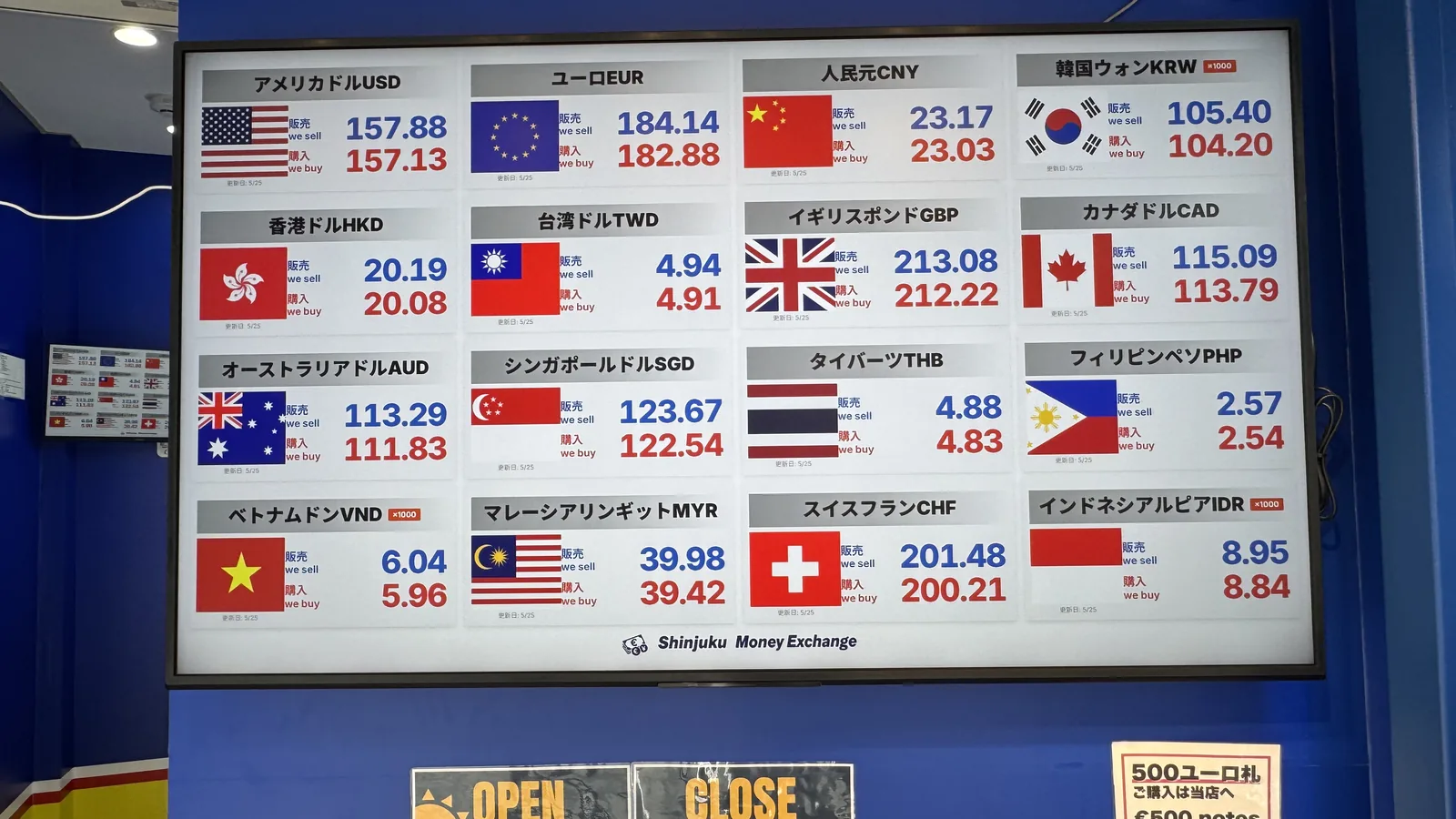
Photo: Yen Finder Editorial, Shinjuku 2026-05-24
SponsoredThis article contains affiliate links. We may earn a commission when you sign up through them, but our recommendations and editorial stance are not influenced by the partnerships.
Contents📖 ~6 min read
If you're arriving in Tokyo with US Dollars ($USD), the place you choose to exchange can cost you several percent of the amount — easily the difference between a downtown counter and an airport booth on the same $500. This guide lays out the best strategy for converting USD → JPY in Tokyo, broken down by location, time of day, and amount.
TL;DR — The Bottom Line for USD in Tokyo
Amount
Recommended method
Why
Under $100 (emergency)
Airport counter is fine
Small amount, real loss only ¥300-500
$100-500
Street exchange shop at Shinjuku West Exit
Best cash rate, roughly mid-market −1 to −2.5%
$500-2,000
Wise / Revolut card at ATM
Wins on rate + fee combined
Over $2,000
Split across multiple days + use Wise as base
Over ¥100,000 at one shop takes time even for staff
💡 Yen-conversion note: A few percent of spread on $500 can run to several thousand yen lost — roughly the combined cost of one day's food, transport, and a sightseeing entry fee in Tokyo.
Comparison Axis ① The 5 Major USD Exchange Areas in Tokyo
Area
Representative shops
Rate competitiveness
Access
Shinjuku West Exit / underground arcade
World Currency Shop / Daikoku, etc.
🟢 Top tier
1-3 min walk from JR Shinjuku Station
Shibuya / Center Gai
World Currency Shop, etc.
🟢 High
3-5 min walk from JR Shibuya Station
Ginza / Yurakucho
Travelex / Sumitomo Mitsui Bank
🟡 Moderate
3-5 min walk from JR Yurakucho Station
Haneda Airport (HND)
Major exchange company counters
🔴 Roughly mid-market −3 to −6%
Direct from arrivals lobby
Narita Airport (NRT)
Major exchange company counters
🔴 Roughly mid-market −3 to −6%
Direct from arrivals lobby
Shinjuku West Exit is the cost king. Treat Haneda and Narita airport counters as emergency-only. For details see #16 Top USD Exchange Shops in Shinjuku.
Comparison Axis ② Wise / Revolut Card vs Street Exchange Shop
Item
Street exchange (Shinjuku)
Wise / Revolut card (ATM withdrawal)
Rate
Roughly mid-market −1 to −2.5%
Mid-market −0.5% (Wise)
Fee
¥0 (settled at counter)
¥220 per transaction (7-Bank ATM)
Convenience
Only during shop hours
24h ATM access
Per-transaction cap
None (even millions of yen)
¥30,000-100,000 per withdrawal
Best for
Large amounts of ¥50,000+
Small amounts of ¥10,000-30,000
Bottom line: For larger amounts (over $500), go to a street exchange shop; for smaller amounts you'd rather split up, use a Wise/Revolut ATM withdrawal.
Comparison Axis ③ How Time of Day and Day of Week Affect the Rate
USD/JPY rates move 24 hours a day, so the timing of your exchange shifts the number slightly. That said:
Day-to-day fluctuation: ±0.3-0.8% (noise level for tourists)
Just after US jobs report (1st Friday each month, 21:30 JST): can swing ±1-2% → avoid the 30 minutes right after
Weekends: street exchange shops shift roughly ±0.3% worse (lower liquidity)
Across a 1-week to 1-month trip, JPY tends to swing about 1-3% — smaller than the 5-7% gap between exchange shops. Where you exchange matters far more than when you exchange.
Comparison Axis ④ The DCC (Dynamic Currency Conversion) Trap
When paying with a USD-denominated credit card, the terminal sometimes asks "Pay in USD or in JPY?" That's DCC (Dynamic Currency Conversion), and picking USD costs you 3-7%.
Comparison Axis ⑤ Which kind of USD traveler are you?
Pick the row that matches you, then use the axes above for the details.
If you're…
Best USD move in Tokyo
Why
Changing $500+ in daytime
A Shinjuku West Exit street shop (WCS / Daikoku)
Top-tier cash rate (roughly mid −1 to −2.5%); the saving outweighs the trip
A budget traveler pulling small amounts
A Wise / Revolut card at a 7-Eleven Seven Bank ATM
Near mid-market, 24/7, ¥220/withdrawal — best for ¥10,000–30,000
Just landed, need a little cash now
Exchange only ¥10,000 at the airport
Airport is roughly mid −3 to −6%; cap it and do the rest downtown
Holding a 0%-FX USD credit card
Tap to pay and always choose JPY (never USD/DCC)
DCC costs 3–7%; you barely need cash beyond a small buffer
Timing-sensitive / weekend-heavy
Exchange on a weekday; don't chase the rate
Where you exchange beats when by far; weekends run ~0.3% worse
3 Common Mistakes Tourists Make
Exchanging the full amount at the airport counter → ¥2,500-5,000 lost on $500. Exchange only ¥10,000 at the airport, then do the real exchange in the city.
Paying in USD via DCC → even on a ¥500 coffee, you pay 3-7% extra.
Mixing up Shinjuku East and West Exit → East Exit is tourist-oriented with slightly worse rates; West Exit is the real target.
Recommended Route (3-Day Tokyo Plan with USD)
Day
Plan
Funds on hand
Day 0 (pre-departure)
Issue and top up Wise / Revolut card
1 card
Day 1 (arrival)
Exchange only ¥10,000 at the airport / head into the city
A: The exchange counters at MUFG, Sumitomo Mitsui, and Mizuho run around mid-market −2 to −3%, worse than street exchange shops. Not recommended for tourists.
Q: What about the hotel front desk?
A: Front-desk exchange at major hotels is typically mid-market −4 to −6%. Truly a "last resort" tier.
Q: Are $100 bills or $20 bills better?
A: It depends on the shop. Some exchange shops give a slightly better rate for $100 bills (less counter handling). Bringing both denominations is the safe bet.
Q: Can I exchange using a credit card?
A: No. Exchange is cash-to-cash by rule. To get yen via a credit card, you'd need an ATM cash advance (high interest) or a Wise / Revolut card (recommended).
Q: What about leftover yen before flying home?
A: Converting back to USD at the airport costs you another 4-6%. It's smarter to convert via Pocket Change (the airport's kiosk-style service) into e-money or Amazon gift cards, or save the yen for your next trip.
About this article: Yen Finder Editorial / Photographed 2026-05-24 / Last verified 2026-06-19. Rates and business information are based on each shop's official sources. Exchange rates fluctuate constantly, so please confirm the final rate on the in-store display.