TWD to JPY in Tokyo: Complete Currency Exchange Guide 2026 — For Taiwanese Travelers
⚡ 30-Second Answer: TWD → JPY in Tokyo: Best: buy JPY at a Taipei street counter before your flight. Taiwanese travelers have one of the highest Japan-repeat rates globally. Tokyo downtown counters (Shinjuku-West/Ikebukuro) typically run around mid −1% to −2.5%, varying by shop and day. Rates are indicative and move daily — check the live rate before you go (only World Currency Shop is live-tracked here).
Quick Reference
Value
Optimal route
Buy JPY at Taipei street shop before flight
Tokyo downtown counters
Shinjuku-West/Ikebukuro, roughly mid −1% to −2.5%
Wise/Revolut
about mid −0.5% + ~¥220 ATM
Worst
Airport/hotel (roughly mid −3% to −7%)
Last verified
June 2026
📖6 min read
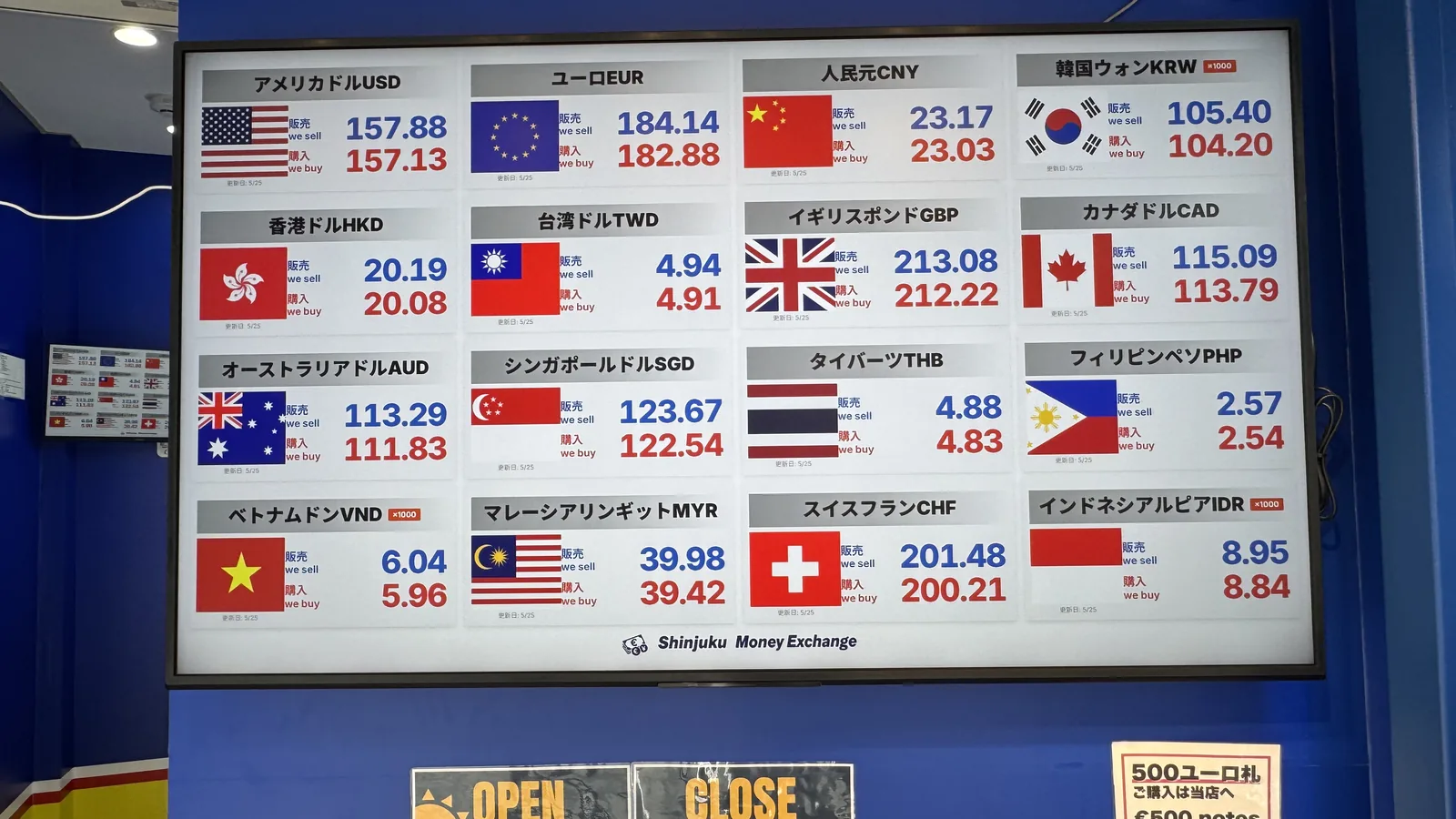
Photo: Yen Finder Editorial, Shinjuku 2026-05-24
SponsoredThis article contains affiliate links. We may earn a commission when you sign up through them, but our recommendations and editorial stance are not influenced by the partnerships.
Contents📖 ~7 min read
Taiwanese travelers have one of the highest repeat-visit rates to Japan in the world, and Tokyo trips tend to be longer and more frequent than average. This guide covers the best strategy for exchanging Taiwan Dollars (NT$ TWD) → Japanese Yen (¥ JPY) in Tokyo, with a side-by-side look at Taiwan vs Japan rates, a list of shops that handle TWD, and alternative methods.
TL;DR — The bottom line for TWD in Tokyo
Amount
Recommended method
Why
Under NT$1,000 (small)
Buy JPY at a Taipei bank
Best rate, prepare before departure
NT$1,000–5,000 (about 1 week in Tokyo)
Buy JPY in Taipei + top up at a Japanese ATM
Pre-load 90%, adjust on the ground
NT$5,000–15,000
TWD street exchange + UnionPay debit ATM combo
Big amounts at street shops, small amounts at ATMs
Long stay (1 month+)
Wise / Revolut TWD account + JPY withdrawal
Lowest per-transaction cost
💡 Yen conversion note: A 5% rate gap on a NT$3,000 exchange costs you about 5% of the yen you'd otherwise receive — roughly the price of a bowl of ramen in Tokyo. (Check the live TWD/JPY rate for the exact amount.)
Comparison ① Taiwan vs Tokyo — where should you buy yen?
For Taiwan residents, buying JPY at a Taipei bank generally gives the best rate:
Location
TWD → JPY rate (relative to mid-market)
Street exchange shops around Taipei 101
Closest to mid-market (best of these)
Major Taiwanese banks (Mega Bank / Cathay United / CTBC, etc.)
Slightly wider than Taipei street shops
Tokyo (downtown counters)
Roughly mid −1% to −2.5%, varies by shop & day
Taoyuan Airport (TPE) exchange counters
Wider than downtown counters
Tokyo (airport counters)
Roughly mid −3% to −6% (worst)
⚠️ Rates are indicative and move daily — always check the live rate before you go. Only World Currency Shop is live-tracked on Yen Finder.
Verdict: Best order is Taipei street exchange > Taiwanese banks > Tokyo downtown counters > Taoyuan Airport > Tokyo airports. The most efficient approach is to buy 90% of your yen in Taipei before flying.
Comparison ② TWD exchange spots in Tokyo
TWD is handled at fewer shops than USD or EUR — that's the reality:
Area
Representative shops
Handles TWD
Rate competitiveness
Ikebukuro
Chinese-affiliated exchange shops
✅
🟢 Roughly mid −1% to −2.5%
Shinjuku-West
World Currency Shop, etc.
✅
🟢 Roughly mid −1% to −2.5%
Shibuya
Major exchange chains
🟡 Some
🟡 Roughly mid −1.5% to −2.5%
Ginza / Yurakucho
Travelex
✅
🟡 Roughly mid −2% to −3%
Haneda Airport (HND)
Major exchange companies
✅
🔴 Roughly mid −3% to −6%
Narita Airport (NRT)
Major exchange companies
✅
🔴 Roughly mid −3% to −6%
Shinjuku-West and Ikebukuro are the two main areas in Tokyo that handle TWD. Ikebukuro in particular has many Chinese-affiliated exchange shops, and their TWD / CNY / HKD rates tend to be especially competitive.
Comparison ③ ATMs via UnionPay debit cards
Taiwan-issued debit and credit cards with the UnionPay mark can withdraw JPY from UnionPay-compatible ATMs across Japan:
ATM
UnionPay support
Rate + fee
Seven Bank ATM
✅
About mid −0.5% + ~¥220/withdrawal
Lawson Bank ATM
✅
About mid −0.5% + ~¥220/withdrawal
AEON Bank ATM
✅
About mid −0.5% + ~¥220/withdrawal
Japan Post (Yucho) ATM
✅
About mid −0.5% + ~¥220/withdrawal
Once the ~¥220 fee is included the effective ATM cost is modest and predictable, and can actually beat a downtown counter for small withdrawals, while the 24-hour availability and widespread placement make it a strong backup option. (The ~−0.5% network margin is a published, firm figure; check the live mid-market rate for the day.)
Comparison ④ Using electronic payments
Taiwan-issued credit cards work at the vast majority of stores in Japan. Specifically:
Store category
Accepted?
Major department stores / chains
✅
Convenience stores
✅
Family restaurants / large restaurants
✅
Street stalls / small independent shops
🔴 Limited
If you register your Taiwan-issued card to Apple Pay or Google Pay, you can travel with it alongside Suica. Watch out for the DCC (Dynamic Currency Conversion) trap: always choose to be billed in JPY.
Comparison ⑤ Which kind of TWD traveler are you?
Pick the row that matches you, then use the comparisons above for the details.
If you're...
Best TWD move in Tokyo
Why
Changing NT$5,000+ in daytime
An Ikebukuro Chinese-affiliated exchange shop
Competitive TWD rate (roughly mid −1% to −2.5%); serves many Chinese-speaking visitors
Flying soon and well-organized
Buy 90% of your yen at a Taipei street shop first
Taipei street counters sit closest to mid-market, usually better than Tokyo; arrive ready
A budget traveler pulling small amounts
A UnionPay debit card at a Seven Bank ATM
About mid −0.5% + ~¥220, 24/7 and everywhere
Holding a 0%-FX credit card
Tap to pay and always choose JPY (never DCC)
DCC costs 3–7%; with Apple Pay + Suica you barely need cash
Just landed, need a little cash now
Exchange only ~¥10,000 at the airport
Airport is roughly mid −3% to −6%; cap it, top up at Shinjuku-West or Ikebukuro
Three common mistakes tourists make
Exchanging everything at Taoyuan Airport or Narita Airport → on NT$3,000 that's ¥1,500–2,500 lost. The rule is to buy 80% in advance at a Taipei bank.
DCC charged in TWD: if a restaurant asks "Would you like to pay in TWD?", saying yes costs you 3–7%. Always choose JPY.
Expecting IC payments at small shops: street stalls and small independent shops are often cash-only. Carry ¥10,000–20,000 in cash.
A: For a 5–7 day Tokyo trip, ¥80,000–100,000 is a good benchmark. Cash demand mainly comes from street stalls, small shops, vending machines, and local buses, which together usually account for about 30–40% of total spend. The rest is covered by credit card + Apple Pay.
Q: What if I have leftover yen?
A: If you visit Japan often, keeping it for next time is the most efficient option. Alternatively, convert it to electronic money or Amazon gift cards via Pocket Change machines at the airport. We don't recommend changing it back to TWD (JPY → TWD), because you'll lose another 5–7%.
Q: Can I withdraw JPY using a Taiwan-issued credit card?
A: Yes, but cash-advance fees (2.5–3%) plus interest apply. A Wise or Revolut debit card, or a UnionPay debit card at an ATM, will keep fees lower.
Q: Where can I exchange TWD on the spot in Ginza or Shinjuku?
A: The main options are World Currency Shop in Shinjuku-West, Chinese-affiliated exchange shops in Ikebukuro, and Travelex in Ginza.Ikebukuro often has the best TWD rates because it serves many Chinese-speaking visitors.
Q: Are there specialist TWD exchange shops in Japan?
A: Very few shops handle TWD only. It's more common to find multi-currency exchange shops (USD / EUR / CNY / TWD / HKD, etc.). These tend to be clustered in the Chinatown areas of Tokyo, Osaka, and Fukuoka.
About this article: Yen Finder Editorial / photographed 2026-05-24 / last verified 2026-06-03. Rates and store information are based on each provider's official sources. Exchange rates fluctuate constantly, so please confirm the final rate at the counter.