7 hidden fees to watch for at exchange counters in Japan in 2026
⚡ 30-Second Answer: Hidden fees at exchange counters = ①even "no commission" booths bake 5-8% spread in, ②¥500-1,000 minimum fees (kills small exchanges), ③max-fee caps on large amounts, ④small-bill (¥1,000 only) surcharges, ⑤vague "special rate" markups. Wise/Revolut is fully transparent — zero hidden fees.
Quick Reference
Value
"No commission" booths
Hides 5-8% spread
Min fee
¥500-1,000/transaction
Small-bill premium
Extra fee
"Special rate"
Vague markup
Wise/Revolut
Fully transparent
Last verified
June 2026
✓ Last verified: May 2026
📖8 min read
SponsoredThis article contains affiliate links. We may earn a commission when you sign up through them, but our recommendations and editorial stance are not influenced by the partnerships.
Contents📖 ~10 min read
Most "0% commission" signs at Japanese exchange counters are
technically true and economically misleading — the shop's profit is
hidden in the spread between the displayed rate and the live
mid-market rate, plus six other tactics that quietly pad the cost.
This guide names every fee mechanism that real shops use, the
actual size of each, and how to spot them before you hand over
cash. Most of these tactics raise costs by 0.3–2.0% — small alone,
significant in combination.
TL;DR
Spread markup is the biggest hidden fee, typically 1–4%
built into the displayed rate.
Minimum-amount thresholds add a tax on small exchanges.
Denomination penalties kick in on bills under $20 / €20.
Weekend / late-night surcharges add 0.3–0.5%.
Old-bill rejection can leave you stranded with a useless
handful of cash.
DCC at ATMs and shops (not the exchange counter) triggers a
second markup — always choose JPY.
Round-down / round-up rules pocket a few yen per
transaction — small but cumulative.
#1 — The spread (the biggest hidden fee)
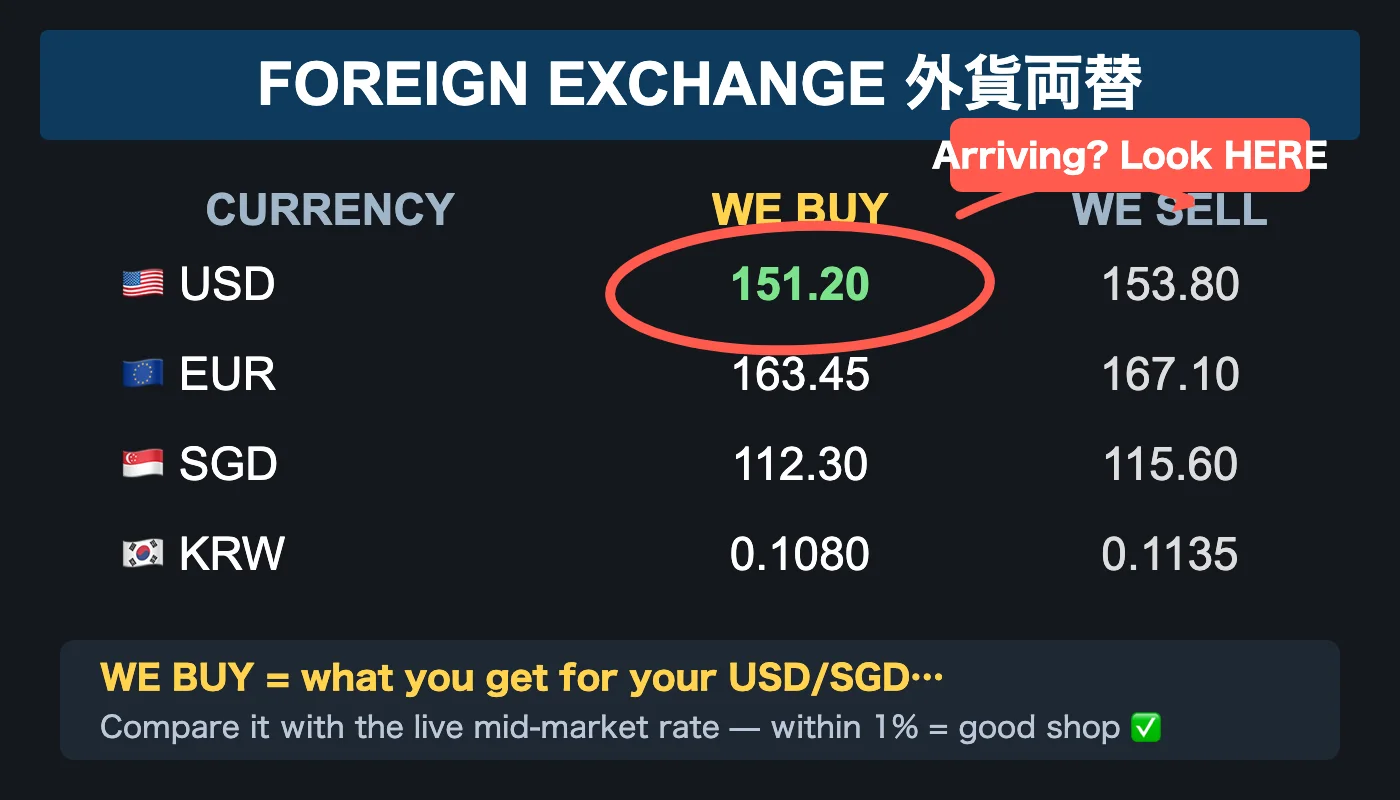
When a shop displays "0% commission" or "no fees," they're often
referring only to a separate line-item commission they don't charge.
The shop's actual profit comes from the spread — the difference
between their displayed exchange rate and the live mid-market rate.
For USD at a typical downtown counter, the buy rate usually lands
about 1% to 2.5% below the live mid-market rate (it varies by
shop and by day). The mid-market rate moves constantly — check the
live rate on your phone before you walk in; rates quoted here are
indicative only. Among Japanese chains, only World Currency Shop
publishes a rate Yen Finder tracks live, and its USD buy rate sits
around mid −2%.
So on a $1,000 exchange at a mainstream downtown counter:
Roughly 1–2.5% lost to the spread vs mid-market
¥0 in line-item "commission"
The whole cost lives in the spread (which the "0%" sign quietly omits)
How to spot it: check the live mid-market rate before walking
in. If the displayed buy rate is more than 1.5% below mid-market
on USD/EUR, you're looking at a wide spread.
Some shops add a flat fee on exchanges below a minimum amount. The
fee may be:
¥500–¥1,000 on amounts under ¥10,000
¥200–¥300 on amounts under ¥5,000
A worse rate tier (e.g., 1% more spread) below the minimum
How to spot it: ask "minimum?" before exchanging small amounts.
Some shops won't accept exchanges under ¥3,000 at all.
Workaround: for amounts under ¥10,000, a 7-Eleven Seven Bank
ATM is often cheaper than any shop's small-amount tier. The flat
ATM fee (¥110–¥220) is fixed regardless of withdrawal size.
#3 — Denomination penalties
Many shops apply a worse rate to small bills (US $1 / $5, €5 /
€10). The reasoning is operational: small bills are slower to count
and harder to inventory. The penalty is typically:
US $1 bills: 5–10% worse rate than the displayed rate
US $5 / €5: 2–4% worse
US $10 / €10: 0.5–1% worse
US $20+ / €20+: displayed rate
How to spot it: the rate board may have a separate column
labeled "small notes" (小額紙幣) with worse numbers. If you don't
see one, ask explicitly before handing over $1 / $5 bills.
Workaround: consolidate to $20+ bills before flying. Worth
breaking your $5s at home.
#4 — Weekend and late-night surcharges
Some 24-hour exchange counters (especially at airports and
non-station locations) charge a small surcharge outside business
hours. Typical amounts:
After 8 pm: 0.3–0.5% wider spread
Weekends: 0.2–0.4% wider spread
Public holidays: 0.3–0.6% wider spread
How to spot it: rate boards rarely advertise this — it's baked
into the displayed rate. The same shop's daytime rate vs night
rate should differ on a comparable currency.
Workaround: use a 7-Eleven Seven Bank ATM after-hours instead
of a counter. Seven Bank's late-night surcharge is the ¥110→¥220
ATM fee (a flat ¥110 difference, not a percentage), much cheaper
on amounts above ¥3,000.
Subscribe to the weekly digest (free, unsubscribe anytime).
Email used for the newsletter only. Never shared.
Last verified: 2026-05-07
#5 — Old-bill rejection (and "verification fee")
Most Japanese counters won't accept:
Marked, written-on, or stained foreign bills
US bills issued before 2009 (older "small portrait" series)
EUR bills with significant wear or torn corners
Foreign coins (most won't accept any coins at all)
A few counters will accept "old" bills but apply a verification
fee of ¥500–¥1,000 — effectively a way to extract margin while
appearing to help.
How to spot it: if your bills look pre-2010 or have any visible
wear, ask the staff before handing over. The "we can take this but
there's a small handling fee" line is the warning.
Workaround: bring clean, post-2009 USD bills only. Same for
EUR — older designs with even small wear are most likely to
trigger penalties.
⚠️ Coins cannot be exchanged at all: Japanese exchange
counters do not buy back coins from any country. A wallet
full of your home-country coins is just dead weight — bring
banknotes only.
#6 — Dynamic Currency Conversion (at ATMs and shops, not the counter)
One common misconception first. At a cash-exchange counter you
generally cannot pay for currency by card — anti-money-laundering
rules and the ban on cash-advance-style transactions prevent it — so
DCC does not happen at the exchange counter. The two places to
watch are:
ATM withdrawals: if a Seven Bank ATM asks "withdraw in your
home currency?", always pick the local currency (Japanese yen /
JPY)
Card payments at shops: if the terminal asks "JPY or USD?",
always pick JPY
Choosing your home currency (this is Dynamic Currency Conversion,
DCC) adds a 5–8% markup over the mid-market rate at the terminal.
How to spot it: if the screen shows an amount in your home
currency, choose JPY.
Smaller-print rule: many shops round the JPY received down to
the nearest ¥100 or ¥500, while rounding the foreign currency
up to the next ¥10,000 — small per transaction, cumulative
across the day.
Example: if your exchange works out to an odd figure like ¥72,563,
the shop may round the yen you receive down to ¥72,500 and round
the foreign currency it keeps up to the nearest whole bill. The
~¥60 difference disappears into the shop's margin. Across hundreds of
daily transactions, it adds up.
How to spot it: ask the staff to confirm the exact yen amount
before handing over your cash. A shop that won't disclose
rounding rules is a red flag.
How do all 7 fees stack up in practice?
For a $500 USD exchange at a typical airport counter on a Saturday
evening with $100 in $5 bills:
Cost
Approximate size
Spread (airport buy rate, ~mid −3% to −6%)
the bulk of the cost
Saturday late-night surcharge (already in spread)
(included)
Small-bill penalty on $100 of $5s
a small extra
Round-down on receipt
a few tens of yen
Total cost
roughly 4–6% of the swap
That's a single transaction landing several percent below mid-market
— well above the already-bad airport rate. The same exchange at a
Shinjuku West Exit downtown counter on a weekday morning typically
costs only the spread (~mid −1% to −2.5%) with no other fees. These
figures are indicative and move daily; check the live rate before you
commit.
The number to remember: the difference between the worst
combination (airport + weekend + small bills + old-note fee) and the best
(central Tokyo weekday + clean bills + JPY-paid card) on a $500
exchange is roughly ¥4,500–¥6,000 — over 6% of the swap.
What this means for your trip
✅ Always check the live mid-market rate before walking up to
a counter.
✅ Bring clean, post-2009 bills in $20+ denominations.
✅ Avoid weekend / late-night airport counters when possible;
use a 7-Eleven Seven Bank ATM instead.
✅ Decline DCC at every terminal — choose JPY.
✅ Ask about minimums and rounding before handing over cash.
⚠️ Don't trust "0% commission" signs as the full story.
⚠️ Don't exchange small amounts (<¥3,000) at counters; use
ATM or accept the convenience cost.
Frequently asked questions
Are these fees illegal?
No — Japan's regulators allow a wide range of pricing tactics as
long as they're disclosed in the rate or in posted notices.
"Disclosed" can be tiny print on a placard 2 meters from the
register, which doesn't help most travelers in practice.
Which Japanese exchange chains are the most transparent?
World Currency Shop publishes its rate online with the
mid-market markup visible; Wise (digital) shows every fee in
the app before each transaction. Most physical chains (Travelex,
Dollar Ranger, Daikoku) are within industry norms but don't break
out the spread separately.
What if I'm charged a fee that wasn't disclosed?
Ask for a manager and request the official price list. If the fee
was applied without disclosure, most shops will refund or adjust.
For airport counters, the airport's tourist information desk can
mediate.
Do online exchange platforms have these issues?
Most reputable online platforms (Wise, OFX, XE Money) charge
explicit, disclosed fees and avoid the spread markup. The
trade-off is that you typically can't get cash on the spot — you
get a transfer or a card.
How much does the airport counter actually cost vs the worst
mistake combo?
On a $500 exchange:
Best central-Tokyo shop: cost about ¥0–¥500
7-Eleven ATM with no-FX-fee card: cost about ¥350–¥600
Average central-Tokyo shop: cost about ¥1,000–¥1,500
Airport counter: cost about ¥2,000–¥3,500
Worst combination (airport + weekend + small bills + old-note fee):
cost about ¥4,500–¥6,000
A factor of 10x between best and worst on the same physical
amount of money.
Can I dispute a Japanese exchange shop's rate after the fact?
Practically, no. Japanese consumer protection agencies handle
egregious fraud cases, but a "wide spread" or "small-bill penalty"
that was technically disclosed in fine print is not actionable.
Better to walk away before transacting.
What's the single biggest watch-out for a first-time visitor?
Always check the live mid-market rate on your phone before
walking in — if the displayed rate is well below mid-market, leave
for another shop. On top of that, always decline DCC and choose
JPY at ATMs and in shops. These two habits alone save more than
all the other tactics combined.
Put this to work — live rates on Yen Finder
Yen Finder shows the live mid-market rate alongside every
shop's current rate, with a colored badge indicating spread size.
Green badges mean the shop is within 0.5% of mid-market; red
means 2%+ off — that's the spread you'd be paying. Open the app
before any exchange and the math is settled.
Last verified 2026-05-07. Fee tactics evolve as competition
shifts; the underlying mechanism (spread + minor add-ons) is
stable, but specific surcharges may differ shop-to-shop.