CNY to JPY in Tokyo: Complete Currency Exchange Guide 2026 — For Mainland Chinese Travelers
⚡ 30-Second Answer: CNY → JPY in Tokyo: Alipay / WeChat Pay accepted at 70-80% of major Tokyo tourist spots — physical exchange matters less than for other currencies. Best exchange: Ikebukuro Chinese shops, roughly mid −1% to −2.5% (varies by shop and day). UnionPay debit ATM = roughly mid −1% to −2% + ¥220. Rates are indicative and move daily — check the live rate before you go.
Quick Reference
Value
Primary
Alipay/WeChat Pay (70-80% coverage)
Best exchange
Ikebukuro Chinese shops (roughly mid −1% to −2.5%)
UnionPay ATM
7-Eleven/Lawson/Aeon/Yucho
Airport
roughly mid −3% to −6%
Last verified
June 2026
✓ Last verified: Sep 2026
📖7 min read
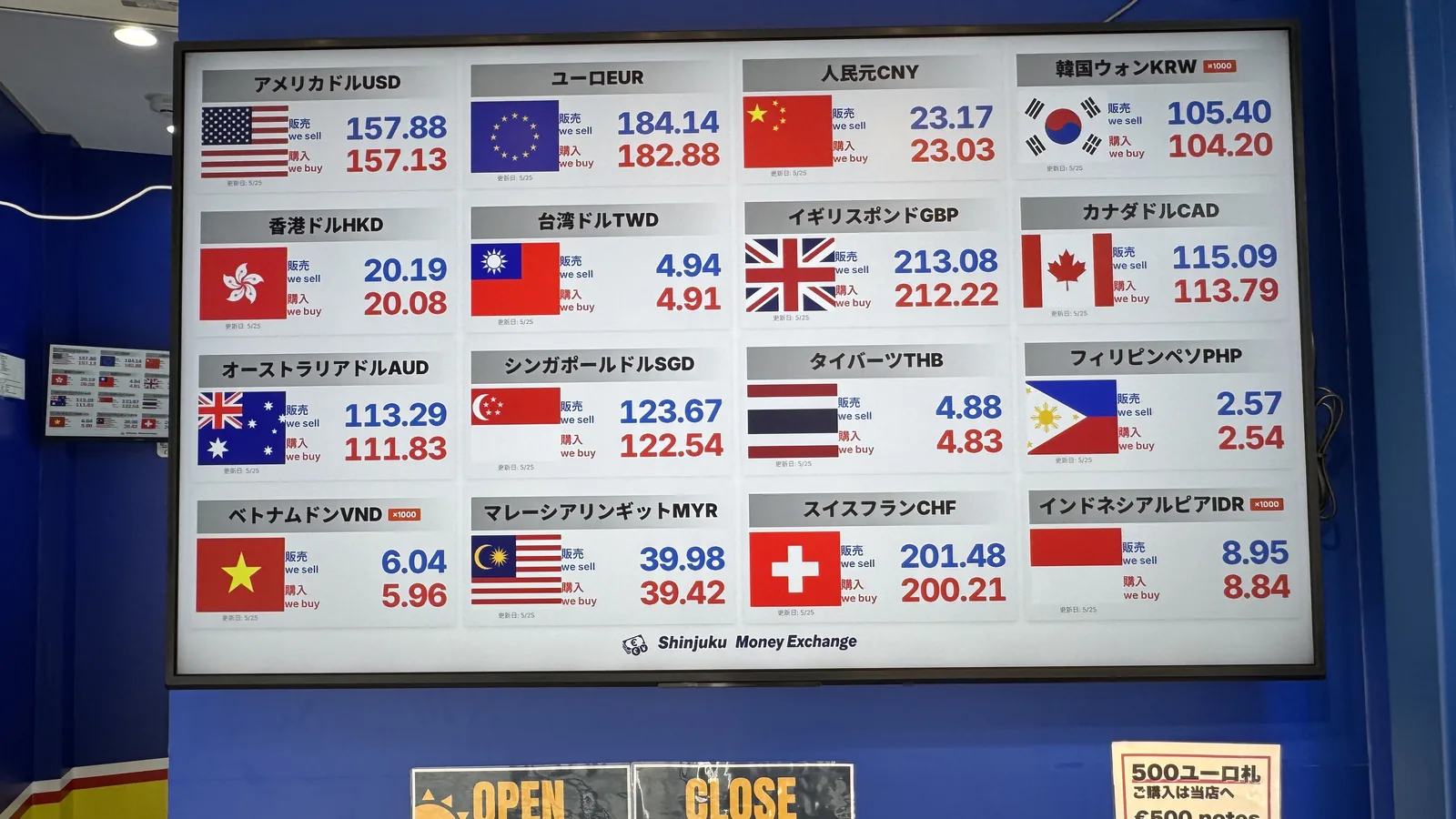
Photo: Yen Finder Editorial, Shinjuku 2026-05-24
SponsoredThis article contains affiliate links. We may earn a commission when you sign up through them, but our recommendations and editorial stance are not influenced by the partnerships.
Contents📖 ~7 min read
For mainland Chinese travelers visiting Tokyo, exchanging Chinese yuan (¥CNY) into Japanese yen (¥JPY) comes with its own quirks that USD/EUR travelers don't deal with. In Japan, UnionPay (银联) + Alipay + WeChat Pay are widely accepted, so electronic payments — not cash exchange — can be your main payment method on the trip. This guide is written for mainland Chinese travelers heading to Tokyo, and lays out the full CNY exchange and payment strategy.
TL;DR — CNY in Tokyo, the bottom line
Amount
Recommended method
Why
Under ¥100 CNY (emergency only)
Airport counter is fine
Small amount, real loss only ¥3-5
¥100-2,000 CNY (everyday shopping)
Alipay / WeChat Pay
FX handled on the CNY side, good rate
¥2,000-10,000 CNY (larger cash need)
Shinjuku or Ikebukuro street exchange shops
Roughly mid −1% to −2.5%, dedicated CNY counters
Over ¥10,000 CNY
UnionPay debit card at ATM
Wins on rate + withdrawal fee combined
💡 JPY conversion note: 1 CNY buys roughly 20-something yen (check the live rate — it moves daily). On ¥1,000 CNY, a 5% spread is the price of about one bowl of ramen in Tokyo, lost to fees.
Angle 1 — What makes mainland Chinese travelers different
Handling CNY in Japan is not the same as USD/EUR:
Item
USD/EUR
CNY
Street exchange shop support
Standard at major chains
Only at certain specialized shops
Bank exchange
Standard
Available at major city banks
Electronic payment at tourist spots
Limited
Alipay / WeChat Pay widely accepted
UnionPay (银联) cards
Partial
Accepted at many ATMs
Unlike USD/EUR where cash exchange is the default, for CNY the structure is "go electronic-first" — that's where fees get minimized.
Angle 2 — Where to exchange CNY in Tokyo
Area
Representative shop
Handles CNY
Rate competitiveness
Shinjuku-West
World Currency Shop etc.
✅
🟢 Roughly mid −1% to −2.5%
Ikebukuro (many Chinese-run shops)
Chinese-owned exchange shops
✅
🟢 Roughly mid −1% to −2.5% (often best)
Ueno-Okachimachi
Major exchange chains
✅
🟡 Roughly mid −1.5% to −2.5%
Ginza / Yurakucho
Travelex
✅
🟡 Roughly mid −1.5% to −2.5%
Haneda Airport (HND)
Major exchange operators
✅
🔴 Roughly mid −3% to −6%
Narita Airport (NRT)
Major exchange operators
✅
🔴 Roughly mid −3% to −6%
Rates above are indicative and move daily, and vary by shop — check the live rate first. yenfinder live-tracks World Currency Shop; treat other figures as ballpark.
Chinese-run shops in Ikebukuro often have the best rates — that's a Tokyo-specific quirk. Shinjuku-West is consistently solid, and for larger amounts, check the rate by phone or in person first.
Two more zones worth knowing about: Akihabara exchange counters cluster around the electronics stores and see heavy Chinese foot traffic, so rates stay reasonably competitive even though it's not a top-tier zone; Shin-Okubo — Tokyo's Korea Town — also has a cross-border CNY/KRW exchange cluster, since many operators there serve both Chinese and Korean visitors. Bic Camera's in-store exchange counters (major branches) are a convenient one-stop option if you're already shopping there — the trade-off is a rate that typically runs a bit worse than a dedicated exchange shop, so treat it as a convenience option rather than a rate-shopping destination.
Angle 3 — Using Alipay / WeChat Pay
Alipay / WeChat Pay acceptance at Tokyo's major tourist spots and large stores is around 70-80%:
Store category
Alipay
WeChat Pay
Major department stores (Isetan, Mitsukoshi, Takashimaya etc.)
✅
✅
Large electronics retailers (BIC Camera, Yodobashi)
✅
✅
Drugstores (Matsukiyo etc.)
✅
✅
Don Quijote
✅
✅
Convenience stores (7-Eleven, FamilyMart, Lawson)
✅
✅
Uniqlo, Muji
✅
✅
Large restaurant chains
🟡 Varies
🟡 Varies
Street stalls, small shops
🔴 Limited
🔴 Limited
The most cost-efficient travel style is "bring ¥10,000-20,000 JPY in cash + cover the rest with Alipay/WeChat Pay". The FX margin is processed on the CNY side at around 0.5%, comparable to street exchange shops.
Angle 4 — UnionPay cards and ATMs
UnionPay debit/credit cards work at many ATMs across Japan:
ATM
UnionPay accepted
Rate + fee
Seven Bank ATM
✅
Roughly mid −1% to −2% + ¥220 per withdrawal
Lawson Bank ATM
✅
Roughly mid −1% to −2% + ¥220 per withdrawal
AEON Bank ATM
✅
Roughly mid −1% to −2% + ¥220 per withdrawal
Japan Post (Yucho) ATM
✅
Roughly mid −1% to −2% + ¥220 per withdrawal
MUFG, SMBC
🟡 Partial
Depends on bank
24-hour availability + widely installed at airports, major stations, and convenience stores — for UnionPay users, ATMs are "yen on demand, no exchange needed".
Angle 5 — Which kind of CNY traveler are you?
Pick the row that matches you, then use the angles above for the details.
If you're...
Best CNY move in Tokyo
Why
Doing everyday shopping and dining
Pay with Alipay / WeChat Pay (always in JPY)
70-80% coverage; FX handled on the CNY side at ~0.5%, barely need cash
Changing ¥2,000+ CNY in daytime
An Ikebukuro Chinese-run exchange shop
Often the best Tokyo rate (roughly mid −1% to −2.5%); the saving outweighs the trip
Wanting yen on demand, no exchange
A UnionPay (银联) debit card at a 7-Eleven Seven Bank ATM
Roughly mid −1% to −2% + ~¥220, 24/7, widely installed
Just landed, need a little cash now
Exchange only ~¥10,000 JPY at the airport
Airport is roughly mid −3% to −6%; cap it, do the rest downtown
Heading to Asakusa stalls / small shops
Carry ¥10,000-20,000 JPY cash; don't rely on Alipay
Street stalls and mom-and-pop shops often don't accept it
3 mistakes tourists commonly make
Exchanging the full amount at the airport counter → on ¥2,000 CNY, that's ¥1,500-2,000 lost. Alipay/WeChat Pay + UnionPay ATM is far more efficient.
Paying in CNY via "DCC": when a restaurant asks "Would you like to pay in CNY?" and you say yes → 3-7% lost. Always choose JPY-denominated billing.
Expecting Alipay at small shops: street stalls, mom-and-pop shops, and small storefronts around Asakusa often don't accept it. Always carry ¥10,000-20,000 JPY in cash.
Recommended flow (3-day Tokyo plan in CNY)
Day
Plan
Cash & payment
Day 0 (before departure)
Set up Alipay / WeChat Pay for Japan use + prep UnionPay card
All cards ready
Day 1 (arrival)
Exchange just ¥10,000 JPY at airport + withdraw ¥10,000 JPY at UnionPay ATM
¥20,000 cash + Alipay
Day 2 (sightseeing & shopping)
Alipay at department stores and electronics, cash at small shops
A: Both apply a small margin on top of the PBOC (People's Bank of China) reference rate, so you pay a modest markup over mid-market — broadly comparable to a good street shop (roughly mid −1% to −2.5%). Exact figures move daily, so check the live rate. Convenience is the main advantage on larger individual transactions.
Q: What's the ATM withdrawal limit on a UnionPay card?
A: It depends on your issuing bank and your personal settings, but typically ¥30,000-100,000 JPY per day. You'll need to enable "overseas use in Japan" with your issuing bank in advance.
Q: How do I spot Alipay-accepting shops on the street?
A: Look for "Alipay" "支付宝" "WeChat Pay" "微信支付" logo stickers at the storefront. The safest move is to ask "Alipay OK?" at the register. The logos are often displayed alongside JCB / UnionPay.
Q: Better to buy JPY in mainland China or exchange CNY in Japan?
A: Buying JPY at a mainland China bank carries a modest markup over mid-market, broadly comparable to Japan street exchange (roughly mid −1% to −2.5%) — check the live rate either way. But factor in the per-transaction caps and the paperwork involved.
Q: What if I have JPY left over?
A: Hold it for your next trip to Japan, or use Pocket Change (airport kiosks) to convert into e-money / Amazon gift cards. Converting back to CNY (JPY→CNY) costs another 5-7%, so it's not recommended.
Editorial info: Yen Finder Editorial / photographed 2026-05-24 / last verified 2026-06-19. Rate and business info are based on each shop's public information. FX rates move constantly — confirm the final rate at the counter.