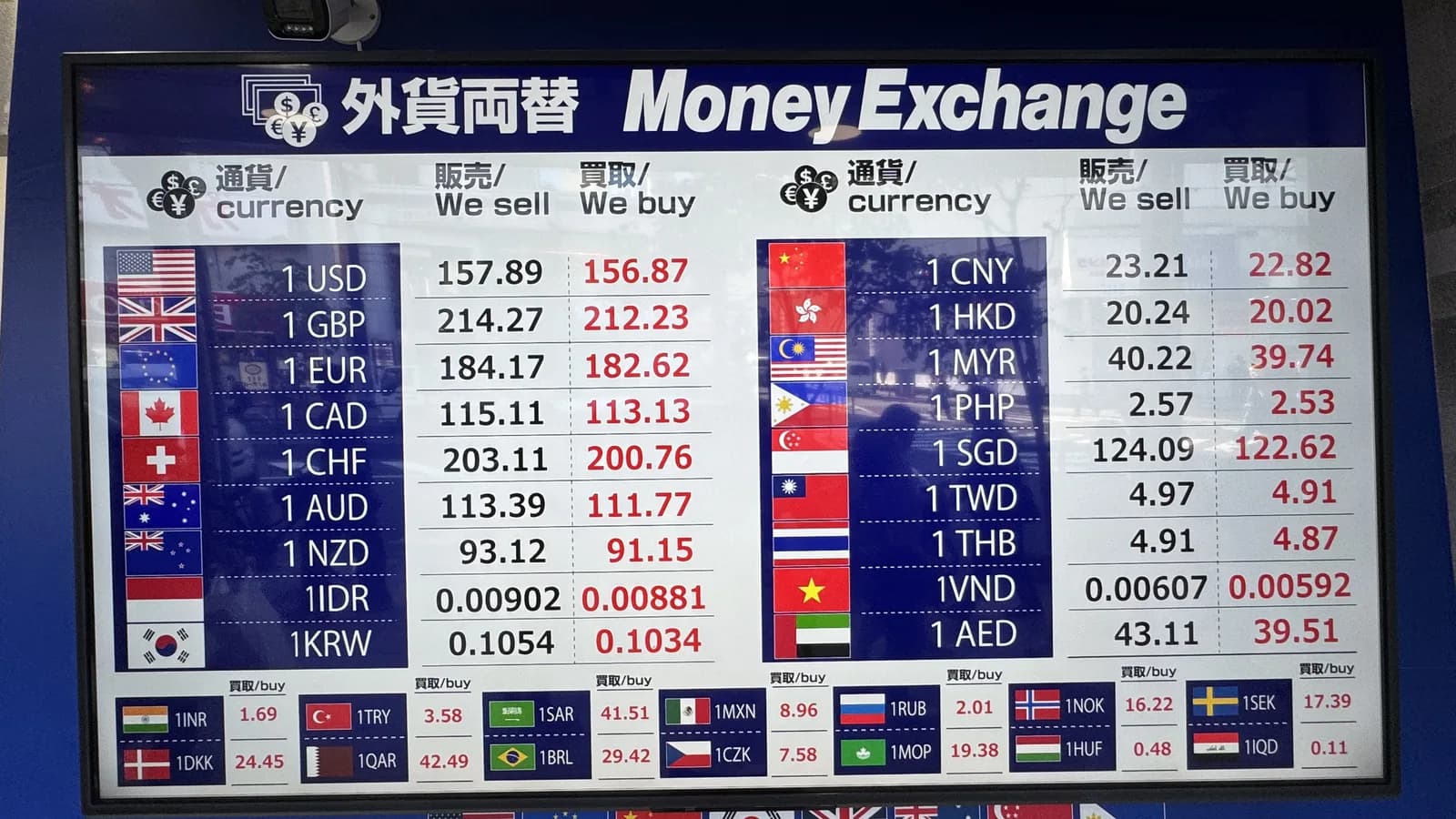
Buy rate vs sell rate at Japanese exchange shops: a 60-second clarifier
⚡ 30-Second Answer: "Buy rate" = shop buys your foreign currency (you JPY → foreign), "sell rate" = shop sells foreign (you foreign → JPY). The gap = the spread = shop's profit, 2-8%. Tourists bringing USD to exchange for JPY look at the "buy rate" (WE BUY). Many displays show shop-perspective, which is the inverse of yours — read labels carefully.
Quick Reference
Value
Buy rate
Shop buys your foreign
Sell rate
Shop sells foreign (your direction)
Spread
2-8%
Tourists check
Buy rate (WE BUY)
Display gotcha
Shop perspective common
Last verified
2026-08-25
✓ Last verified: Aug 2026
📖4 min read
Photo: Yen Finder Editorial, Shinjuku 2026-05-25
SponsoredThis article contains affiliate links. We may earn a commission when you sign up through them, but our recommendations and editorial stance are not influenced by the partnerships.
Contents📖 ~4 min read
At every Japanese exchange shop, the rate board has two
columns labeled from the SHOP'S perspective: "WE BUY" (お買取)
is what they pay you when you sell them foreign cash, and
"WE SELL" (お売り) is what they charge you when you buy
foreign cash from them. The columns are from the shop's
perspective, not yours — a confusion that costs travelers
unnecessary mental friction. This 60-second guide settles it.
TL;DR
Selling foreign cash for yen? Look at the WE BUY column.
Buying foreign cash with yen? Look at the WE SELL column.
WE BUY rate is always lower than WE SELL (gap = spread).
For arriving tourists with USD/EUR/CNY: the WE BUY column
is the relevant one.
What does each column mean?
The label is the shop's action:
WE BUY (お買取)
The shop is buying foreign currency from you. You are
selling your USD/EUR/etc. to them and receiving yen.
For an arriving tourist with $500 USD:
WE BUY rate of 149.00 means you receive ¥74,500
This is the column that matters for arriving tourists
WE SELL (お売り)
The shop is selling foreign currency to you. You are
paying yen to receive USD/EUR/etc.
For a departing tourist needing $100 USD:
WE SELL rate of 154.00 means you pay ¥15,400
This is the column that matters for departing tourists or
travelers heading abroad
Quick example
A Tokyo shop's USD board:
Column
Rate (1 USD =)
Direction
WE BUY
149.00 JPY
We buy your $1; you receive ¥149
WE SELL
154.00 JPY
We sell you $1; you pay ¥154
Customer with $500 USD cash → WE BUY × 500 = ¥74,500.
Customer paying for $500 USD → WE SELL × 500 = ¥77,000.
The shop's spread: ¥5 per $1 exchanged.
Why is the rate from the shop's perspective?
Banking convention. Throughout the financial industry, rates
are quoted from the dealer's perspective:
A bank's "USD bid" rate = what the bank pays for USD
A bank's "USD ask" rate = what the bank charges for USD
The customer reads it as the inverse
Japanese exchange shops follow this convention with English/
Japanese labels.
What about ATMs?
ATMs always show the rate from your perspective — "1 USD = X
JPY." No buy/sell confusion because the ATM only does one
direction (you withdraw yen, the rate converts your home
currency).
For ATMs:
"Pay in JPY or your home currency?" — always JPY
The rate displayed on the ATM screen is what your card-issuing
bank applies to convert
What this means for your trip
✅ For arriving tourists: read the WE BUY column.
✅ For departing/abroad-bound travelers: read the WE
SELL column.
✅ Higher BUY rate = better for arriving tourists.
✅ Lower SELL rate = better for departing travelers.
⚠️ Don't confuse: WE BUY < WE SELL, always. The gap is the
shop's profit.
Frequently asked questions
Are the columns ever labeled in English?
Yes — most central Tokyo shops label them clearly: "WE BUY"
and "WE SELL" in English alongside Japanese. Smaller shops may
only use Japanese labels.
What if the rate board only shows one column?
Some shops show a "rate" column that defaults to the WE BUY
rate (most common transaction direction). Ask "Sell rate?" or
"WE SELL?" if you need the other direction.
Is "buy rate" sometimes called "bid"?
Yes — banking jargon: "bid" = WE BUY; "ask" = WE SELL. Tourist
shops typically don't use these terms.
How does this apply to Wise/Revolut?
Wise/Revolut don't have separate buy/sell rates — they convert
at mid-market with a flat disclosed fee. Same number for both
directions; the fee is what differs.
See live rates before you exchange
Yen Finder labels rates from the customer's perspective:
"You receive" and "You pay" instead of WE BUY/WE SELL. The
information is the same; the framing makes it instantly
readable.