About Yen Finder

A live comparison of yen-exchange rates across Japan, built for foreign tourists. Compare each shop against the live mid-market in real time.

Links

  • Tips
  • Map
  • Submit a rate
  • Trip budget calculator
  • JR Pass calculator
  • ATM cost simulator

Site

  • About
  • Privacy
  • Terms
  • Methodology
  • Store owners ✉
© 2026 Yen Finder · nando.llcRates are informational. Confirm at the shop before exchanging.
[Sponsored] This site participates in affiliate programs (Wise, Revolut, etc.). Some links are recommendations we believe in; we may receive a commission when a reader signs up through them. Coverage and rankings are not influenced by these commissions.
HomeMapToolsTipsSubmit
Wise (green) and Revolut physical cards — the two-card combo to bring to Japan

Yen Finder Editorial

← All articles
Yen Finder Editorial (nando LLC) · Last updated: 2026-05-20 · Editorial policy: on-site data & primary sources only
📖7 min read
Y
Yen Finder Editorial
Tokyo-based · operated by nando LLC•Last verified: May 20, 2026
About this site →
SponsoredThis article contains affiliate links. We may earn a commission when you sign up through them, but our recommendations and editorial stance are not influenced by the partnerships.
[Sponsored]

💳 Skip the exchange shop — a Wise card gives you the mid-market rate (−0.5%), typically ¥1,500–3,000 better per ¥30,000.

Get a Wise card free ↗
Contents📖 ~7 min read
  • Four card types worth knowing as a visitor
  • 1. FX-first cards (Wise, Revolut)
  • 2. Premium cards (Amex Platinum, Mitsui Sumitomo Platinum)
  • 3. Points cards (JCB W, Rakuten Card)
  • 4. Debit cards (your home-country bank)
  • Main-card comparison (FX-first)
  • Wise card
  • Revolut card
  • Premium card comparison
  • Amex Platinum
  • Marriott Bonvoy Card
  • Real costs of 4 cards on a 1-week Tokyo trip
  • The tourist ideal: carry both Wise and Revolut
  • What to do when cards don't work
  • Street stalls, shrines, admission fees, old restaurants (80% cash)
  • Some regional taxis (30% cash-only)
  • 100-yen shops and coin laundries
  • Temple and shrine offerings
  • Should you bring a home-country card?
  • Best card by country
  • Visitors from the US
  • Visitors from Korea
  • Visitors from China
  • Visitors from Taiwan
  • Things to watch when paying
  • Watch out for DCC (Dynamic Currency Conversion)
  • Apple Pay / Google Pay setup
  • Loss and theft
  • FAQ
  • Q: Wise or Revolut — if I can only pick one?
  • Q: Travel insurance via card, or buy separate?
  • Q: Will foreign-issued cards work at Japanese hotels?
  • Q: Can I use multiple cards at the same convenience store ATM?
  • Q: What's the contactless cap?
  • Q: Do I need a PIN? (the trap that locks foreign cards)
  • Related articles

The best card for Japan travel 2026 — Wise, Revolut, Amex, JCB head-to-head

⚡ 30-Second Answer: Best Japan travel cards 2026: ①Wise debit (mid +0.5%, ¥200K/mo free ATM) ②Revolut (real-time + virtual) ③Chase Sapphire Preferred (US, 3× bonus) ④Capital One Venture X (US, no FX fee). "No FX fee + miles + travel insurance" trifecta is the bar. JCB (100% in Japan) + Visa/MC (95% overseas) combo = effective 100% coverage.

Quick Reference Value
#1 (debit) Wise (mid +0.5%)
#2 Revolut
US #1 Chase Sapphire Preferred
US #2 Capital One Venture X
JCB combo 100% in Japan
Last verified June 2026

On a $1,500 Japan trip, the Wise card saves about ¥6,000 vs. a regular bank card that quietly costs you ¥30,000+ — "the card you carry changes the bill" is not a slogan, it's arithmetic. Wise and Revolut kill the FX fee, Amex Platinum wins on points and lounges, JCB W is built for tourists in Japan — each has a sweet spot. For 99% of visitors, the answer is carrying both Wise and Revolut.

Four card types worth knowing as a visitor

1. FX-first cards (Wise, Revolut)

  • 0% foreign transaction fee, mid-market rate
  • Minimum total travel cost
  • Best fit for tourists

2. Premium cards (Amex Platinum, Mitsui Sumitomo Platinum)

  • Hefty annual fees, deep perks
  • Airport lounges, hotel upgrades
  • Worth it if you travel 4-6+ times a year, or for business trips

3. Points cards (JCB W, Rakuten Card)

  • High rewards rate on domestic spend
  • 1.5-3.5% foreign transaction fee
  • Built for Japan residents

4. Debit cards (your home-country bank)

  • 1.5-3% foreign transaction fee (typical)
  • Capped by your balance
  • Use as an emergency backup

Main-card comparison (FX-first)

Wise card

Item Detail
Annual fee ¥0
Card issue fee $9-15 (one time)
FX fee 0.4% (mid-market)
ATM withdrawals Free up to ¥30,000/month, 1.75% above
Currencies held 40+
Support 24/7 multilingual
Best for Long trips, heavy spending, anyone who also sends money internationally

Revolut card

Item Standard Premium Metal
Annual fee ¥0 ¥980/mo ¥1,980/mo
FX fee 0% up to ¥150K/mo, 1% above 0% up to ¥250K/mo, 1% above 0% up to ¥400K/mo, 1% above
ATM withdrawals Free up to ¥32,000/mo Free up to ¥64,000/mo Free up to ¥128,000/mo
Travel insurance None Included Included
Airport lounges None None Included
Best for Short trips, spend kept inside the free allowance Hundreds of thousands of yen/month spenders High-net-worth

→ Deeper comparison: #67 Revolut vs Wise vs bank cards

Premium card comparison

Amex Platinum

Item Detail
Annual fee $695/year (region-dependent)
FX fee 0% (in some regions)
Points 5x on travel spend
Airport lounges Centurion + Priority Pass
Hotel perks Hilton / Marriott / Hyatt status
Travel insurance Strong
Break-even 6-8 trips/year + ¥500,000+ annual spend

→ Amex Platinum only earns its keep if you travel 4+ times a year. For a single Japan trip, Wise wins outright on cost.

Marriott Bonvoy Card

  • Annual fee $250-$650
  • One free Marriott night per year
  • For a visitor doing Tokyo + Kyoto for a week, Marriott points can cover roughly 40% of the trip cost

Real costs of 4 cards on a 1-week Tokyo trip

A visitor, solo, 1 week, $1,800 (about ¥270,000). The Revolut row assumes the realistic case — a trip that includes at least one weekend:

Card FX fee ATM cost Total cost
Wise ¥600 ¥0 (inside the 30K free allowance) ¥600
Revolut Standard (weekday only) ¥0 ¥0 (inside the 32K free allowance) ¥0
Revolut Standard (any weekend use) +1% weekend FX ¥0 ¥1,000-2,700
Amex Platinum (0% FX) ¥0 ¥150 (fee) ¥150
Mitsui Sumitomo standard ¥4,500 ¥220/withdrawal × several ¥4,500-¥5,500
Rakuten Card ¥4,500-¥6,000 ¥220/withdrawal ¥5,000-¥7,000
US-bank-issued Visa ¥8,100-¥9,450 ¥500-¥800/withdrawal ¥10,000-¥15,000
US-bank-issued Amex (non-Platinum) ¥7,000-¥9,000 ¥500-¥800/withdrawal ¥9,000-¥13,000

→ Read this carefully, because the table hides a trap. On paper Revolut Standard looks like ¥0 — and it genuinely is if every exchange and withdrawal lands on a weekday. But Revolut charges a 1% "weekend" FX markup from Friday 17:00 to Sunday 18:00 ET on the Standard plan (Premium/Metal/Ultra are exempt). Most trips include a weekend, and that 1% on a week of spending easily beats Wise's flat ¥600. Wise's flat ~0.5%, 24/7, no weekend surprise, is why it wins outright for the typical traveler. Revolut wins only if you can keep all your money moves to weekdays — or pay for Premium.

💡 Recommended tools[Sponsored]
  • Get a Wise card ↗

    Mid-market rate −0.5%, no hidden markup. Saves ~¥6,000 on a $1,500 trip.

The tourist ideal: carry both Wise and Revolut

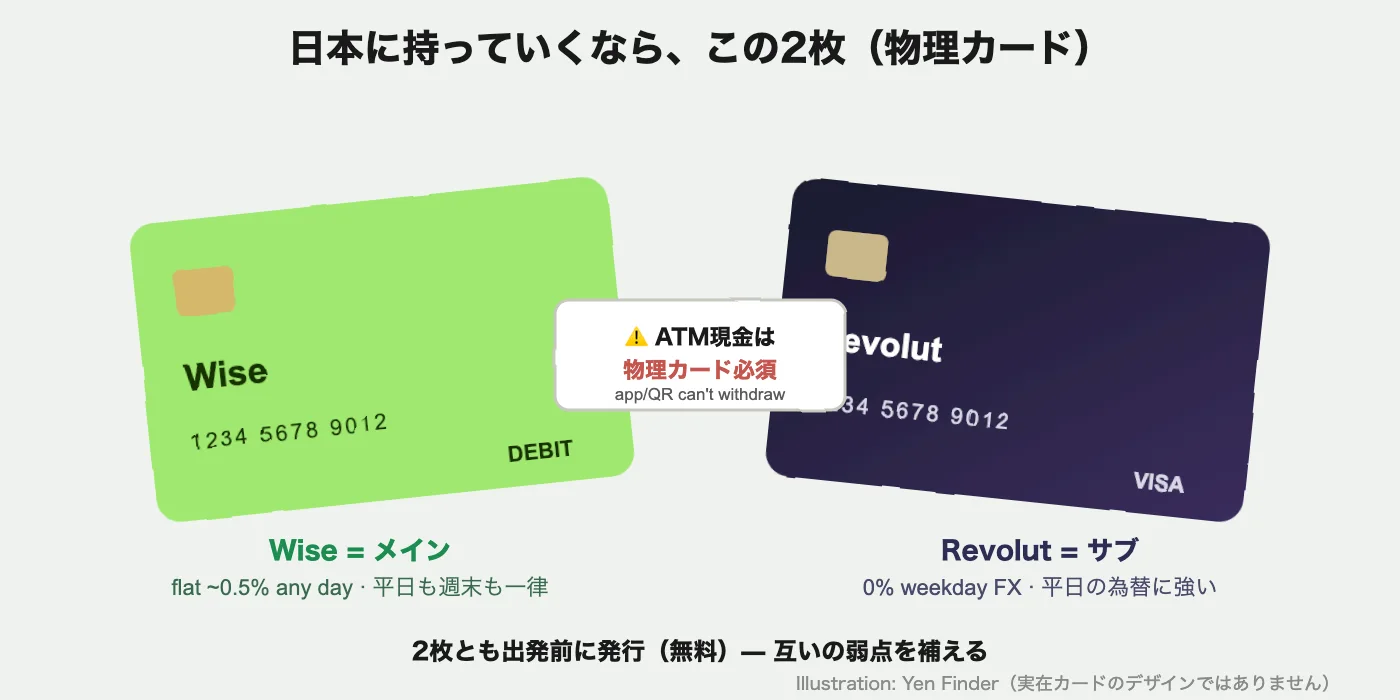
Wise (green) and Revolut physical cards side by side — Wise as the everyday main card, Revolut for weekday FX; both physical cards needed for ATM cash

Wise: main card (daily spend + ATM withdrawals, flat ~0.5% any day)
Revolut Standard: secondary (0% FX on weekdays; mind the 1% weekend markup)
- Use Revolut for weekday spending inside its free ATM allowance
- Lean on Wise for weekends and once you pass the allowance
- Order BOTH physical cards before you fly — cash at Japanese ATMs needs the plastic, not the app
- Buy travel insurance separately

💳 Bring both — they're free to get and cover each other's weak spots:

👉 Get a Wise card free — best for everyday spend, any day of the week →

👉 Open Revolut — best for 0% weekday FX →

All-in cost: ¥600/month on Wise alone, or ¥600/month combined (card fee) + travel insurance separately.

What to do when cards don't work

Street stalls, shrines, admission fees, old restaurants (80% cash)

→ Carry a little cash (¥3,000-¥5,000/day)

Some regional taxis (30% cash-only)

→ Book through GO / Uber and prepay on card

100-yen shops and coin laundries

→ Often coin-only — keep a few ¥100 and ¥500 coins on you (a coin laundry run is ¥500-1,200, not fifty coins' worth)

Temple and shrine offerings

→ ¥5 and ¥10 coins (auspicious)

Should you bring a home-country card?

Yes, at least one. Reasons:

  1. Emergency backup (if Wise / Revolut freezes your account)
  2. Flight and hotel re-verification (card matching)
  3. Long-lead bookings (anything booked 1+ month before departure)
  4. Cards with built-in travel insurance (auto-attached coverage)

But don't actually swipe it in Japan (1.5-3% FX fee).

Best card by country

Visitors from the US

Card Verdict
Wise Recommended main card
Charles Schwab Visa Debit ATM fees rebated
Bank of America card 3% foreign transaction fee
Chase Sapphire Reserve Built for travel miles

Visitors from Korea

Card Verdict
Wise Recommended main card
Hana Bank Trip Card Travel-focused
KB International 1.5% foreign transaction fee

Visitors from China

Card Verdict
AlipayHK Strong Japan support
WeChat Pay Same
UnionPay Visa Variable foreign transaction fee
Wise Works across Greater China too

Visitors from Taiwan

Card Verdict
Wise Recommended main card
CTBC Bank Japan-trip card Dedicated product

Things to watch when paying

Watch out for DCC (Dynamic Currency Conversion)

  • Pick "Japanese Yen (JPY)" at the terminal
  • Picking "pay in US dollars (USD)" adds a 3-7% fee on top

→ Details: #12 Avoiding DCC

Apple Pay / Google Pay setup

  • Suica works on iPhone XS+ and Pixel 4+
  • Before you fly, test at a chain store or convenience store
  • Details: #74 Adding Suica on iPhone

Loss and theft

□ Save every card number in an encrypted phone note
□ Check balances daily in-app
□ Prefer contactless / IC-chip taps (anti-skimming)
□ Leave a spare card in the hotel safe

FAQ

Q: Wise or Revolut — if I can only pick one?

A: Long trip with more than ¥1,500/month in fees → Wise, short trip under ¥1,500/month → Revolut Standard. Details: #15 Comparison

Q: Travel insurance via card, or buy separate?

A: Revolut Premium / Amex Platinum bundle it. Wise has none → buy separately (World Nomads, Allianz).

Q: Will foreign-issued cards work at Japanese hotels?

A: Visa / Mastercard / JCB / Amex are all fine. Hotels do place a temporary $200-300 deposit hold at check-in (released at check-out).

Q: Can I use multiple cards at the same convenience store ATM?

A: Yes. Cycling through Wise + Revolut + your home card lets you pull ¥100,000+ in a single day.

Q: What's the contactless cap?

A: IC chip + no PIN = up to ¥10,000 on most cards. Above that, insert the IC and enter a PIN.

Q: Do I need a PIN? (the trap that locks foreign cards)

A: Yes — set and memorize a 4-digit PIN on every card before you fly. Japanese payment terminals and Seven Bank ATMs require a 4-digit PIN for anything over the tap limit. Cards that are signature-only at home, or whose PIN you've never used, get declined or locked here — and you can't fix it on the spot. Check each card's PIN in your banking app now, not at the register.

Related articles

  • #15 Wise vs Revolut vs bank cards
  • #66 Wise card Japan review
  • #67 Revolut vs Wise
  • #4 Cash vs card in Japan
  • #96 Cash vs card vs Wise — the real cost

Last verified: 2026-05-20. Card terms shift year-over-year. Confirm the latest with the issuer before signing up.

💡 Recommended tools[Sponsored]
  • Get a Wise card ↗

    Mid-market rate −0.5%, no hidden markup. Saves ~¥6,000 on a $1,500 trip.

  • Get a Revolut card ↗

    Zero FX inside the monthly free allowance. Best for short trips.

  • Book on Klook ↗

    Pre-book JR passes, theme-park tickets, and tours. Skip the ticket-counter queues on arrival.

  • Book on KKday ↗

    Taiwan-based Asia tourism marketplace. Compare prices side-by-side with Klook for JR Pass, USJ, onsen, and experience tours.

  • Book on Agoda ↗

    Asia-strong hotel booking site. Skip the hotel-desk exchange counter and book card-accepting properties directly.

  • Book a Japan stay on Jalan ↗

    Recruit's hotel booking site. One of Japan's largest inventories, especially strong on onsen ryokan and regional inns.

  • Book Japan hotels on AirTrip ↗

    Japan hotel inventory from business class to resort, with strong same-day availability.

Related articles

  • Wise vs Revolut vs your bank: a 3-way fee comparison for a Japan trip
    Wise vs Revolut vs your bank: a 3-way fee comparison for a Japan trip ⚡ 30-Second Answer: Short trips = Revolut Standard (free tier covers it), Long/large = Wi
  • Wise card in Japan: ultimate 2026 review with real usage data
    Wise card in Japan: ultimate 2026 review with real usage data ⚡ 30-Second Answer: Wise Debit Card is the optimal choice for Japan. Mid-rate + 0.5% fixed (lowes
  • Revolut vs Wise in Japan in 2026: which fintech card actually wins for travelers?
    Revolut vs Wise in Japan in 2026: which fintech card actually wins for travelers? ⚡ 30-Second Answer: Revolut vs Wise = use both strategically. Wise wins on tr
  • Cash vs card in Japan in 2026: which actually gives you more yen?
    Cash vs card in Japan in 2026: which actually gives you more yen? ⚡ 30-Second Answer: The "cash ¥20,000-30,000 + Wise/Revolut card" hybrid is the gold standard
  • Cash vs card vs Wise: a 3-way breakdown using real Japan trip receipts
    Cash vs card vs Wise: a 3-way breakdown using real Japan trip receipts ⚡ 30-Second Answer: Japan travel money breakdown: cash vs card vs Wise = ①cash ¥20-30K (
  • Best Singapore Credit Cards for Japan Trip 2026 — DBS, Citi, UOB, OCBC Compared
    Best Singapore Credit Cards for Japan Trip 2026 — DBS, Citi, UOB, OCBC Compared ⚡ 30-Second Answer: For a Singapore→Japan trip in 2026, the optimal card stack

Subscribe to the weekly digest (free, unsubscribe anytime).

Email used for the newsletter only. Never shared.

Last verified: 2026-05-20