SponsoredThis article contains affiliate links. We may earn a commission when you sign up through them, but our recommendations and editorial stance are not influenced by the partnerships.
Contents📖 ~6 min read
EUR to JPY in Tokyo: Complete Currency Exchange Guide 2026 — European Traveler Edition
⚡ 30-Second Answer: EUR → JPY in Tokyo: fewer acceptance points than USD. Best: downtown specialist counters (Shinjuku-West/Ikebukuro) at roughly mid −1% to −2.5%, varying by shop and day. Wise/Revolut from a EUR balance ≈ mid −0.5% (published fee), the most predictable option. €500 via ATM saves real money vs the airport. Rates move daily — check the live rate before you go (only World Currency Shop is live-tracked here).
Quick Reference
Value
Best exchange
Downtown counters (Shinjuku-West/Ikebukuro), roughly mid −1% to −2.5%
Worst
Airport / hotel (roughly mid −3% to −7%)
Wise/Revolut ATM
≈ mid −0.5% + ¥220 fee (most predictable)
Last verified
June 2026
European travelers arriving in Tokyo with euros (EUR) face two challenges that USD holders don't: fewer shops accept EUR, and rates tend to be slightly worse. This guide breaks down the best strategy for converting EUR → JPY in Tokyo, covering how EUR differs from USD, which shops to use, and the best alternatives.
TL;DR — EUR in Tokyo, the Bottom Line
Amount
Recommended option
Why
Under EUR 100 (emergency)
Airport counter is OK
Small amount, actual loss only EUR 4-6
EUR 100-500
Major exchange shops near Shinjuku West Exit
EUR-friendly shops with city-center rates (check the live rate)
EUR 500-1,500
ATM via Wise / Revolut card
Withdraw JPY from your EUR balance at about mid-market −0.5% (published fee)
Over EUR 1,500
Split across multiple visits + city-center shops
Per-transaction limits apply at many shops
Tip: On EUR 500, a several-percent rate gap between the airport and a downtown counter can cost you the equivalent of one night at a Tokyo business hotel. Check the live rate before you decide where to change.
Factor 1: EUR Exchange Spots in Tokyo
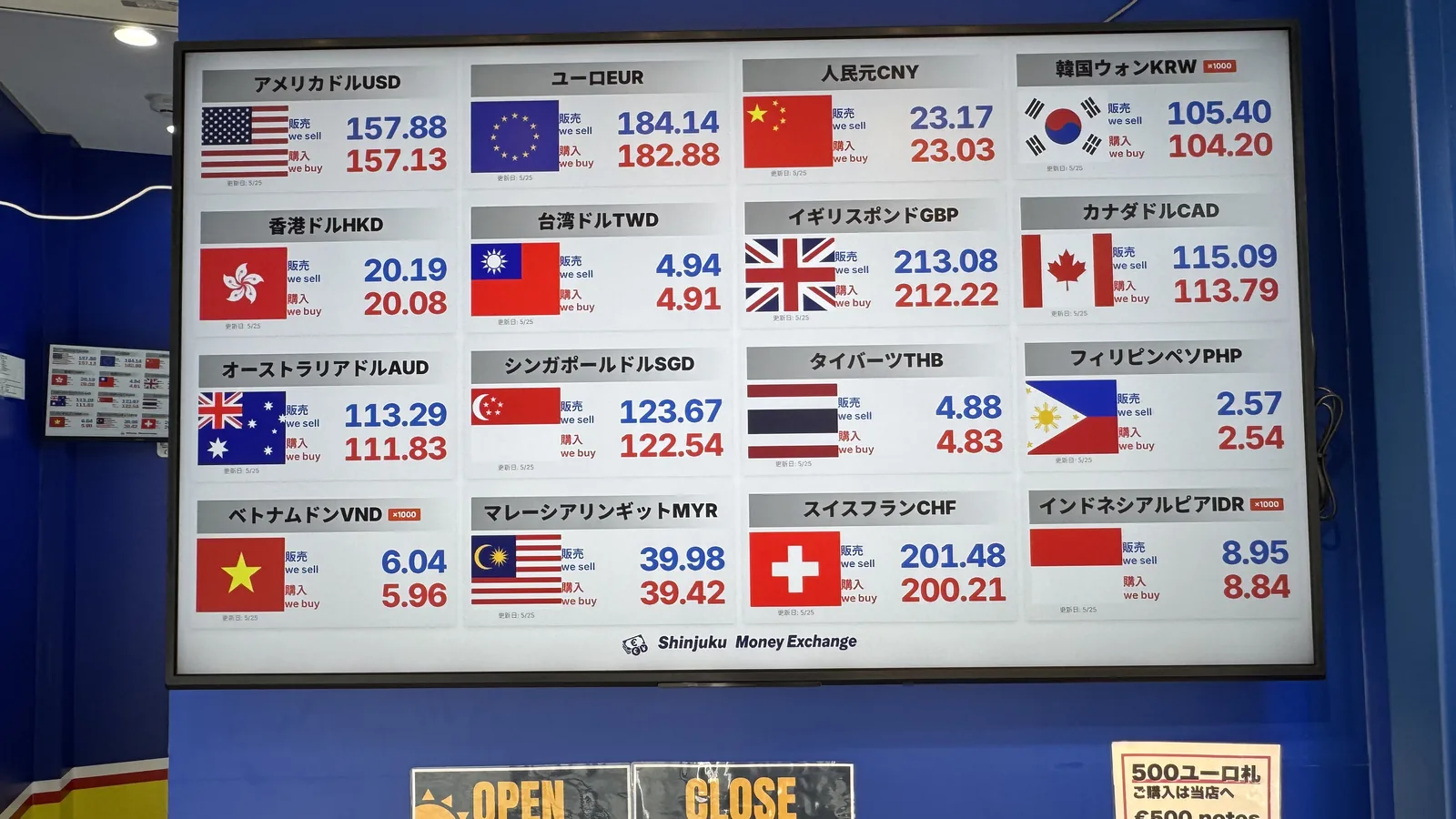
The reality: fewer shops handle EUR compared to USD. The trick is to look for shops that explicitly advertise "Yes, we accept EUR" on their signage.
Area
Representative shops
Handles EUR
Rate competitiveness
Shinjuku West Exit
World Currency Shop, etc.
Yes
Green: roughly mid −1% to −2.5%
Shibuya
Major exchange shops
Yes
Green: roughly mid −1% to −2.5%
Ginza / Yurakucho
Travelex / Daikoku
Yes
Yellow: roughly mid −2% to −3%
Haneda Airport (HND)
Travelex / SMBC, etc.
Yes
Red: roughly mid −3% to −6%
Narita Airport (NRT)
Major exchange operators
Yes
Red: roughly mid −3% to −6%
Ikebukuro / Ueno
Smaller exchange shops
Varies by shop
Check in advance
Expect EUR rates to run a touch worse than USD as standard, and note that the exact spread varies by shop and by day — the figures above are indicative ranges, not guarantees. Only World Currency Shop is live-tracked on Yen Finder, so check the live rate before you go. There are no EUR-only specialist shops, so the rule of thumb is to pick a city-center shop that handles both USD and EUR.
Factor 2: Why Wise / Revolut Win for EUR
EUR is the currency where Wise and Revolut shine most:
Item
City-center exchange (Shinjuku)
Wise / Revolut card
EUR → JPY rate
roughly mid −1% to −2.5% (varies)
≈ mid −0.5% (published fee)
Time spent finding EUR-friendly shop
30+ minutes
None (just one card)
Per-transaction cap
None
¥30,000-100,000/withdrawal
ATM fee
¥0
¥220/withdrawal
Wise/Revolut withdrawals land at about mid −0.5% (the published fee) plus the ¥220 ATM fee, which is the most predictable cost of any option here. For EUR 1,000 withdrawn through Wise, once you factor in travel time and shop opening hours, Wise / Revolut is far more convenient than hunting for a city-center shop. If you live in Europe, you probably already have a Wise EUR account, so there's no extra prep work.
Factor 3: The DCC Trap — Watch Out Especially with EUR
When paying with a EUR-denominated credit card, you'll sometimes be asked: "Would you like to pay in EUR or JPY?" Choosing EUR costs you 3-7% extra.
Always choose JPY. This matters even more for cards issued in Italy, France, or Spain, where DCC tends to be the default suggestion. That split-second answer at the register makes a real difference. For details, see #12 How DCC Works.
Comparison Axis 5 — Which kind of EUR traveler are you?
Pick the row that matches you, then use the axes above for the details.
If you're...
Best EUR move in Tokyo
Why
Changing €500+ in daytime
A Shinjuku West Exit shop (e.g. World Currency Shop)
Top EUR cash rate (roughly mid −1% to −2.5%); the saving outweighs the trip
A budget traveler pulling small amounts
A Wise/Revolut card at a 7-Eleven Seven Bank ATM
Near mid-market (≈ mid −0.5%), 24/7, ~¥220/withdrawal
Just landed, need a little cash now
Exchange only ~¥10,000 at the airport
Airport runs roughly mid −3% to −6%; cap it, do the rest downtown
Holding a 0%-FX EUR credit card
Tap to pay and always choose JPY (never DCC)
DCC costs 3-7%; you barely need cash
Unsure a shop even takes EUR
Stick to a city-center shop that lists EUR; or just use Wise
Q: Which is easier to exchange in Japan, USD or EUR?
A: USD wins easily — more shops accept it, and rates are better. EUR is a major reserve currency within Europe, but in Japan it doesn't have anywhere near the coverage that USD does.
Q: Can I exchange EUR at a bank?
A: Yes, but bank counters at MUFG, SMBC, and others give you roughly mid −2% to −3%, which is typically worse than a good city-center exchange shop.
Q: Are EUR 100 notes or EUR 20 notes better?
A: It depends on the shop. Larger notes sometimes get a slightly better rate. EUR 500 notes are increasingly being refused due to counterfeit concerns, so it's best not to bring them.
Q: Should I convert leftover yen back to EUR before flying home?
A: Converting JPY back to EUR costs another 5-7%. Smarter options: use Pocket Change (airport kiosks) to convert into e-money or Amazon gift cards, or save the yen for your next trip.
Q: What if I'm from outside the Eurozone (UK or Switzerland)?
A: GBP and CHF have even fewer exchange options. For Swiss francs, head to the major shops at Shinjuku West Exit or Travelex in Ginza — those are your safest bets. The same applies to GBP. With a Wise or Revolut card, you stay near the mid-market rate (about mid −0.5%, the published fee) regardless of source currency, which is the biggest advantage.
Editorial info: Yen Finder Editorial / photographed 2026-05-24 / last verified 2026-06-03. Rates and operating details are based on official information from each shop. Exchange rates fluctuate constantly, so please confirm the final rate at the counter before transacting.