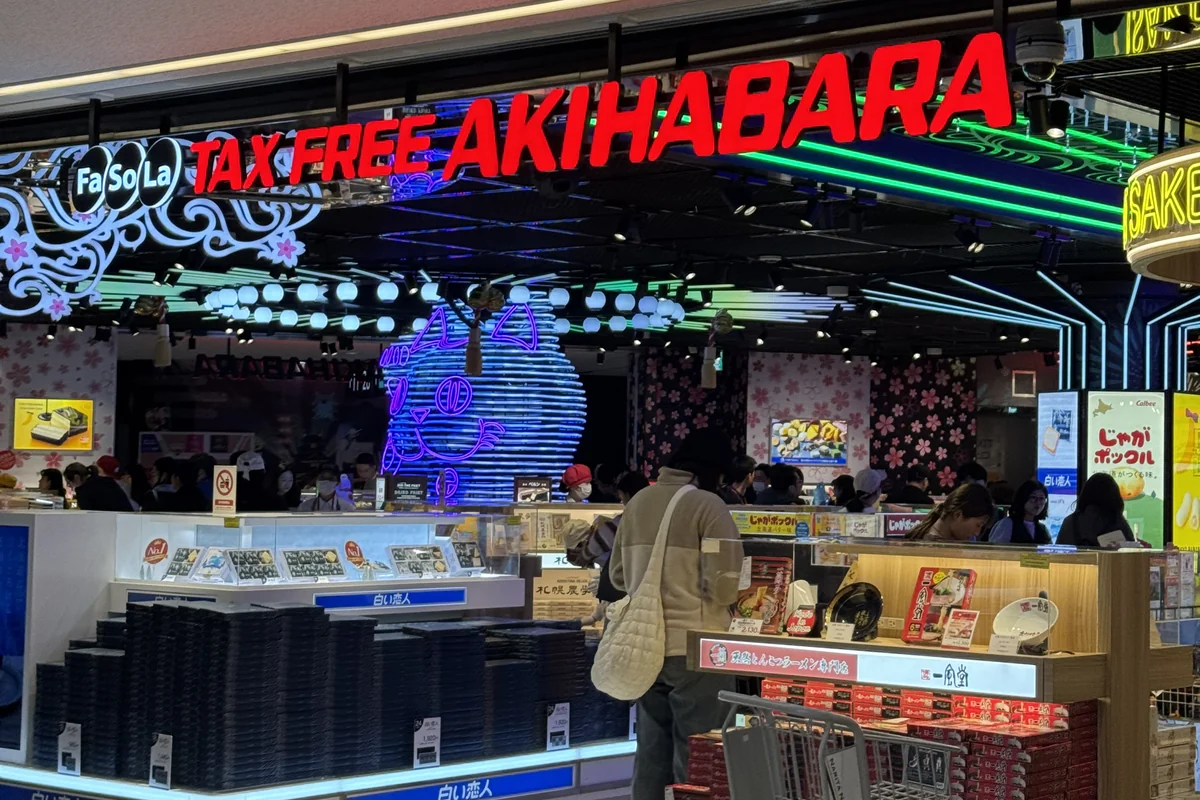
Tax-free shopping in Japan in 2026: 5-minute walkthrough for foreign tourists
⚡ 30-Second Answer: Foreign tourists exempt from 10% consumption tax at certified stores when spending ¥5,000+ same-day same-store. Requires passport. General goods (electronics, clothes) must leave Japan within 6 months. Consumables (cosmetics, food) sealed and unopened. Refund processed at in-store counter, all payment methods accepted.
Quick Reference
Value
Requirements
¥5,000+ same-day same-store + passport
Tax exempted
Consumption tax 10%
General goods
Take out of Japan within 6 months
Consumables
Sealed bag, no opening
Last verified
June 2026
✓ Last verified: Jul 2026
📖8 min read
SponsoredThis article contains affiliate links. We may earn a commission when you sign up through them, but our recommendations and editorial stance are not influenced by the partnerships.
Contents📖 ~9 min read
Foreign tourists in Japan can buy items free of the 8–10%
consumption tax at certified retailers, on purchases of ¥5,000 or
more at a single store on the same day, by presenting their
passport at the time of purchase. The system is straightforward
once you've done it once, and applies to electronics, clothing,
souvenirs, cosmetics, and food alike. This guide walks through the
process, the rule changes shipping in 2025–2026, and the practical
strategies to maximize savings without paperwork pain.
TL;DR
Buy ≥¥5,000 worth at a tax-free certified retailer on the
same day, present your passport, sign a short form.
Save 10% on most items, 8% on some food and drinks.
Two categories: general goods (electronics, clothing — keep
the receipt, can use in Japan) and consumables (cosmetics,
food — sealed bag, must export within 30 days).
Major change starting late 2026: shift to a "refund-on-
departure" model at airports, replacing the current
point-of-sale exemption. Pay attention to which model your
purchase uses.
Who qualifies for tax-free shopping in Japan?
You qualify if you are:
A non-resident foreign tourist on a "Temporary Visitor" visa
(the standard tourist stamp from immigration)
In Japan for less than 6 months
Buying items for export (i.e., taking them out of Japan)
Carrying your passport at the time of purchase
You don't qualify if you are:
A foreign resident with a long-term visa
A Japanese citizen, even one living abroad
Buying items to be left behind in Japan as gifts to residents
Without your passport in hand at the time of purchase
The passport requirement is firm — you cannot apply for the refund
later, even with the receipt.
Where can I shop tax-free?
Look for the "TAX-FREE SHOP" sticker in the window or near the
register. Certified retailers include:
All major department stores — Mitsukoshi, Matsuya, Daimaru,
Takashimaya, Isetan, Sogo
Approximately 50,000+ retailers are certified nationwide. In
practice, almost every store frequented by foreign tourists is.
What's the actual process at the register?
⚠️ Note for 1 November 2026: the flow below is the current system, valid through the end of October 2026. From 1 November the country moves to a refund method — you pay the tax-included price at the register and receive the consumption tax back after customs confirms export on departure. See Japan's November 2026 tax-free change.
The flow takes 3–5 minutes:
Reach the threshold — buy ≥¥5,000 worth of qualifying goods
from one retailer on the same day. Multiple items can be
combined.
Tell the staff "tax-free" when you reach the register.
Present your passport — the staff will scan or photocopy it.
Sign the agreement form — confirms you'll export the items.
Pay the tax-excluded price — the discount applies at the
register; no separate refund visit needed.
Receive the receipt and tax-free purchase record, which is
stapled to your passport (or stored electronically since 2024).
That's the full process. The receipts and record are checked at
your departure point — keep them safe.
The bottom line: the entire tax-free shopping process
is now electronic for most certified retailers — Japan
switched the system to digital records in 2021,
eliminating the paper-stapled-to-passport step at most stores.
What's the difference between general goods and consumables?
The two categories have different rules:
General goods (一般物品)
Electronics, clothing, accessories, watches, jewelry, leather
goods, etc.
Threshold: ¥5,000 or more at one store on the same day
Can be used in Japan before export
Must export within 6 months
No special packaging required
Consumables (消耗品)
Cosmetics, food, beverages, alcohol, tobacco, medicines, etc.
Threshold: ¥5,000–¥500,000 at one store on the same day
Sealed in a special bag that must not be opened until you've
left Japan
Must export within 30 days
Cannot be used in Japan after purchase
A single store can combine both categories on the same receipt;
each is calculated separately.
Subscribe to the weekly digest (free, unsubscribe anytime).
Email used for the newsletter only. Never shared.
Last verified: 2026-07-27
What rule changes are coming in 2025–2026?
Japan's tax-free system is undergoing its biggest change since
introduction. The current point-of-sale exemption model is being
replaced by a refund-on-departure model:
Aspect
Current (until late 2026)
New (2026 onwards)
When discount applies
At the register, paying tax-free price
Pay full price at register, refund at airport
Verification
Passport scan at register
Passport scan + customs check at departure
Refund method
Immediate (no refund needed)
Credit card refund or cash at airport
Risk to retailer
If tourist doesn't export, retailer pays back
Customs verifies; retailer protected
The main practical impact: starting late 2026, you'll pay full
price upfront and recover the tax at the airport before flying
home. This adds a small step on departure day but eliminates some
abuse cases the current system has seen.
For 2026 trips, the current point-of-sale system is still in
place — confirm at the time of purchase which system applies.
No. You can pay by cash, credit card, debit card, Alipay,
WeChat Pay, UnionPay — all qualify for tax-free treatment as
long as you meet the other criteria. The discount comes off the
same way regardless.
That said, since the discount is the same, the right payment
question becomes: which method costs you the least in FX/fees?
For nearly all foreign tourists in 2026, the answer is a
no-FX-fee card (Wise, Revolut, Capital One, Schwab) — see
article #4 for the full reasoning.
What if I want to combine purchases across multiple stores?
You can't combine across stores. The ¥5,000 threshold applies
per retailer per day. So:
Buying ¥3,000 at one store and ¥3,000 at another = no tax-free
on either
Buying ¥3,000 at a store, then ¥2,500 more at the same store
later that day = qualifies (combined receipt)
Big stores get this advantage: a department store like Mitsukoshi
treats the entire building as one retailer for tax-free purposes,
so combining purchases across multiple departments works.
What's the minimum I need to save to make it worth it?
The tax rate in 2026 is 10% on general goods and 8% on
food/drink. So:
¥5,000 minimum purchase = save ¥500 (general) or ¥400 (food)
¥10,000 = save ¥1,000 / ¥800
¥50,000 = save ¥5,000 / ¥4,000
¥100,000 = save ¥10,000 / ¥8,000
The 3-minute paperwork pays for itself even at the minimum
threshold. Skip tax-free only if you're under ¥5,000 — that's the
only scenario where it doesn't apply.
What this means for your trip
✅ Bring your passport everywhere shopping — it's the only
way to qualify.
✅ Aim for ≥¥5,000 per store per day when possible; combine
small purchases.
✅ Keep all tax-free receipts until you leave Japan — customs
may inspect.
✅ Don't open the sealed consumables bags until after you've
passed Japanese customs on departure.
✅ Pay by no-FX-fee card for the FX-cost win on top of the
tax savings.
⚠️ Confirm the current vs new system at the register if
shopping in late 2026 — the model is changing.
⚠️ Don't try to claim tax-free as a Japanese resident or with
a long-term visa — checked at the border.
Frequently asked questions
Can I claim tax-free for items I'll use during my trip?
For general goods (electronics, clothing, accessories): yes,
you can use them during your trip and export afterward. For
consumables (cosmetics, food, drink): no, the sealed bag must
remain unopened until you leave.
What if I buy a ¥10,000 item but my flight is in 7 months?
General goods need export within 6 months. If you bought after
that window or your flight is delayed beyond 6 months, you may
owe back the tax — file with Japan Customs.
Do I get the tax back at the airport on departure?
Under the current system: no separate refund — the discount was
applied at the register. Under the new system (post-late-2026):
yes, refund at the airport. Both systems will run in parallel for
some time during the transition.
Can I split a purchase to hit the ¥5,000 threshold?
Yes, as long as the splits are at different stores. At a single
store, the threshold applies to the total same-day spend.
What about second-hand stores or markets?
Second-hand stores (Hard Off, Book Off, used kimono shops, etc.)
typically aren't tax-free certified, even when they cater to
tourists. Check for the "TAX-FREE SHOP" sticker before assuming.
Are duty-free at the airport and tax-free in stores the same thing?
No. Airport "duty-free" is a separate scheme tied to leaving the
country (no consumption tax + no import duty). In-store tax-free
is just consumption-tax exemption. Both are real, but they're
different systems with different paperwork.
What happens if customs at departure asks to see my purchases?
Show them in the original sealed bags (consumables) and original
condition with receipts (general goods). Customs may pull random
spot-checks; if your items can't be verified, you may be required
to pay the tax. Standard practice is fine; just keep the receipts
until you've passed through.
Check today's real rates on Yen Finder
Yen Finder doesn't process tax-free purchases directly, but
the Tips tab links to certified-retailer locator tools and
the official JNTO tax-free portal.
Use the Map tab in shopping districts (Ginza, Shinjuku,
Akihabara) to locate the closest tax-free certified stores.
Last verified 2026-05-07. The Japanese government is implementing
a major change to the tax-free shopping system in late 2026 — the
new "refund-on-departure" model will replace the current
point-of-sale exemption. Check Japan Customs
for the current state on your travel dates.