⚡ 30-Second Answer: Osaka = Kansai's largest city, with 88% card acceptance. Exchange clusters in two hubs: Umeda = WCS Osaka Ekimae Daisan Building (mid −1 to −1.5%, the cheapest in Kansai) / Namba = OCAT 1F WCS (mid −1.5%). After 19-20:00 it's Smart Exchange machines + 7-Eleven ATMs. ¥20,000-30,000 cash + Wise/Revolut covers the rest. Takoyaki stalls + Dotonbori carts = cash only.
Quick Reference
Value
Umeda best
WCS Osaka Ekimae Daisan Bldg (−1 to −1.5%)
Namba best
OCAT 1F WCS (−1.5%)
24h ATM
7-Eleven Umeda + Namba
Cash needed
¥20,000-30,000
Card acceptance
88%
Last verified
June 2026
✓ Last verified: Jun 2026
📖7 min read
SponsoredThis article contains affiliate links. We may earn a commission when you sign up through them, but our recommendations and editorial stance are not influenced by the partnerships.
The complete pillar guide for handling money in Osaka, one page. After Tokyo, Osaka has Japan's strongest currency exchange market. Good USD, EUR, and CNY rates cluster across three zones: Umeda (around Osaka Station), Namba / Shinsaibashi (Dotonbori shopping district), and Tennoji (south). USD rates trail Tokyo by only 0.3-0.5%, and via Kansai International Airport the market for KRW, CNY, and TWD often matches or beats Tokyo.
This page covers the arrival in Osaka → stay → onward travel to Kyoto and Kobe money flow across 6 axes.
TL;DR — your no-stress Osaka money playbook
Cash to carry: ¥10,000-15,000/day per person (Dotonbori street food, small izakaya, shrine offerings)
Best exchange: WCS Osaka Ekimae Daisan Building, or Namba OCAT 1F WCS, mid-market −1.5%
Best ATM: Umeda / Namba 7-Eleven Seven Bank ATMs 24/7; with Wise/Revolut, mid-market
Hotels: Umeda is business, Namba mid-range, Shinsaibashi / Dotonbori luxury. Compare Rakuten Travel / Agoda / Jalan / JTB
The hub where JR Osaka + Hankyu + Hanshin + Osaka Metro all cross. Exchange shops concentrate at WCS Osaka Ekimae Daisan Building, Hilton basement, and Hankyu Sanbangai. Office-heavy area with strong card acceptance.
Namba / Shinsaibashi / Dotonbori (South)
Tourism, shopping, and food central. Namba Parks, NAMBA CITY, Shinsaibashi-suji shopping arcade, Dotonbori Glico sign area. Street food, standing bars, and traditional izakaya run on 80% cash.
Tennoji / Abeno (further south)
Abeno Harukas and Tennoji Zoo zone. Few exchange shops, ATMs mostly in konbini.
Which kind of traveler are you in Osaka?
Osaka's money setup shifts with how you travel and where you'll spend. Find your row.
If you're…
Osaka money move
Why
A Dotonbori / street-food first-timer
Carry ¥15,000–¥20,000 cash; tap card only at chains
Street stalls, standing bars and izakaya run ~80% cash here
Carrying a Wise or Revolut card
Pull yen at a Umeda or Namba Seven Bank ATM, skip counters
Near mid-market, 24/7; Osaka counters can't beat it
Doing a big exchange in daytime
WCS Osaka Ekimae or Namba OCAT
The two transparent counter hubs; avoid the airport rate
Based in Umeda for business
Card-first; small cash buffer
Umeda is office-heavy with strong card acceptance
On a Kansai day-trip from Kyoto/Nara
Sort cash before you come; Tennoji/Abeno is thin on counters
Few exchange shops south; rely on konbini ATMs
2. Exchange — Umeda and Namba OCAT are the two hubs
🧭 Finding the #1 shop is half the battle. WCS Osaka Ekimae Daisan Building has the best rate in Kansai, but the Umeda underground (Whity Umeda, the Daisan/Daini/Daiichi building maze) is even more confusing than Shinjuku. If you get lost underground, surface at street level once and walk to the building above-ground with Google Maps — far faster than trying to thread the basement.
4. Card strategy — Dotonbori is the cash-80% exception
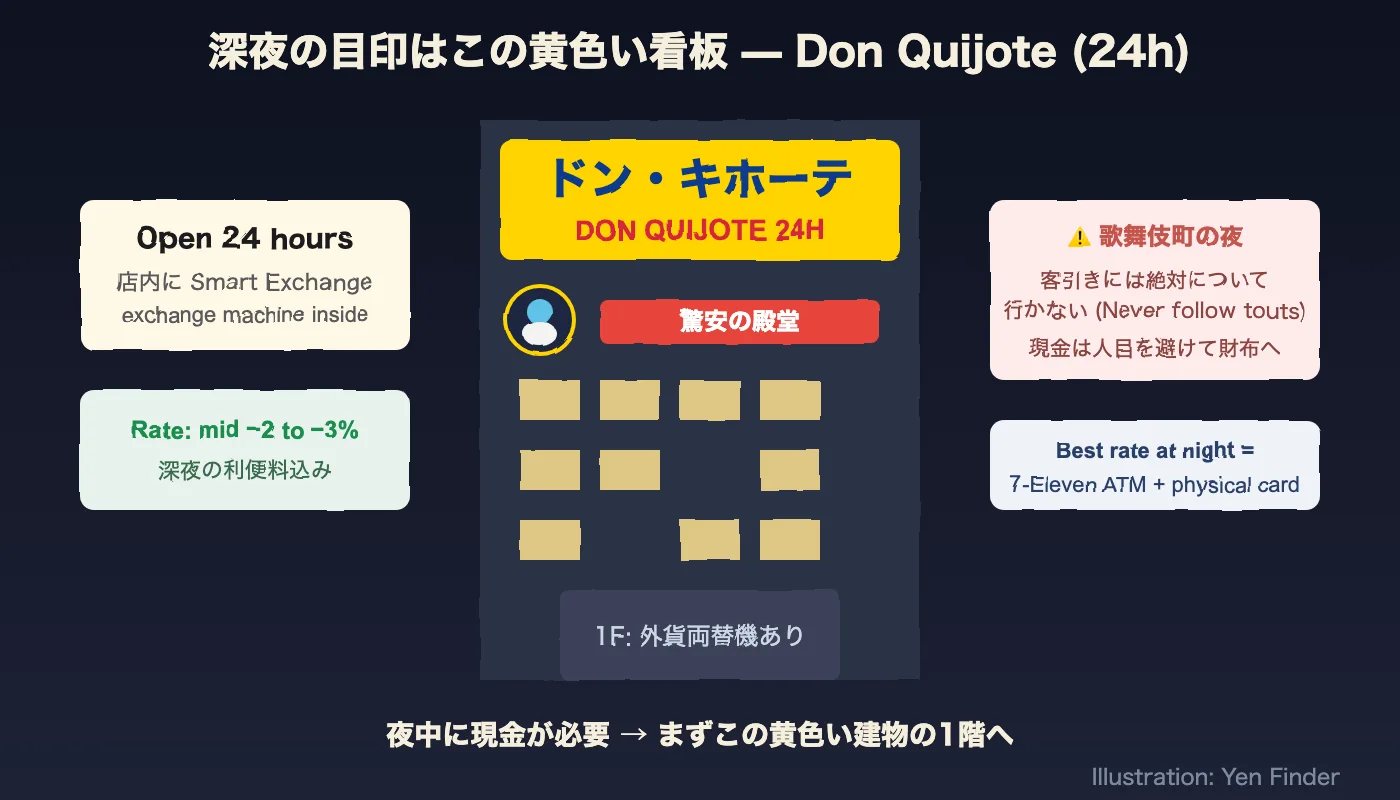
The takoyaki and kushikatsu stalls along Dotonbori are genuinely
cash-first — keep ¥5,000-10,000 in small notes on you here. The
nearest reliable top-up is the 24-hour Don Quijote with its
in-store ATM (the one with the Ferris wheel on the canal); a
Seven Bank ATM with your physical card gives the better rate.
For inbound travelers, Agoda has the most familiar interface and the widest English-language inventory across all four Osaka zones — and free cancellation on most rooms.
Q: How big is the Tokyo / Osaka exchange rate gap?
A: Osaka trails Tokyo by 0.3-0.5%. On $500, that's ¥225-375. No reason to backtrack to Tokyo just to exchange.
Q: Run out of cash mid-Dotonbori?
A: FamilyMart ATM in front of the Glico sign, or any 7-Eleven toward Amerikamura — both 5 minutes away. Better to withdraw ¥10,000-20,000 up front.
Q: Should I exchange at Kansai International Airport?
A: Up to ¥10,000 is fine (for train fare home). Anything more — wait until Umeda or Namba WCS. Airport rate is mid −5 to −7%.
Q: Are Osaka → Kyoto / Kobe transit cards accepted?
A: JR, private rail, and metro all accept IC cards — Apple Pay Suica / PASMO / ICOCA all tap through. One 2026 gotcha: issuing or topping up ICOCA (or Suica) in Apple Wallet often fails with a foreign-issued Visa — Mastercard and Amex go through far more reliably. If your Visa is rejected, just charge the card with cash at any station ticket machine.
Q: Cheapest way to buy USJ tickets?
A: Official and Klook are usually price-matched. Klook's QR-on-phone instant delivery is the practical win for skipping the box office.