Old and new yen notes in 2026: are pre-2024 banknotes still legal tender, and what changed in the redesign?
⚡ 30-Second Answer: Old ¥10,000 (Fukuzawa) / ¥5,000 (Higuchi) / ¥1,000 (Noguchi) are still in active circulation, accepted everywhere. The 2024 series (issued July 3, 2024: Shibusawa ¥10,000, Tsuda ¥5,000, Kitasato ¥1,000) circulates alongside them, not instead of them. Even older generations (Shotoku Taishi, Soseki) aren't legally retired but are hard for a visitor to swap. The only friction in 2026 runs the other way: a meaningful share of independent vending machines and small ticket machines still can't read the new notes — feed them your old ones.
Quick Reference
Value
Old ¥10,000 Fukuzawa / ¥5,000 Higuchi / ¥1,000 Noguchi
Legal, but keep as souvenir or sell to a collector
Last verified
September 2026
✓ Last verified: Sep 2026
📖8 min read
SponsoredThis article contains affiliate links. We may earn a commission when you sign up through them, but our recommendations and editorial stance are not influenced by the partnerships.
Contents📖 ~9 min read
Yes — every Bank of Japan banknote issued since 1885 is still legal tender today. That means the pre-2024 series you might have left over from a previous trip (Fukuzawa Yukichi ¥10,000, Higuchi Ichiyō ¥5,000, Noguchi Hideyo ¥1,000) is fully spendable in 2026. The 2024 redesign (Shibusawa Eiichi ¥10,000, Tsuda Umeko ¥5,000, Kitasato Shibasaburō ¥1,000) is a parallel issue, not a replacement. Banks, ATMs, big retailers, and most stores accept both interchangeably. And here's the 2026 twist most guides get backwards: the friction runs the other way — it's the new 2024 notes that a meaningful share of vending machines and ramen-shop ticket machines still can't read, because operators have been slow to update the hardware. Your old Fukuzawa note is the safer one to feed a machine.
TL;DR
All Bank of Japan notes since 1885 are legal tender — Article 46 of the Bank of Japan Act
Pre-2024 ¥1,000 / ¥5,000 / ¥10,000 are fully spendable in 2026, no exchange needed
2024 redesign (Shibusawa / Tsuda / Kitasato) is in parallel circulation, not replacement
Friction points (reversed): major chains, ATMs, and station ticket machines are now ~100% updated, but a meaningful share of independent/rural vending machines and small ramen-shop ticket machines still reject the 2024 new notes; old notes work almost everywhere
If a shop refuses: deposit at any bank, ATM, or post office to swap into the new design
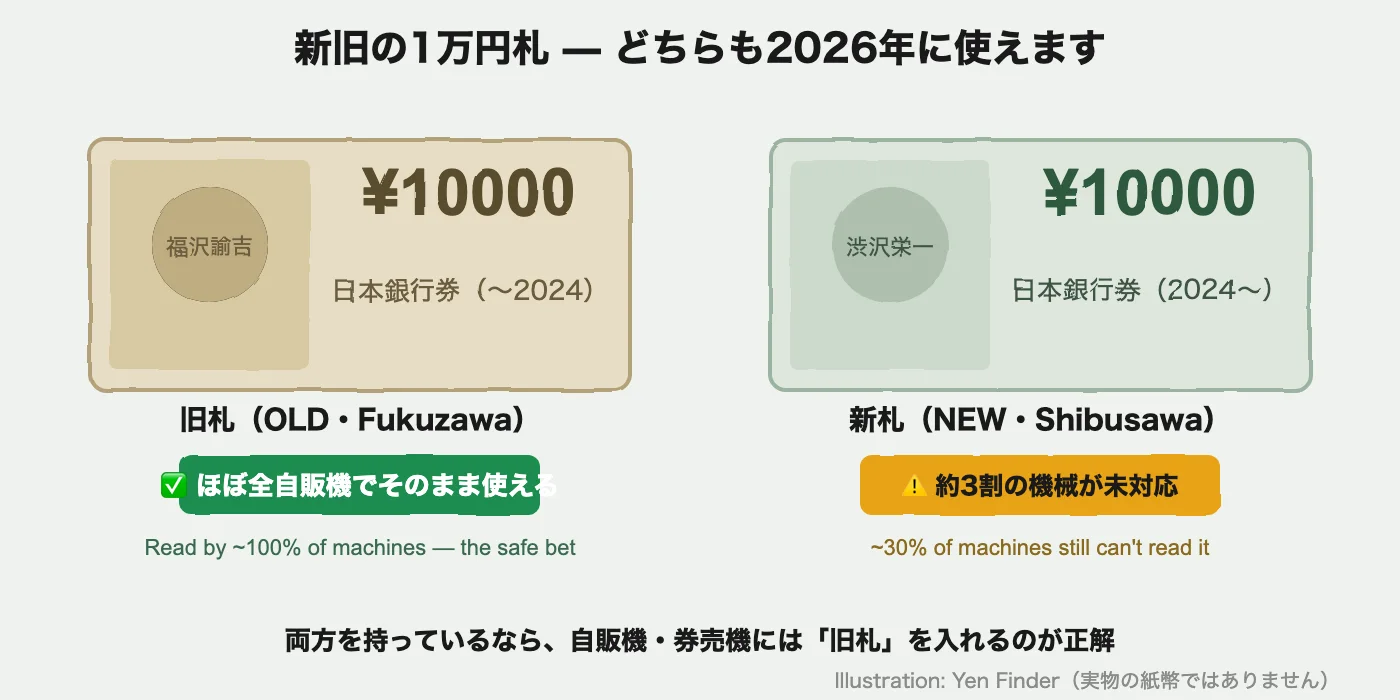
If you've got the Fukuzawa note on the left in your wallet, relax: it spends everywhere in 2026, machines included. Don't rush to swap it for the new Shibusawa note on the right.
The legal basis
Under Article 46 of the Bank of Japan Act, banknotes issued by the Bank of Japan are legal tender "without limit". The Bank of Japan has issued — and as a matter of policy continues to honor — every banknote it has ever issued since the Bank of Japan was founded in 1885. That includes:
Meiji-era convertible notes (1885+)
Early Showa Bank of Japan notes
The 1946 currency reform Yamato-class notes
The 1958–1984 Iwakura/Itagaki/Shotoku series (one famous edge case below)
💡 Got a genuinely old note (Shotoku Taishi ¥10,000, Soseki ¥1,000)? It's still legal tender, but a tourist won't get a Japanese megabank (MUFG/SMBC/Mizuho) to swap it without an account — they mostly decline non-resident counter exchange or charge heavily. Realistic options: a Bank of Japan branch, or simply keep it as a souvenir / sell to a collector (Mercari, eBay) where it may fetch above face value.
The 1984 Fukuzawa series (¥10,000 with Fukuzawa)
The 2004 Fukuzawa-second series (¥10,000 with hologram)
The 2024 Shibusawa series (current design)
Practical exception: pre-1946 wartime currency was demonetized at the 1946 currency reform. Anything you'll plausibly have as a tourist from the last 80 years is fine.
Who is on the new notes, and why the 2024 redesign happened
The new series went into circulation on July 3, 2024. Old and new portraits side by side:
Denomination
Old portrait (2004 series)
New portrait (2024 series)
Colour
¥10,000
Yukichi Fukuzawa
Eiichi Shibusawa
brown (old) / pale blue-grey (new)
¥5,000
Ichiyō Higuchi
Umeko Tsuda
purple
¥1,000
Hideyo Noguchi
Shibasaburō Kitasato
blue
¥2,000
Shureimon gate
unchanged
green
All coins
—
unchanged
—
The ¥5,000 colours barely differ, but the portraits make the two series easy to tell apart. The ¥2,000 note is legal tender but barely printed any more and rarely seen outside Okinawa.
The redesign is not about retiring old notes. The Bank of Japan does a major banknote redesign roughly every 20 years for anti-counterfeiting reasons. The 2024 series adds:
3D holographic portrait — the world's first on a banknote; the face appears to turn as you tilt it
High-definition watermark patterns and a new watermark bar
Microprint upgrades and intaglio printing you can feel
Larger denomination numerals and repositioned tactile marks for the visually impaired
Counterfeit yen is rare to begin with, but the 20-year refresh cycle keeps the security tech ahead of consumer-grade printing technology. Old notes don't become illegal — they just become a known-quantity authentication problem that the new notes solve more elegantly. See article #93 for the counterfeit-yen reality.
Where the old notes work fine (i.e. almost everywhere)
All banks and ATMs: Seven Bank, Japan Post, AEON, FamilyMart e-net, Lawson Bank — every ATM in Japan accepts pre-2024 notes on deposit (and dispenses a mix of old and new on withdrawal as inventory rotates).
All major retailers: convenience-store chains, supermarkets, department stores, drugstore chains, restaurant chains
Train station ticket machines: JR, private rail, subways — all accept old notes
Most independent shops and restaurants: a pre-2024 ¥1,000 in cash is functionally identical to a 2024 ¥1,000 from the staff's perspective
Subscribe to the weekly digest (free, unsubscribe anytime).
Email used for the newsletter only. Never shared.
Last verified: 2026-09-08
Where you might hit friction
Vending machines and ticket machines — and which note to use
Here's the part nearly every other guide gets wrong. Two years after the 2024 redesign, banks, ATMs, convenience-store chains, and station ticket machines are essentially fully updated — but hardware updates are still incomplete at independently-owned beverage vending machines and small-shop ticket machines (ramen counters, etc.), where a meaningful share still cannot read the NEW 2024 notes. Old notes (Fukuzawa, Noguchi) are read by essentially all of them. So:
If you have both, feed the machine your OLD note — it's the one with near-100% acceptance
Don't bother swapping old notes for new before a trip; you'd be trading the reliable note for the occasionally-rejected one
Stuck with only new notes a machine won't take? Try the next machine (newer units read both), use coins (¥100/¥500 always work) or an IC card (Suica/PASMO/ICOCA), which sidesteps cash recognition entirely
The same applies to older coin lockers at tourist spots, laundromat change machines and old capsule-toy machines — station lockers were updated early, the small independent ones lag
For most travellers this comes up zero to two times in a week; carrying a few ¥1,000 notes and ¥100 coins removes the problem entirely
Older QR-payment top-up terminals
A small number of PayPay / au PAY / d-pay cash-top-up terminals (the ones inside some convenience stores) have lagged on 2024-design recognition. Drop the cash into a Seven Bank ATM and load via the bank route instead.
Small countryside shops with old cash registers
Two years on, almost nobody mistakes the 2024 notes for fakes anymore — the real edge case is hardware: an old automatic cash register or coin/change machine that hasn't been updated for the new note's hologram and simply won't feed it through. The fix is the same as the vending machines: pay with your old note, coins, or an IC card. It's a machine limitation, not a refusal.
What if a place actually refuses an old note?
This is genuinely rare, but if it happens:
Don't argue — it's not worth the hassle. Use a different note (try the 2024 design if you have one, or coins).
Deposit the old note at any bank, post office, or Seven Bank ATM. The bank will swap it into new-design notes on your next withdrawal automatically.
Keep one or two old high-denomination notes as souvenirs if you want — they retain their face value forever, no expiration.
Same rule: all Bank of Japan commemorative coins since their issue date are legal tender at face value. So the ¥500 Showa-era commemorative, the ¥1,000 Tokyo Olympic 2020 silver, etc. all spend like normal coins (though numismatic value may exceed face value — don't spend a rare one at a vending machine).
Practical guidance for tourists
Bringing leftover old yen from a previous Japan trip? Spend it normally. Don't bother trying to exchange it for the new design.
About to leave Japan with old yen? It's still worth its face value — convert via Pocket Change, spend at the airport convenience store, or save for your next trip.
Don't pay an exchange fee to swap old yen for new design. Banks do this for free if you ask, or it just happens naturally through normal ATM use.
Frequently asked questions
Will an ATM give me old or new notes?
It depends on the machine's inventory. Seven Bank and the big-bank ATMs now dispense mostly 2024 notes; Japan Post and some others still mix in old ones. Either is fine. The "new notes" option on some bank ATMs means unused, crisp notes, not the 2024 design — ask at a bank counter if you specifically want the new series.
Is the ¥2,000 note still valid?
Yes. It is legal tender, but production has effectively stopped and it rarely circulates outside Okinawa; many visitors keep one as a souvenir.
I have a 1958 Shotoku Taishi ¥10,000 — can I spend it?
Legally yes, but a shop will not recognise it and a megabank will not swap it for a non-resident. Its collector value usually exceeds face value, so check the market before doing anything with it.
What about torn or damaged notes?
The Bank of Japan exchanges damaged notes at full value when at least two-thirds of the note remains, and at half value when between two-fifths and two-thirds remains; less than that is worthless. Shops and machines will refuse a badly torn note, so take it to a bank counter rather than trying to spend it.
Can I exchange leftover yen back to my currency with old notes?
Yes — exchange counters and airport desks accept old and new series alike.
How long will the old notes stay valid?
Indefinitely. The Bank of Japan has no plan to demonetise any post-1946 issue. What may change over the years is machine acceptance, not legality.