The hidden cost of exchanging money at Tokyo's airports (and how a 20-minute detour saves ¥3,000)
⚡ 30-Second Answer: Airport counters are the worst place to exchange (roughly mid −3% to −6%) = where tourists lose their first money. Exchange only ¥5,000-10,000 at airport, the rest downtown. Downtown specialist shops (roughly mid −1% to −2.5%) are several times better, and a Wise/Revolut card via a Seven Bank ATM (about mid −0.5% plus ~¥220) is the most predictable good rate of all.
Quick Reference
Value
Airport rate
roughly mid −3% to −6%
Downtown specialist shops
roughly mid −1% to −2.5%
Travel card via Seven Bank ATM
about mid −0.5% + ~¥220
Airport exchange amount
¥5,000-10,000 only
Last verified
June 2026
✓ Last verified: Jun 2026
📖8 min read
Yen Finder Editorial
SponsoredThis article contains affiliate links. We may earn a commission when you sign up through them, but our recommendations and editorial stance are not influenced by the partnerships.
Contents📖 ~10 min read
Tokyo airport exchange counters typically run several percent below the
mid-market rate (roughly mid −3% to −6%) — meaning every $500 you swap on
arrival quietly costs you a meaningful chunk of yen. The fix is simple: change just enough
yen to reach your hotel, then use a 7-Eleven ATM or an in-town
exchange shop for the rest. This guide shows the actual numbers, why
airport rates are structured the way they are, and a working
"land at Haneda → reach your hotel" cash budget that minimizes the
damage.
TL;DR
Airport counters run several percent below mid-market (roughly
mid −3% to −6%) — a meaningful loss that scales with the amount
you exchange. Rates are indicative and move daily; check the live
rate before you commit (only WCS is live-tracked on the map).
You almost never need yen the moment you land — Suica, Pasmo,
foreign cards, and Apple Pay handle the first day.
Withdraw a small amount from a 7-Eleven Seven Bank ATM (inside
every terminal) and exchange the bulk in Shinjuku, Shibuya, Ginza
or Tokyo Station the next day.
How much does an airport exchange actually cost?
We compared the typical spreads each type of counter charges against the
Bank of Japan's published mid-market rate
for USD/JPY. Because USD/JPY moves daily, the table below frames each
option as a spread below the live mid-market rate rather than a fixed
yen figure — check the live rate (only WCS is live-tracked) before you
exchange:
Where you exchange
Typical cost vs mid-market
Mid-market (BOJ daily fix)
— (reference)
Travel card (Wise/Revolut) via Seven Bank ATM
about mid −0.5% + ~¥220 ATM fee
Downtown specialist exchange shop
roughly mid −1% to −2.5%
Automated exchange machine (Smart Exchange etc.)
~mid −10% (measured Jul 2026) (Jul 2026, Tokyo Station)
Bank counter
roughly mid −2% to −3%
Haneda T3 airport counter
roughly mid −3% to −6%
Hotel front desk
roughly mid −4% to −7%
Why this matters: the gap between a downtown specialist shop and a
typical Haneda counter is several percent of whatever you exchange —
on a larger swap, that's a casual dinner in Tokyo, paid for by a
20-minute walk.
Why are airport exchange rates so much worse?
Airport counters aren't intentionally ripping anyone off. Three
structural costs push their spread up:
1. Captive customer base
Once you're past arrival immigration, the only competitor is another
counter 30 meters away with the same cost structure. Without
competitive pressure, spreads stay wide.
2. Operational overhead
Cash-handling, security, 24/7 staffing, and rent in the most expensive
retail real estate in the country add up. According to industry
estimates, a single Haneda exchange counter costs ¥3–5 million per
month to operate before profit.
3. Currency mix and inventory cost
Airport counters carry every Asian, European and Pacific currency on
hand at all times. Holding less common currencies (THB, VND, IDR,
MYR) ties up cash that can't be redeployed quickly, so those rates
are even worse than the headline USD/EUR pair.
What about between airport counters?
A 2024 field survey at Haneda Terminal 3 by
Gurutto Tokyo
found a spread of about 0.6% between the best and worst counter
on USD on the same day — small per transaction but ¥1,500–¥3,000 on a
larger exchange. Travelex tends to be slightly better than the
generic "Japan Airport Terminal" counters, while
Pocket Change and Shinhan Bank Japan vary.
What's the realistic "land at Haneda → reach your hotel" cash budget?
You almost never need much yen during your first 6 hours in Tokyo.
Here's a working budget for a solo arriving traveler:
Need
Yen
Card OK?
Notes
Suica/Pasmo top-up
¥3,000
💴 cash
A physical Suica/PASMO loads with cash only at station machines — foreign cards don't work there. For card top-up, use a digital Suica in Apple Wallet (foreign Visa often fails — use Mastercard/Amex)
Train to your hotel
¥0
(Suica)
Tokyo trains all accept Suica/Pasmo
Taxi alternative
¥0–¥3,000
✅
All Haneda taxis accept foreign cards
First konbini / coffee
¥1,500
✅
Most konbini accept Apple Pay and foreign cards
Emergency cash buffer
¥3,000
n/a
Just in case
Total day-one yen
¥7,500
One small airport exchange, max
Worth remembering: ¥10,000 is plenty for your first day in
Tokyo, even if everything goes wrong. That's the only amount worth
exchanging at airport rates.
What's the 20-minute fix?
If your hotel is anywhere in central Tokyo, you'll pass at least one
7-Eleven inside 30 minutes of arrival.
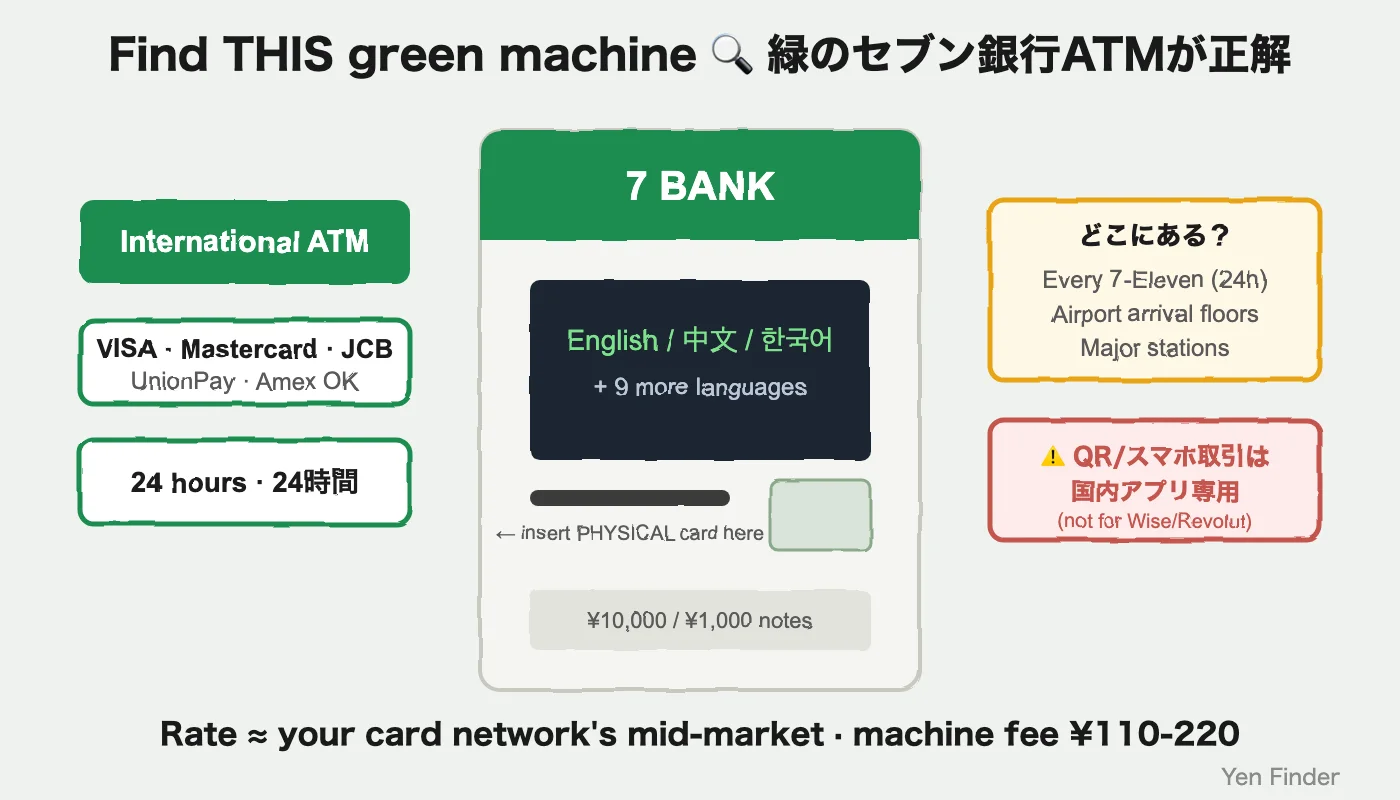
Seven Bank ATMs work with
most foreign Visa, Mastercard, JCB, UnionPay and American Express
cards 24/7, in English (and 11 other languages), with rates very
close to mid-market — your card network sets the rate, and the ATM
adds a small operator fee of ¥110–¥220.
Comparison for $500 cash needed within your first 24 hours:
Source
Effective rate
Time investment
Notes
Airport counter (only)
roughly mid −3% to −6%
5 min, no detour
Worst rate, fastest
Airport ¥10K + 7-Eleven ATM
bulk at about mid −0.5% + ~¥220
5 + 5 min
Recommended for most arrivals
Airport ¥10K + downtown shop next morning
bulk at roughly mid −1% to −2.5%
5 min + 30 min walk
Cash rate, requires planning
The math is consistent: a 15-minute walk to a konbini ATM saves you
several percent on the bulk of your cash. A downtown shop the next
morning lands in a similar range. Rates are indicative and move daily —
check the live rate (only WCS is live-tracked).
✅ Exchange ¥5,000–¥10,000 maximum at the airport — enough for
the ride to your hotel and dinner, no more.
✅ Use Suica or Pasmo on your phone for trains; both can be
loaded with a foreign card via Apple Wallet
(article #74 covers the steps).
⚠️ One trap inside that tip: foreign-issued Visa cards frequently
error on in-app Suica top-ups (Mastercard and Amex go through much
more smoothly). If your Visa gets rejected, exchange a few thousand
yen at the airport and load the Suica with cash at any station
machine — then sort out cards later.
✅ Hit a 7-Eleven Seven Bank ATM within your first 24 hours for
the bulk of your cash needs.
✅ Save the larger swap for a Shinjuku, Shibuya, Ginza or Tokyo
Station shop — Yen Finder shows you the closest one with the
best current rate.
⚠️ Don't trust "0% commission" signs at airport kiosks; the
spread is baked in.
⚠️ Avoid hotel front-desk exchanges except as a last resort.
Frequently asked questions
Is Narita any better than Haneda for exchange rates?
No. Narita and Haneda counters run within ~0.3% of each other on the
same day. The airport rate gap vs. central Tokyo is much larger than
the gap between any two airport counters.
Are 24-hour airport counters worse than the daytime ones?
Often, in practice — not because of an official "night rate," but
because so few counters stay open that the one in front of you has no
competition. With no rival board to compare against, late-night rates
tend to sit at the bottom of the day's range. If you can wait until
7 am (or just use the 24-hour Seven Bank ATM with your physical card),
do that instead.
Can I use my home-country card at Japanese ATMs?
Yes, in most cases. 7-Eleven Seven Bank ATMs
accept Visa, Mastercard, JCB, UnionPay, American Express, Discover,
and several other networks. Look for the green "International ATM
service" sticker. ATM fee: ¥110–¥220 per withdrawal.
What about Pocket Change at the airport?
Pocket Change is a kiosk that converts
foreign coins into Japanese e-money or PayPay credit. It's brilliant
on the way home (you can offload ¥10–¥500 coins that no shop will
take), but on arrival its rates are competitive with — not better
than — the regular counters.
Should I exchange before flying instead?
Almost never. Home-country bank exchange rates are typically 4–7%
below mid-market, worse than even the airport counters in Tokyo. The
exception is if your bank uses Wise-style transparent fees (a few
banks now do).
Check today's real rates on Yen Finder
When you land, open Yen Finder → tap Map → filter for
"Open Now". The closest 7-Eleven ATMs and exchange shops within
1 km of your destination station will appear, each pin colour-coded
against the live mid-market rate. Tap any pin for today's exact rate
and the walking time from your station.