Where to exchange foreign currency in Shinjuku — west exit, east exit, late-night options all in one place
⚡ 30-Second Answer: Shinjuku West Exit is Tokyo's most reliable USD exchange cluster. WCS West tends to be the strongest counter — downtown specialist counters here sit in the rough mid −1% to −2.5% band, with West Exit shops usually a touch better than the East Exit ones. Over $500 that gap is worth a couple of lunches for a five-minute walk. Rates are indicative and move daily — check the live rate before you go (only WCS is live-tracked on this site).
Quick Reference
Value
Best area
Shinjuku West Exit (underground concourse)
West rate
roughly mid −1% to −2%
East rate
roughly mid −2% to −2.5%
$500 difference
a couple of lunches
Last verified
August 2026
✓ Last verified: Sep 2026
📖14 min read
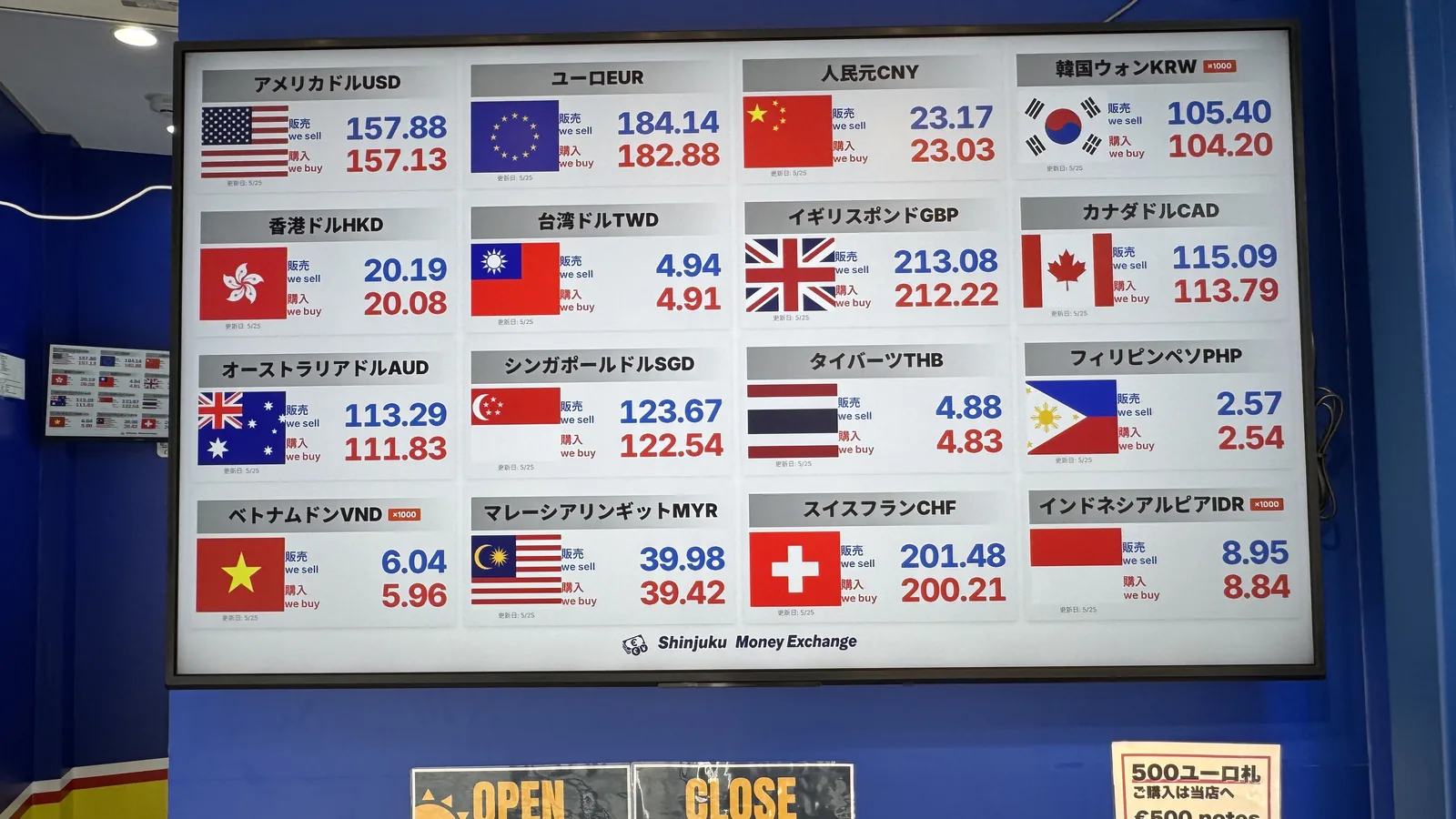
Photo: Yen Finder Editorial, Shinjuku 2026-05-25
SponsoredThis article contains affiliate links. We may earn a commission when you sign up through them, but our recommendations and editorial stance are not influenced by the partnerships.
Shinjuku Station moves about 3.5 million people a day, making it one of the busiest terminals in the world. There are plenty of exchange counters, and at a glance they all look interchangeable — but in reality, the same $500 can vary by a couple of lunches' worth depending on which counter you walk into. A one-kilometre walk is often the difference.
This page maps out what's where in Shinjuku, which counters are actually the best, and what to do if you arrive late at night — all based on me actually walking the routes and trying the counters more than once.
The short answer first
Since this gets long, here's the rough version up top:
Best daytime rate: World Currency Shop (WCS) Shinjuku West Exit is consistently strong — roughly mid-market −1% to −2%, varying by day
East exit is slightly worse: the small independent windows around Kabukicho and Yasukuni-dori run roughly mid-market −2% to −3%, sometimes worse
Late night (after 8pm): no staffed counter stays open — your options are Smart Exchange auto-machines (the 24-hour units in Kabukicho and inside Don Quijote) or a Seven Bank ATM with your physical card
ATM crowd: Withdrawing from the Seven Bank ATM inside the station with a Wise or Revolut card beats walking to a counter on FX cost
Korean won specifically: Walk to Shin-Okubo — KRW is the one currency that beats anything at Shinjuku Station
The rest of the page is structured in that order.
Four ways to get yen in Shinjuku
There are four main ways to obtain Japanese yen in Shinjuku. Each one shines in a different situation, so it helps to know the categories up front.
1) Dedicated exchange counters (WCS, Dollar Ranger)
Specialist shops that swap foreign cash for yen. Shinjuku has two big chains — WCS and Dollar Ranger — plus several independent operators. Rates are typically 1.5-3% below the mid-market rate (the number you see when you Google "USD JPY"). This is your best bet when you want to convert a larger amount in one go during the day.
2) Convenience store ATMs (Seven Bank, Lawson, FamilyMart)
You insert your foreign-issued card (Wise, Revolut, your home-country debit card) and pull yen out. Open 24/7, with five or more Seven Bank ATMs inside Shinjuku Station alone. The FX rate is essentially the mid-market rate quoted in the app — often a better deal than the counters. The catch: a per-transaction cap of ¥30,000.
3) Station and department-store counters
JR Shinjuku Station outside the gates, the Keio and Odakyu underground concourses, and department stores like Isetan and Takashimaya all have exchange counters — but the rates are honestly weak. Expect to pay 1-2% more than at a dedicated chain, as the price of convenience. Use these only as a last-resort fallback when everything else is closed.
4) Smart Exchange vending machines
Self-service machines in front of Shinjuku Alta and at the entrance to Kabukicho — feed foreign banknotes in, yen comes out. The 24-hour availability is the appeal, but rates are mid-market −2 to −3% and honestly not great. Keep them in mind only for late-night small-amount exchanges.
Which option fits which traveler?
If you're…
Best Shinjuku option
Why
Changing $500+ in one go, in daytime
WCS / Dollar Ranger counter (West Exit)
Best counter rates, roughly mid −1% to −2%; worth the short walk
Pulling smaller amounts over several days
Seven Bank ATM + Wise / Revolut
Near mid-market, 24/7, no passport, ¥30,000/transaction
Arriving late at night with no yen yet
Seven Bank ATM, or a Smart Exchange machine as backup
Counters are closed; the ATM still gives the best rate
Carrying Korean won (or other niche currency)
Walk to Shin-Okubo
KRW rates there beat the station by 1–1.5%
Worried only about convenience, small amount
Station / department-store counter
Worst rates, but right by the gates — fine for ¥10,000
Already living on a 0% FX travel card
Just tap to pay; skip exchanging cash
You rarely need physical yen beyond a small emergency buffer
West exit — where the rates are best
In Shinjuku, if your goal is "just point me at a good exchange counter," start at the west exit.
World Currency Shop Shinjuku West Exit
Exit JR Shinjuku Station's west exit, head into the underground concourse, and walk 2-3 minutes. It's tucked into the concourse on the way toward the Keio Plaza Hotel and Hyatt.
Rates: USD roughly mid-market −1% to −2%, EUR similar, CNY/KRW roughly mid-market −1.5% to −2.5% (indicative — they move daily)
Hours: 10:00-19:00 daily
Wait: 5-10 minutes on a weekday lunchtime, 15-30 minutes on a weekend afternoon
The peak crowd is Saturdays 2-4pm; on a weekday morning you may have the place to yourself. If you'd rather speak English, writing "In English" on a slip of paper goes a long way — some staff will switch over for you.
Dollar Ranger Shinjuku West Exit
A little deeper down the underground concourse, past WCS.
USD and EUR mainly, with some CNY/KRW
Rates: USD roughly mid-market −1.5% to −2.5%, EUR around the same
Hours: 10:00-20:00 weekdays, until 19:00 on weekends — like every staffed counter in Shinjuku, it does NOT run overnight
A useful rule of thumb: counters by day, machines and ATMs by night. WCS or Dollar Ranger before 19:00-20:00; after that it's Smart Exchange units and Seven Bank ATMs — that's the real Shinjuku playbook.
Travelex Keio Shinjuku
Inside the Keio department store at the west exit, a minute or two from the other two counters.
The widest currency menu in Shinjuku (around 30 currencies) — the place for Thai baht, Vietnamese dong, Indonesian rupiah and other currencies the specialists don't stock
Rates: typically mid-market −2% to −3% on USD/EUR, so use it for the rare currencies, not for your main dollar exchange
Hours: 11:00-19:00 daily
Ninja Money Exchange (Interbank), Omoide-yokocho
A small counter tucked into Omoide-yokocho, the alley of yakitori stalls just north of the west exit. It works on a reservation basis (book online, then walk up), which means no queue once you're there.
17 currencies
Hours: 11:00-19:00 weekdays, 12:00-19:00 weekends
Why the west exit is better
Three structural things are going on, and none of them is luck.
Density. Four dedicated chains — WCS, Dollar Ranger, Travelex Keio and Ninja Money Exchange — sit within about 300 metres of each other. When a customer can see the rival's board from your door, a spread that's half a percent too wide simply sends them next door, so the West Exit boards stay tight.
Repeat customers. The west side faces the skyscraper office district and has more residences nearby, so the counters live on local repeat business rather than tourists. Business travellers buying a few hundred dollars before a flight keep inventory turning over and rates fresh.
Tourist traffic on the east side. The east exit is the route to Godzilla, Kabukicho and Shin-Okubo, and Kabukicho's draw is nightlife, not shopping. A window that depends on passing tourists can post a slightly worse rate and still stay busy — that's the structural reason for the gap, and it's why the East Exit shops are positioned for convenience rather than price.
On the same day, the gap between the best West Exit counter and an average Kabukicho window on USD can reach 1-2% — roughly ¥150-¥300 per $100.
If you'd rather not think, walk this loop from the JR west exit. The whole thing takes about 15 minutes on foot plus a few minutes at each stop, and you can drop any stop you don't need.
Seven Bank ATM inside JR Shinjuku Station — 24/7. If you carry a Wise or Revolut card, pull your first ¥30,000 here and you may not need the rest of the loop.
World Currency Shop Shinjuku West — 2-3 minutes into the underground concourse. Compare its board against today's mid-market rate; this is the reference counter (10:00-19:00).
Dollar Ranger Shinjuku West — a couple of minutes further along the concourse (10:00-20:00). If its USD board beats WCS today, exchange here.
Travelex Keio Shinjuku — inside the Keio department store (11:00-19:00). Only if you need a currency the first two don't carry.
Ninja Money Exchange in Omoide-yokocho (11:00-19:00 weekdays, 12:00-19:00 weekends) — reserve online first; a good backup when WCS has a weekend queue.
Best time to walk it: 10:30-12:00. Every counter is open and the day's fresh rate is on the board. Late afternoon (16:00-18:00) also works, though some boards are still showing the morning figure. Same chain, different branch can differ slightly on the same day, so trust the board in front of you, not the chain's reputation.
One survival tip for the Shinjuku dungeon: to move between the
west and east sides without getting lost (or re-entering the ticket
gates), use the underground East-West Free Passage (東西自由通路) —
it crosses under the JR tracks in about a minute and is signposted in
English. If your sense of direction is poor, go above ground and follow GPS instead — the underground network west of the station has more exits than anyone can memorise.
East exit — more convenient, slightly worse rates
The TOHO Cinemas with the Godzilla head, Lumine Est, and the area around Shinjuku Alta. Convenient if you want to sightsee and exchange in the same trip.
Smart Exchange machines around Alta / Kabukicho
Self-service units, several within a minute of Alta — including one
inside the 24-hour Don Quijote on the east side
12 currencies; the units inside 24-hour venues run all night
Rates: mid-market −2 to −3% — the convenience tax for the hour
A correction from an earlier version of this page: there is no
24-hour staffed Dollar Ranger in east Shinjuku — Dollar Ranger's
only Shinjuku branch is the west-exit one (10:00-20:00). The only Travelex in Shinjuku is likewise the Keio branch on the west side; there is no Travelex counter in Lumine Est or Kabukicho.
Small windows along Yasukuni-dori and in Kabukicho
Pawn-shop style FX windows and tourist-facing shops; a few stay open until 23:00-24:00
Rates vary widely and are often mid-market −3% or worse — fine for a late ¥10,000 top-up, wrong for the bulk of your exchange
English support is patchy; if you need it, stick to the West Exit chains
Independent counters under Shinjuku Ohgado
Several small, owner-operated shops
Rates vary widely shop-to-shop, so compare the boards before you commit
Many of the staff are Chinese or Southeast Asian — CNY and THB transactions move quickly
Arriving in Shinjuku at night: how to get cash
International flight lands in the evening; you check into your Shinjuku hotel at 9pm and realise you want a little cash for tomorrow morning. Your options narrow fast.
9-11pm: machines or ATM — every staffed counter is closed
No staffed counter in Shinjuku runs past ~20:00. Your realistic
options: a Smart Exchange machine (Kabukicho street units and the
one inside the 24-hour Don Quijote; mid −2 to −3%) for converting
foreign banknotes, or a Seven Bank ATM with your physical
Wise/Revolut card — which beats the machines on rate anyway.
After 11pm: ATM only
Every staffed counter is closed; the Smart Exchange machines and convenience-store ATMs are what's left.
Seven Bank ATMs inside JR Shinjuku Station (24-hour; about ¥30,000 per withdrawal with Wise or Revolut)
Lawson and FamilyMart ATMs above ground at the west, east, and south exits (also 24-hour)
The upside of an ATM is that you get essentially the mid-market rate — often a better deal than the counters.
Smart Exchange machines
Self-service banknote-to-yen machines on the streets of Kabukicho and the east exit area. The 24-hour operation is convenient in principle, but the rate is mid-market −2.5 to −3%. Tuck it in the back of your mind as "last-last-resort when everything is shut."
ATM withdrawal vs. counter exchange — which is better?
This is a common question. The short version:
Situation
Best option
One big exchange ($500+)
Counter (WCS Shinjuku West)
Smaller amounts, several times
ATM (Wise/Revolut at Seven Bank)
Just a bit at night
ATM only
Korean won, Taiwan dollar, other niche currencies
Counter (especially if you walk to Shin-Okubo)
For the ATM route, Wise's fee-free allowance depends on where your account is registered (as of 2026: ¥25,000/month for Japan-registered accounts, $250/month for US accounts, €250/month for EU accounts); above it Wise adds roughly 1.75-2.7% plus a small fixed fee. Check the figure in your app, then spread withdrawals across several days so each one stays under the ¥30,000 Seven Bank cap.
Head 10-12 minutes north of the Shinjuku east exit along Okubo-dori and you hit Shin-Okubo's Koreatown. Korean-run travel agencies and ticket shops are densely packed, with ten-plus stores; KRW-to-JPY rates often beat Shinjuku Station by 1-1.5%.
Notable shops:
Monex Korea (mid-block on Okubo-dori)
Henam Korean Exchange Centre
Korean-grocery counters with an exchange window in the back
For any currency other than KRW, though, rates are average. Chinese yuan is the one partial exception — Shin-Okubo shops are competitive on CNY and the lead flips day to day against the West Exit, so it's only worth the walk if you're going anyway. Taiwan dollars and Singapore dollars are better stocked at the station, and for Thai baht or Vietnamese dong go to Travelex Keio. If you need USD or EUR, just take care of it around Shinjuku Station — no need for the detour.
How to read the rate board
The boards posted in exchange-counter windows are confusing the first time. "WE BUY" vs. "WE SELL" — which one applies to you?
WE BUY: the shop is buying foreign currency, so this is the rate you get when you hand over foreign cash and receive yen (your rate)
WE SELL: the shop is selling foreign currency, i.e. the rate for yen-to-foreign-currency
Visitors only need to look at WE BUY. Check the day's live USD/JPY mid-market rate first (it moves daily), then compare the board against it: a WE BUY rate within about 1% of mid is excellent, while anything more than ~2% below mid is a sign to try another shop. A cash buy rate can never reach the mid-market rate itself.
Real-world example: a couple of lunches over a 1km walk
The spreads I've seen on a single day line up roughly like this (all relative to that day's mid-market rate — check the live rate yourself before relying on any figure):
Counter near Keio Plaza: around mid −3%
WCS Shinjuku West Exit: around mid −1% (the best of the day)
Dollar Ranger Shinjuku West Exit: around mid −2%
Small window on the Kabukicho side: around mid −4% (the worst)
On a $500 exchange, the gap between the best counter and the worst typically works out to a couple of thousand yen — two or three lunches. "Same $500, a meaningful swing between shops" — if you don't know, you just leave money on the table.
FAQ
Q: Weekday morning vs. Saturday afternoon — when is it less crowded?
A: Weekday morning (10am-noon) by a wide margin. Saturday afternoon, WCS can have a 20-30 minute wait.
Q: Do I need ID to exchange?
A: For amounts of ¥100,000 or more, a passport is required. Below that you generally don't need one, but carry it just in case.
Q: Can I do yen-to-foreign-currency in Shinjuku too?
A: Yes — if you want to convert back to USD or similar before flying home, the same counters handle it. The rate is slightly worse on the return leg, so you'll get back less than you originally received.
Q: Other than Korean won, is any currency worth the detour to Shin-Okubo?
A: Basically no. Stick with Shinjuku Station. Shin-Okubo is only worth it for KRW.
Q: With a Wise card pulling yen from a Shinjuku ATM, what does it actually cost?
A: Wise's own FX is about mid −0.5%, plus Seven Bank's ¥110/¥220 operator fee per withdrawal. Wise waives its own withdrawal fee up to a monthly allowance that depends on your account's country (¥25,000 for Japan accounts, $250 for US, €250 for EU as of 2026) and charges roughly 1.75-2.7% plus a small fixed fee above it. Pulling $500 over 3-4 days therefore lands somewhere around a counter's 1-2% spread, and the ATM wins on convenience. Full breakdown in the Wise vs Revolut comparison.
Q: How long does it take to walk from the East Exit to the West Exit?
A: About 8-10 minutes through the underground passage; above ground with traffic lights it's closer to 15. The underground route is also dry when it rains.
Q: What about the South Exit and the New South Exit (Busta Shinjuku)?
A: The South Exit has a small, tourist-facing cluster with rates somewhere between West and East. The New South Exit has almost nothing — rely on the JR ViewCard counter inside the station or a Seven Bank ATM.
Q: Can I exchange at my Shinjuku hotel's front desk?
A: Usually yes, but at roughly mid −3% to −5% it's the worst option in Shinjuku. Use it only when everything else is closed and you need a small amount.
Last verified: 2026-09-08. Exchange counter locations and opening hours can change. Confirm the latest details with each shop before relying on this guide.