Don Quijote (Donki) shopping guide 2026: tax-free strategy, what to actually buy, and the late-night chaos
⚡ 30-Second Answer: Don Quijote = tourist's holy grail, with ¥5,001+ purchases qualifying for tax-free (passport) — you save the consumption tax, roughly 8-10% off the shelf price. Stack the tourist discount coupon on top (5% off ¥10,000+, 7% off ¥30,000+ tax-excluded) for up to 17% total savings. 100% card acceptance incl. AmEx/Diners/UnionPay (Wise/Revolut also get you the mid-market FX rate). Mostly 24h. ⚠️ Big change: from Nov 1, 2026 Japan switches to departure-refund tax-free — until then it's deducted instantly in-store.
Quick Reference
Value
Tax-free threshold
¥5,001+
Coupon stacking
Up to 17% total (¥30,000+)
Card acceptance
100%
Hours
Often 24h
Tax saved
~8-10% (consumption tax)
New rule
Departure-refund from Nov 1 2026
Last verified
August 2026
✓ Last verified: Aug 2026
📖10 min read
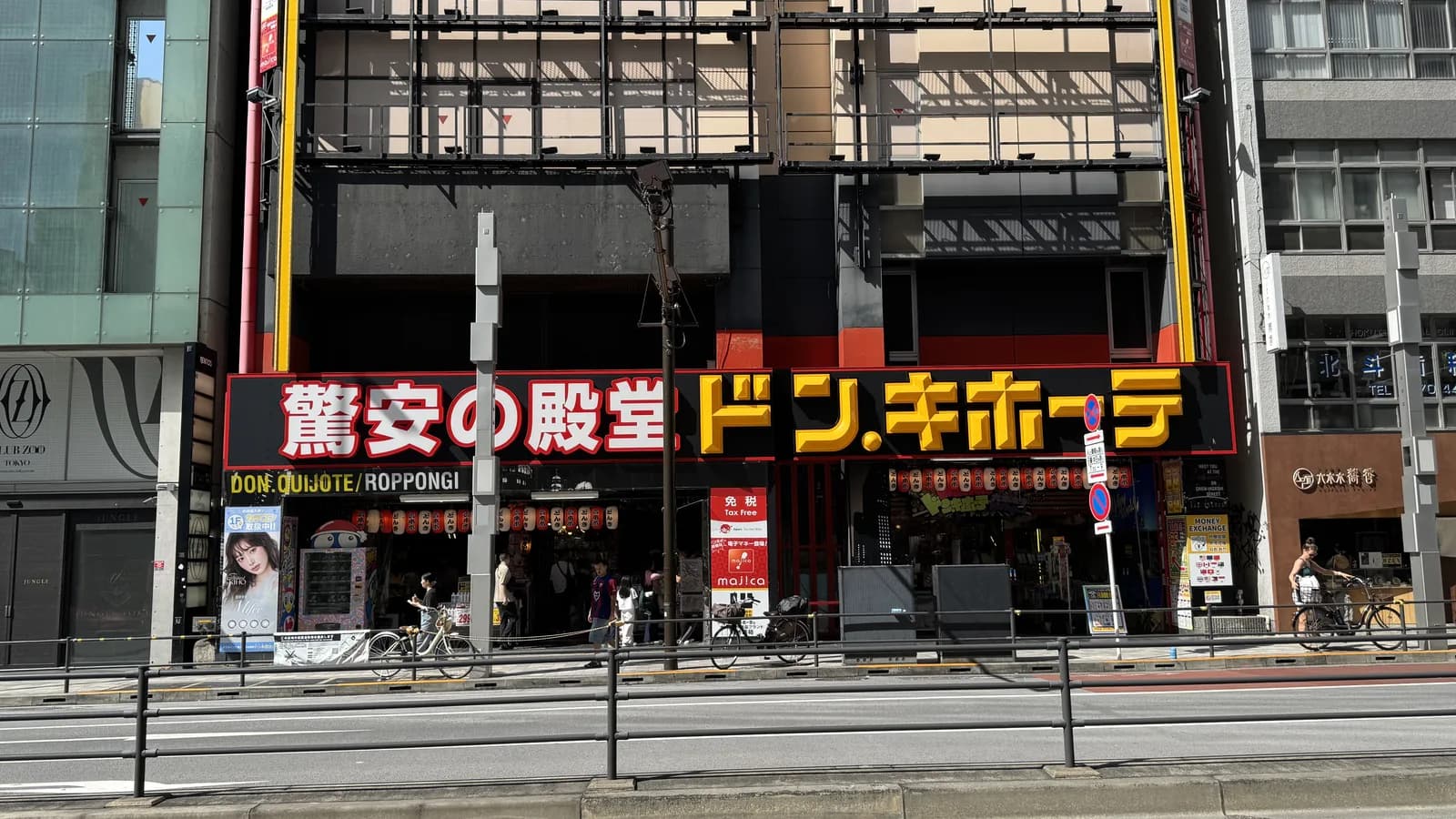
Photo: Yen Finder Editorial, Roppongi 2026-05-26
SponsoredThis article contains affiliate links. We may earn a commission when you sign up through them, but our recommendations and editorial stance are not influenced by the partnerships.
Contents📖 ~12 min read
Don Quijote — universally called "Donki" by Japanese and foreign tourists alike — is the de-facto tourist-shopping default in Japan. With 700+ stores nationwide (including the "Mega Donki" superstores in Shibuya, Roppongi, Shinjuku, Akihabara, and across Osaka/Kyoto), most operating until 03:00 or 24/7, tax-free counters in every major-tourist branch, and an inventory that ranges from cosmetics to dried squid to luxury watches to vacuum cleaners, it's the one shop nearly every visitor walks through at some point. The catch: not everything at Donki is actually cheap. Best-value buys: Japanese cosmetics, drugstore items, snacks, kitchenware, fashion accessories. Worst-value buys: electronics (Bic Camera and Yodobashi beat Donki on price for cameras, headphones, and laptops). The tax-free strategy: bundle purchases to ¥5,000+ in a single visit to qualify, present passport, get the 8-10% off. The chaos is real after 22:00 — go off-peak if you can.
TL;DR
Where: 700+ Donki stores nationwide, 24h or until 03:00 at major tourist branches (Shibuya, Roppongi, Shinjuku, Akihabara, Namba, Umeda, Kyoto Kawaramachi, Naha Kokusai-dori)
Tax-free: yes — ¥5,000+ same-day at same store, passport required, dedicated counter
Best buys: cosmetics, snacks (KitKat flavors, Pocky), Japanese kitchenware, fashion accessories, luggage, fan/cooling goods
Worst buys: electronics (better at Bic Camera / Yodobashi), big-ticket appliances
Off-peak: 10:00-12:00 (any day) is calmest; 22:00-02:00 is genuine chaos at major-tourist branches
Don't: buy alcohol/medicines without checking original drugstore price first — Donki not always cheaper
What Don Quijote actually is
Don Quijote is a discount-variety retailer founded in 1989 — Japan's answer to a department store, drugstore, supermarket, electronics shop, and souvenir bazaar all crammed into a single building. The chain's signature aesthetic is "jungle merchandising": floor-to-ceiling product stacking, narrow aisles, handwritten yellow signage, mascot Donpen (a penguin) plastered everywhere, and a synthesized jingle playing on loop ("Don, Don, Donki, Don Quijote!").
The chain operates ~700 stores in Japan plus international expansions (Hawaii, Singapore, Bangkok, Hong Kong, etc.). Tourist-focused branches in major cities (Shibuya Roppongi, Akihabara, Namba Sennichimae, etc.) typically run 20-22 hours per day or 24/7, with peak chaos from 21:00-02:00 when both inbound tourists and Japanese locals do post-dinner shopping.
The tax-free counter strategy
Every major tourist Donki branch has a dedicated tax-free counter (免税カウンター), typically on a specific floor or at the front of the store. Process:
Step 1: Shop normally
Pick up items throughout the store. Keep all in your basket — you'll pay everything at once.
Step 2: Tally ¥5,000+ at the same store
Tax-free is applied per-receipt-per-store-per-day. So:
¥4,800 from one Donki → does not qualify
¥5,200 from one Donki → qualifies
¥4,800 from Shibuya Donki + ¥4,800 from Roppongi Donki → neither qualifies (different stores)
Step 3: Take everything to the tax-free counter (not regular cashier)
The tax-free counter handles passport verification + tax-exempt processing. Bring:
Your passport (entry stamp/sticker required — see article #88 for the digital-stamp rule that started in 2025)
All your selected items
Payment method
Step 4: Sign the form
The counter staff fills in a digital form showing what you bought. You sign or thumbprint it. The receipt is attached to your passport.
Step 5: Pay
You pay the tax-free price (excluding 10% or 8% consumption tax). Save 8-10% on the spot.
Step 6: Keep the items sealed (consumables only)
For consumables (cosmetics, food, drinks), items are put in a sealed clear plastic bag. Do not open until you've left Japan. General goods (electronics, clothing) have no seal requirement. Note: this sealed-bag rule is being scrapped when the departure-refund system starts on Nov 1, 2026 — but until then, keep the seal intact.
Stack the tourist discount coupon for extra savings
Separate from the consumption-tax exemption, Don Quijote runs a foreign-tourist discount coupon (passport required, no membership sign-up). Spend ¥10,000+ (tax-excluded) and it's 5% off; spend ¥30,000+ and it jumps to 7% off. This stacks with the 10% tax-free deduction for up to ~17% total savings.
Where to get it: the official Donki app, the majica app, printed coupons at airports/hotels/guidebooks, or affiliate coupons via Klook and similar sites
How to use it: open the coupon on your phone and show it at the tax-free counter (screenshots don't work — you need a live connection in-store)
Worked example: a ¥30,000 (tax-excluded) purchase saves ~¥3,000 from the 10% tax exemption, then another ~¥2,100 off the remainder from the 7% coupon — roughly 17% off in total
⚠️ Some items are excluded (alcohol, certain brands, sale items, anything over ¥100,000 per piece) and terms change — confirm at the counter or in the app on the day
The 2026 system change
Japan switches to a refund-on-departure system on November 1, 2026, replacing the current in-store tax exemption. You'll pay the tax-inclusive price at the register, then get the consumption tax refunded at the airport on departure (passport + customs check, within 90 days of purchase). Two things go away under the new rule: the sealed-bag packaging for consumables, and the ¥500,000 consumables cap — consumables and general goods get treated the same. See article #108 for the full breakdown; expect a transition period as retailers like Donki migrate.
Best-value buys at Donki (where it's genuinely cheaper)
Cosmetics and skincare
Donki has aggressive pricing on Japanese cosmetics: Shiseido, Hada Labo, KOSE, Tsubaki, Sekkisei, Curel, SK-II (some), Senka, etc. Often 20-30% cheaper than the same item at a drugstore chain like Matsumoto Kiyoshi for the popular tourist-favorite brands. Best sellers:
Donki has the widest Japanese KitKat flavor selection of any chain — wasabi, matcha, sake, strawberry, Tokyo-banana, regional limited editions. Also Pocky, Hi-Chew, Royce' chocolate (sometimes), Kasugai gummies. Prices are within ~10% of regular supermarket pricing, but the selection is unmatched.
Japanese kitchenware
Donki own-brand knives (¥1,000-¥3,000 range) — surprisingly good quality for the price
Japanese rice cookers (Tiger / Zojirushi smaller models) — Donki sometimes 10-15% cheaper than electronics chains
Bento boxes, chopsticks, pottery — decent prices and selection
Fashion accessories and apparel
Tabi-style socks, Japanese-pattern accessories — better selection than drugstore chains
Luggage (suitcases) — Donki has a surprising selection at competitive prices; can be useful if you've overpacked
Rule of thumb: anything Bic Camera prominently advertises will be cheaper there. Donki carries electronics for one-stop-shopping convenience, not bargain pricing.
Major appliances
Rice cookers (high-end Zojirushi / Tiger): Bic Camera better
Air purifiers, dehumidifiers: Yamada Denki or Bic Camera better
Hair dryers (Dyson, Panasonic premium): Bic Camera better
Brand-name luxury watches and bags
Donki carries luxury watches and brand bags, but the prices reflect Donki's discount margin only — they're not "wholesale cheap." A Casio G-Shock or Seiko at Donki is similar price to Bic Camera. A luxury brand bag at Donki is similar price to the official boutique. Skip Donki for these unless you spot a sale.
Pharmaceutical / medical items
Some over-the-counter medicines are cheaper at proper drugstores (Matsumoto Kiyoshi, Sundrug). Donki's medicine selection is decent but not lowest-price. See article #107 for the drugstore guide.
Sunday morning: surprisingly OK at major Donki branches
Genuine chaos (high-tourist branches)
21:00-02:00 on Friday/Saturday at Shibuya/Roppongi/Akihabara/Namba Donki: 30-60 min wait at tax-free counter, narrow aisles packed shoulder-to-shoulder
Chinese New Year week (late Jan / early Feb) any time: peak inbound shopping
Summer Obon week (mid-August): domestic Japanese travelers add to mix
Christmas season Dec 22-25: heavy gift shopping
Specific store recommendations
MEGA Don Quijote Shibuya (10F building near Shibuya Crossing): biggest tourist branch, has dedicated tax-free counter
Don Quijote Akihabara: best for cosplay supplies + electronics
Don Quijote Roppongi: 24-hour, among the smaller tourist crowds late at night
Don Quijote Namba (Osaka): mega-store with rooftop attraction, full tax-free
Don Quijote Kokusai-dori (Naha, Okinawa): biggest Donki on Okinawa, great for Okinawan specialties
Practical playbook
Plan one major Donki visit per trip, not multiple — bundle purchases to clear the ¥5,000 tax-free threshold
Bring your passport every visit — you'd be amazed how many tourists forget
Go off-peak if at all possible — chaos is real after 22:00 on weekends
Photograph items at competing chains first (drugstores for cosmetics, Bic Camera for electronics) to compare pricing before committing
Use Donki for breadth, not lowest prices — it's the convenience king, not the budget king
Always check the tax-free counter signage — some branches separate consumables and general-goods queues at peak times
Common mistakes
① "Donki is always cheapest"
False. Donki is convenient and broad but not always cheapest. Cosmetics: usually cheaper. Snacks: similar to supermarket. Electronics: more expensive than dedicated chains. Brand luxury: similar to boutique.
② "I'll shop tax-free at multiple Donki stores"
You can, but each ¥5,000 threshold resets per store. Better to bundle at one store.
③ "I'll open the sealed bag in the hotel"
Don't. Keep consumables sealed until departure or you can be charged the consumption tax at customs.
④ "Friday night Donki is the best Japanese experience"
It's an experience, sure. But you'll spend more time queueing than shopping. Go off-peak first, return for the chaos vibe only if you specifically want it.
⑤ "I'll pay in cash to save fees"
Donki accepts cards, IC, Apple Pay, WeChat, Alipay — no card surcharge for tourists. Pay with whatever's most convenient (Wise/Revolut card gets you a mid-market FX rate too).
⚠️ It depends on which app you already carry: if you're from mainland China (Alipay, WeChat Pay), Hong Kong (AlipayHK), South Korea (Kakao Pay), Taiwan, or several Southeast Asian markets, there's a good chance your home payment app already works at Donki's PayPay terminals — as of June 2026, PayPay covers 35 services across 17 countries/regions (full list here). If you're from outside that list (much of Europe, North America), stick with a card or a Wise/Revolut multi-currency card as usual.
Q. What do I need to get tax-free at Don Quijote?
Your original passport (no copies) and a tourist-status stay in Japan. Your total purchase needs to hit ¥5,000+ tax-excluded at the same store on the same day.
Q. Where do I process the tax-free paperwork at Donki?
At the store's dedicated tax-free counter, separate from the regular registers. Show your passport and staff will handle it. At busy branches you may need to take a numbered ticket.
Q. Where do I get the foreign-tourist discount coupon at Donki?
From the coupon-distribution corner near the store entrance, or by downloading it in the official Don Quijote app (MEGA Don Quijote app) or the majica app. Some tourist information centers and airports also hand it out. See the Donki tax-free coupon guide for how to get it and the exact discount tiers.
Q. Can I use the discount coupon and tax-free exemption at the same time?
Generally yes — spend ¥10,000+ (tax-excluded) for 5% off, or ¥30,000+ for 7% off, and that stacks with the 10% tax exemption for up to ~17% total savings. Some coupon types or sale items may be excluded, so confirm at the register or tax-free counter before you check out.
Q. Do I need to worry about the tax-free system change from November 2026?
Yes. From November 1, 2026, Japan switches from in-store point-of-sale tax exemption to a refund-on-departure system: you pay the tax-inclusive price at the register, then claim the consumption-tax refund at the airport (passport + customs check) before you fly out, within 90 days of purchase. The sealed-bag requirement for consumables and the ¥500,000 consumables cap both go away under the new system. See article #108 for the full breakdown, and confirm the latest details with store staff or the National Tax Agency website before you travel.
Last verified 2026-08-25. Donki opening hours and store inventory shift frequently; check the official Donki store locator for current hours.